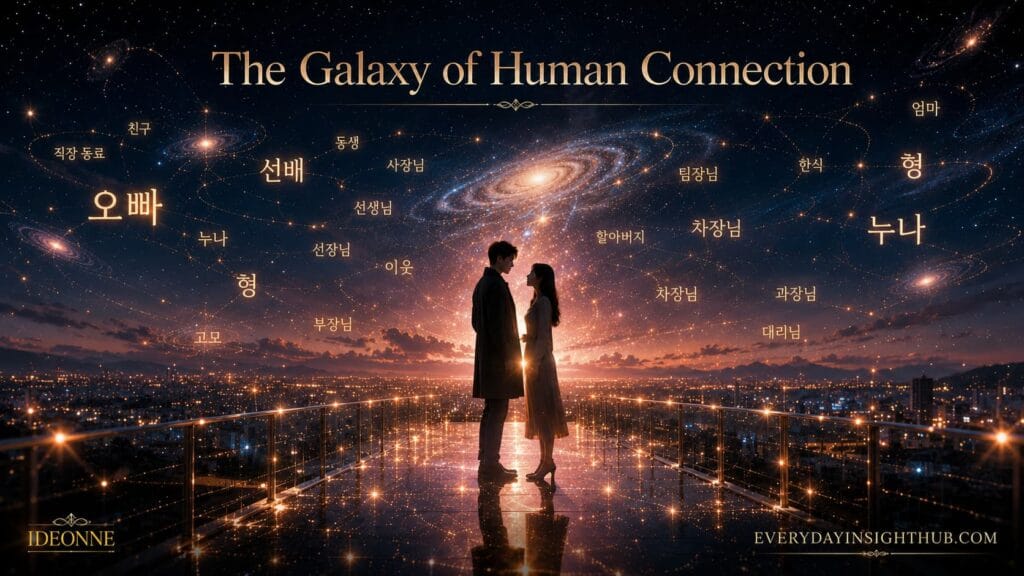
🎬 “The CEO Who Isn’t a CEO”: A Peculiar Language Witnessed in a Midsummer Hongdae Cafe
To truly understand the emotional landscape of K-dramas, global viewers newly initiated into this captivating world almost invariably pose the exact same question: “Why do Korean people rarely call each other by their actual names?” Indeed, looking closely at K-dramas reveals a fascinating linguistic phenomenon. A protagonist’s name is clearly established as Kim Min-su, yet the title rolling off the lips of those around him shifts like a chameleon.
A colleague addresses him as “Min-su Ssi,” a university junior calls out “Min-su Seonbae,” and a subordinate offers a formal “Kim Daeri-nim.” Meanwhile, when filtered through the lips of the woman who loves him, his name softly melts into a tender “Oppa.” Even more peculiar is the scenery of daily life. Upon stepping into a small neighborhood cafe, Korean customers will casually crown a part-time barista working the counter with a grand title: “Sajang-nim”—literally meaning “CEO” or “Owner.”
Jennifer, an ardent K-drama enthusiast from Chicago, experienced this mysterious, textbook culture firsthand during a summer trip to Hongdae, Seoul. Sitting in a bustling cafe on an afternoon when the cicadas were buzzing fiercely outside, she noticed a customer approach the counter and say, “Sajang-nim, an americano, please.” Jennifer nodded to herself, assuming the sophisticated gentleman was the proprietor.
Moments later, a completely different, much younger employee emerged from the kitchen, only for another customer to raise a hand and call out, “Sajang-nim, could we get some extra napkins?” Jennifer’s brow furrowed in sheer bewilderment. ‘Does this tiny coffee shop have a board of co-CEOs?’ she wondered.
That evening, when she posed this puzzle to her Korean friend over grilled pork belly, the friend erupted into laughter. “It’s not a legal title,” the friend explained. “It’s just a comforting act of linguistic courtesy—a way of elevating the other person.” In that exact moment, Jennifer realized that in Korea, a title is not merely a nameplate on a mailbox; it is a living map used to measure the emotional distance between hearts.
🎭 Beyond “Who Are You?”: The Invisible Gravity of Alliance Hidden Behind a Name
This phenomenon carries a profound anthropological revelation. Within the individualistic linguistic framework of Western societies, the fundamental question lingering beneath any dialogue is usually, “Who are you?” It seeks the individual’s independent identity and social status first. Conversely, the architecture of the Korean language operates on an entirely different gravitational pull. It continuously asks the person standing before it an unspoken question: “Who are you in relation to me?” Consequently, Korean honorifics leapfrog over a person’s individual name to bring their social position and emotional proximity to the forefront of human interaction.
Consider the intense office backdrops that populate K-dramas. Characters continuously exchange titles like “Kim Gwajang-nim” (Manager Kim), “Park Bujang-nim” (Director Park), or “Choi Daeri-nim” (Assistant Manager Choi). These terms are by no means the rigid remnants of corporate bureaucracy. Rather, they represent a sophisticated dance of mutual respect, acknowledging the hard-earned space the other person occupies in society and precisely defining where “you and I meet.”
Hans, a cultural linguist from Germany who spent three years embedded within a corporate research institute in Seoul, captured this in his journal: “The Korean language has a bizarre aesthetic of speaking a person’s business card aloud.” Yet, what Hans truly came to realize was that this was not a cold, clinical hierarchy. By vocalizing a title, Koreans were warmly welcoming the other person’s existence into the safe embrace of their shared reality.
🗣️ The Dynamic Coordinates of “Oppa”: The Moment a Stranger Seamlessly Blurs into Family
When the narrative shifts from public professional spaces into the intimacy of everyday life, the spectrum of honorifics becomes even more vibrant. Chief among these is “Oppa,” arguably the very first loanword global K-content fans learn. Many young international viewers initially miscategorize the term as a simple biological synonym for an “older brother.” The reality, however, is beautifully elastic.
A young woman will use “Oppa” to address her actual blood-related brother, a close male upperclassman at university, a trusted high school alumnus, and ultimately, the soulmate she loves. Lucy, a British television critic, initially misunderstood this phenomenon and scribbled a note in her review draft: “Korean romance dramas feature a bizarrely high number of biological brothers.”
After spending months binge-watching dozens of series, however, she completely rewrote her thesis: “I was wrong. ‘Oppa’ is not a biological status; it is an emotional coordinates system.” It is a magical bridge that dissolves the boundary of a stranger, instantly moving the individual from a zone of formal estrangement into the safest territory of family—where trust, affection, and protection reside.
💻 “Just Call Me Hyung”: A Canadian Youth’s Experience with a 0.1-Second Verbal Embrace
This unique Korean capacity to synthesize and expand familial titles into society reaches its zenith with words like “Hyung” (a male’s older brother), “Noona” (a male’s older sister), “Unni” (a female’s older sister), and “Dongsaeng” (a younger sibling). By virtue of these words, yesterday’s stranger can suddenly become today’s sibling—not by blood, but through the sacred alchemy of speech.
Mark, a college student from Toronto, experienced a fresh cultural shock during his first week as a study-abroad student in Seoul. At the welcoming party for a traditional Samulnori (percussion) club he had casually joined, the charismatic club president poured Mark a glass of makgeolli and offered a warm grin: “You can stop bowing so formally now. Just call me Hyung.”
Mark’s Western defense mechanisms immediately flared up, and he froze. ‘We literally met twelve minutes ago. Why is he telling me to call him a brother?’ he thought. Yet, the magic of that single syllable was undeniable. After months of staying up late beating drums and sharing spicy rice cakes together, Mark found himself naturally tapping incoming freshmen on the shoulder and offering the exact same phrase: “Hey, don’t be so stiff. Just call me Hyung.” The language had actively engineered a new reality, and a tight-knit bond grew seamlessly along the warmth of those spoken words.
🎓 “Seonbae” as a Moral Assignment: The Tender Light of Those Who Walked Before Us
Among the many titles found in K-dramas, the one that leaves translators paralyzed is undoubtedly “Seonbae” (often inadequately translated as ‘Senior’). To the Western ear, words like ‘senior’ or ‘upperclassman’ carry a cold, institutional weight, evoking visions of military academies or retirement homes. But in a Korean drama, when a character catches their breath and gasps, “Seonbae-nim!” that short exclamation vibrates with a complex kaleidoscope of emotions: profound reverence, absolute reliance, a deep sense of security, and more often than not, a fluttering romance.
A Seonbae in Korea is not simply someone who happens to be older or higher up on the payroll. They are a guide—someone who has already walked the rough, unfamiliar path you are currently traversing, stumbled over the rocks, gotten lost in the dark, and now willingly reaches back a hand to shine a light for the juniors following behind.
Akira, an essayist from Tokyo, noted this distinct weight while analyzing Korean cinema: “The Korean ‘Seonbae’ is less of a rank and more of a moral assignment.” A true Seonbae feels a deep responsibility for their Hubae (juniors), picking up the dinner tabs, listening to their trivial relationship heartbreaks, and acting as a protective shield against executive wrath. In a modern world that often feels relentlessly transactional, the presence of a Seonbae-nim stands as a beautiful testament to human continuity and generational alliance.
📱 More Thrilling Than a Handshake: The Emotional Earthquake Hidden in a Vowel
Remarkably, even in our current 2026 AI era in which machine translation has reached near-perfection, this intricate web of honorifics remains a realm that technology cannot fully replicate. It has not been archived or lost in the digital age. In KakaoTalk chatrooms and professional emails, Koreans meticulously maintain these verbal boundaries. Even when two individuals know each other’s full names perfectly, they will deliberately append the title—“Professor-nim,” “Team Leader-nim,” or “Seonbae-nim”—as a polite digital shield. To a foreign observer, this hyper-complex etiquette might look exhausting. But to Koreans, it is as natural as breathing—a beautiful way to wrap the other person’s soul in a blanket of dignity.
This brings us to the most thrilling, heart-stopping climax in all of K-drama history. The true peak of a Korean romance rarely happens when the leads finally hold hands or share a kiss; the real epiphany occurs when the titles change. Imagine a female protagonist who, for ten episodes out of a sixteen-episode series, strictly addresses the male lead as “Kim Daeri-nim,” maintaining a rigid, public defense wall. Then comes a rain-soaked night, a moment of shared vulnerability, and she naively lowers her shield, whispering: “Min-su Ssi.” By the final chapters, that title softens even further into its most intimate form: “Min-su-ya.”
To the untrained eye relying solely on the flat, two-dimensional text of Western subtitles, this subtle linguistic metamorphosis goes completely unnoticed. But to the Korean audience, that microscopic shift in vowels is an emotional earthquake. It signals that the walls have crumbled, the distance has collapsed, and two souls have officially crossed a sacred border into intimacy.
Claire, a film critic from Paris, admitted that her entire viewing experience transformed once she cracked this code: “I used to just watch the plot. Now, I listen to how the characters name each other. The truest, most passionate dialogue in a Korean drama is always hidden inside the honorifics.”
✨ The Essence of the “K-Sentiment”: An Elegant Miracle that Erases the Cold Boundaries Between Us
Perhaps this is the very reason why K-dramas have so powerfully captured the hearts of people worldwide. It is not merely due to flashy plots, but because a unique, profoundly human gaze—one that prioritizes relationship over the individual—is beautifully melted into the narrative. This perspective feels unfamiliar yet strangely comforting, reminding us that humans, after all, are not meant to live in isolation, but are beings who deeply yearn to be connected with someone else.
The countless honorifics in K-dramas are the tangible traces of that very connection. They are brilliant, historical cultural inventions born from a people who refused to let their loved ones walk alone through the winters of history. Within the very fabric of language, these titles capture the delicate process of respecting, bonding with, and ultimately loving one another.
When you finally begin to perceive this hidden confession and truly hear the unspoken affection buried deep within these titles, a transformation occurs: global readers are no longer mere passive observers reading flat subtitles on a screen. Rather than simply memorizing a few foreign vocabulary words, they are initiated into the living, breathing map of how Koreans embrace one another and view their position within the social fabric.
It is in that precise, luminescent moment that they cross the threshold into the genuine, beating heart of the “K-sentiment,” fully immersing themselves in the profound, comforting aura that uniquely defines a K-drama.
If the dialogue on screen begins to break through the cold barrier of translation, echoing instead as a deeply moving story that radiates pure human warmth, it is because the reader’s own heart has already decoded the exquisite, multidimensional landscape of relationship built into those honorifics. This tender gaze, which instinctively prioritizes mutual connection over the isolated self, stands as the most elegant, anthropological miracle—one that quietly erases the cold, distant boundaries between us.
🔗 “Your Journey Continues Here 🗺️”
“Ready to turn this new approach into reality? Start your Korean journey by building a rock-solid foundation with: [Learn Hangeul in 1 Hour: A Simple Blueprint to Read the Korean Alphabet]. It’s the fastest, most logical way to crack the code of the world’s smartest alphabet.”
Recommended Reading: To explore further into how language shapes relationships in Korea, read our foundational guide: [Honorifics in Korean: The Linguistic Art of Human Connection].


Pingback: The Easiest and Most Enjoyable Way to Learn Korean