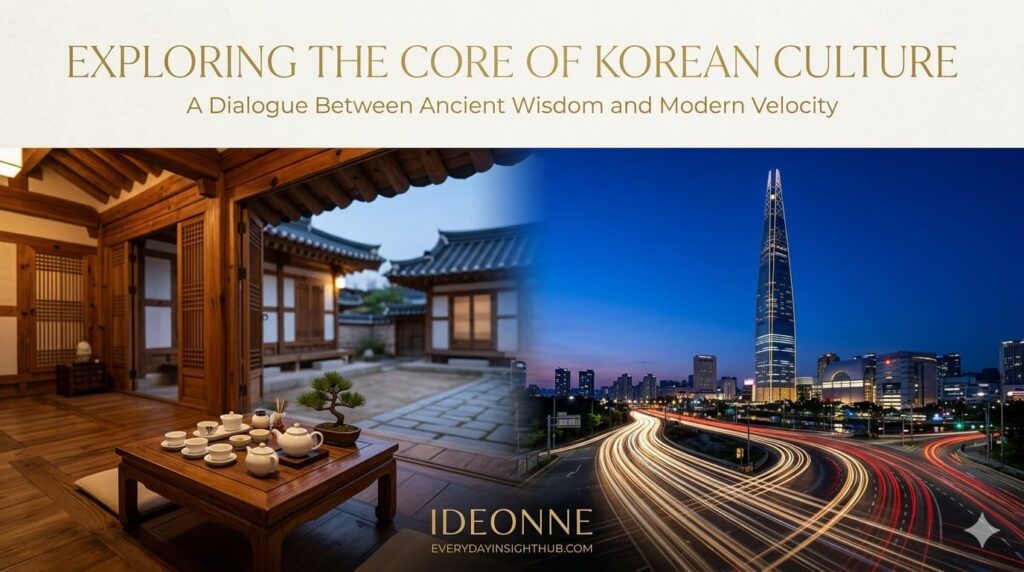
Korean culture and lifestyle are often associated with speed. A meal can be ordered from a phone and arrive while you are still deciding what to watch. A subway train appears, another follows soon after, and a short message may receive a reply almost immediately. In Seoul especially, the feeling can be less like walking through a city and more like stepping onto a moving walkway that never seems to stop.
But that description leaves something important out.
Korean life is not simply fast. It contains remarkably different speeds. A delivery may take minutes, while a traditional fermented sauce can spend months or years developing its flavor. A city can rush through the night, while someone sits quietly over a cup of tea. Young people can discuss artificial intelligence while carrying the latest smartphones, then spend a holiday following customs whose roots reach back generations.
At first, these things can look contradictory.
I have come to see them differently. The more interesting feature of Korean culture is not simply that old and new exist side by side. It is that different parts of life are often allowed to move at different speeds. Some things are valued because they are immediate. Others become meaningful precisely because they take time.
That may be one of the quieter keys to understanding everyday life in Korea.
A Country That Learned to Move Fast
Visitors to Korea often notice speed before anything else. Seoul’s transportation network makes moving across a huge metropolitan area remarkably convenient. Digital services are deeply woven into ordinary routines, while restaurants, shops, banks, public services, and delivery platforms have adapted to expectations of convenience and immediacy.
This speed did not appear from nowhere.
Modern Korea experienced an extraordinary period of economic and technological transformation within a relatively short historical window. As infrastructure, industry, education, and technology developed rapidly, efficiency became more than a business principle. It became part of everyday expectations.
The familiar expression ppalli-ppalli, roughly meaning “quickly, quickly,” is often used to describe this tendency.
But stopping the explanation there creates a misleading picture.
If Korea is simply labeled a “fast culture,” an important question is left unanswered:
If speed is so deeply valued, why are some of the most meaningful parts of Korean life built around waiting?
The answer becomes especially visible at the dining table.
When Fast Delivery Meets Slow Fermentation
Imagine ordering dinner in Seoul. The order is placed digitally. The restaurant receives it almost instantly. A driver may pick it up, navigate the city, and bring it to your door with remarkable efficiency.
Now look at what may be sitting beside that meal.
Kimchi.
Its character depends on processes that cannot be rushed in quite the same way. Fermentation changes ingredients over time, and Korean food culture has developed sophisticated ways of preserving and aging food.
The same principle becomes even clearer with jang—fermented sauces such as doenjang, ganjang, and gochujang. In 2024, UNESCO inscribed the knowledge, beliefs, and practices related to jang making in the Republic of Korea on its Representative List of the Intangible Cultural Heritage of Humanity. The designation covers much more than the sauces themselves: it includes preparation, fermentation, aging, storage, consumption, and the transmission of related knowledge within families and communities.
That distinction matters.
A modern Korean meal may reach the table quickly, but some of the flavors on that table represent accumulated time.
Kimjang offers another example. UNESCO inscribed Kimjang, making and sharing kimchi in the Republic of Korea in 2013, recognizing not only the preparation of kimchi but also the seasonal cycle, family cooperation, sharing, and sense of community associated with the practice.
Seen this way, the contrast becomes less puzzling.
Korean culture does not necessarily choose between speed and patience. It can use speed where speed is useful and time where time itself is part of the value.
The Same City Can Hold Two Clocks
You can see the same rhythm beyond food.
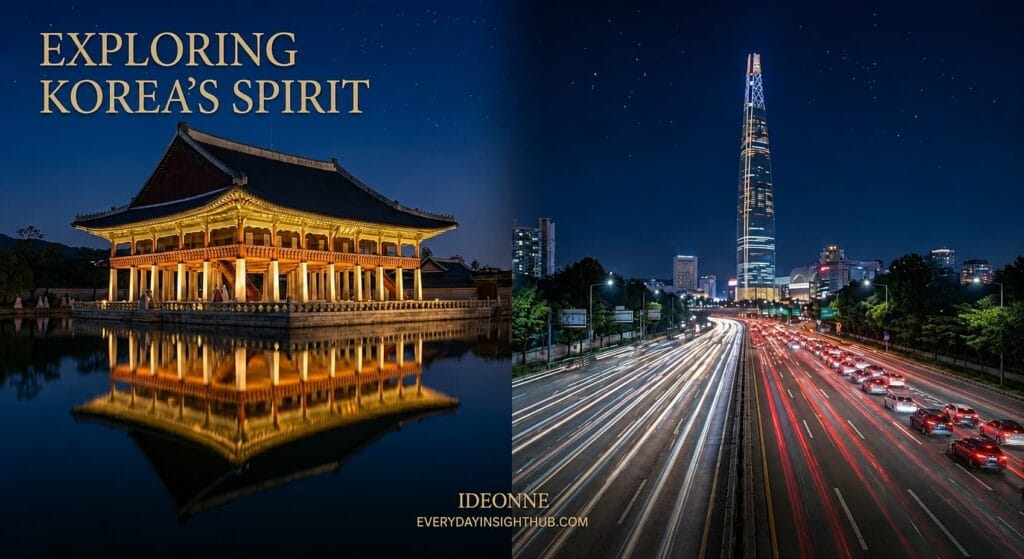
Walk through an area around Gyeongbokgung Palace and another kind of Korean paradox becomes visible. A young person may take photographs with a smartphone beside architecture that has stood for centuries. Someone wearing hanbok may check a navigation app before walking toward a palace gate. A contemporary café may operate only a few minutes from a historic neighborhood.
To an outsider, the scene can initially feel like two periods accidentally occupying the same space.
But perhaps that is the wrong way to look at it.
The smartphone does not make the palace less historic. The palace does not make the smartphone less modern.
The more interesting question is not, “Which Korea is the real Korea?”
It is:
Why should modern life require people to abandon everything that came before it?
Many societies face tensions between preservation and modernization. Korea is no exception. Historic neighborhoods can be threatened by development, and traditions can sometimes be reduced to attractive decoration for visitors.
That tension is worth acknowledging.
Culture survives not because everything remains unchanged, but because people continue deciding what is worth carrying forward.
Why the Floor Can Matter More Than the Furniture
Another example can be found under our feet.
Traditional Korean ondol heating was designed around warming the floor rather than simply heating the air. The historical system was closely connected to the architecture of the home and to the way people used the floor as a living surface. Although modern homes use updated heating technology, the basic idea of warming the floor remains familiar in Korean housing.
This is a small detail with a surprisingly large lesson.
In many modern homes, furniture defines where people sit, eat, work, and rest. Korean living spaces have also changed dramatically, but the idea of a warm floor as a place for sitting, relaxing, eating, or sleeping remains recognizable.
The technology changed.
The bodily relationship with warmth did not disappear.
This is another form of cultural continuity that can be easy to miss if we look only for spectacular traditions.
Culture often survives in ordinary physical habits long after the original technology has changed.
What Visitors Sometimes Misread
A visitor from a culture that strongly separates “fast life” from “slow life” may initially find Korea confusing.
A person may become impatient waiting for a digital service, yet happily spend a long evening talking over food. A city can operate at astonishing speed while people still attach meaning to seasonal foods, family gatherings, traditional holidays, and carefully prepared dishes.
From the outside, this can look inconsistent.
But perhaps the inconsistency lies in the expectation that a culture should have one recognizable personality: fast or slow, traditional or modern, individualistic or communal.
Real cultures are rarely that tidy.
Korean life suggests another possibility: a society can be technologically impatient while remaining culturally patient.
That is a more useful observation than simply calling Korea “fast.”
The Quiet Moment Inside the Speed
There is another side to this rhythm that is easy to overlook.
After the noise of a busy city, a quiet tea room can feel almost physically different. The pace changes. The cup does not need to be consumed immediately. Conversation does not have to compete with traffic. The point is not efficiency. It is attention.
This does not mean that every Korean regularly escapes to a traditional teahouse, nor that Korean society has somehow solved the problem of stress.
It simply shows that Korean culture contains spaces and practices in which slowness is not necessarily a failure of efficiency.
Sometimes, slowness is the activity.
That distinction matters in an age when almost everything can be measured by how quickly it happens.
What Korea’s Contradiction Can Teach Us
Perhaps the most useful lesson is not that the world should become more Korean.
It is that we may need to become more comfortable with different kinds of time.
Some things should happen quickly. Emergency services should be fast. Transportation should be efficient. Information should be accessible. Technology should remove unnecessary friction from everyday life.
Other things become meaningful precisely because they cannot be rushed.
Food needs time to ferment. Trust needs time to develop. A conversation sometimes needs silence. A tradition needs repeated practice before it becomes part of someone’s life.
The mistake is assuming that one speed is appropriate for everything.
Korean culture offers a particularly vivid illustration because its modern history has produced extraordinary acceleration while many older practices continue to value patience, repetition, seasonality, and accumulated experience.
The result is not a perfect balance.
It is a negotiation.
And perhaps that is what makes it interesting.
A Culture With More Than One Pace
When people describe Korea as a place of speed, they are not wrong.
But they are only seeing one side of the clock.
The same society that can deliver dinner with astonishing efficiency can preserve flavors that depend on months or years of fermentation. The same city that races toward the future can maintain spaces where history remains visible. The same generation that embraces artificial intelligence can continue practices inherited from parents and grandparents.
These are not necessarily contradictions that need to be solved.
They may simply be different answers to different needs.
Modern Korea has learned how to move quickly when speed creates value. Older traditions remind people that some forms of value cannot be produced quickly at all.
Perhaps that is the deeper rhythm beneath the apparent chaos: knowing when to accelerate, knowing when to wait, and recognizing that a meaningful life needs both.
The goal is not to stop the roller coaster.
It is to know when to step off, sit down, and let something take its time.
You May Also Enjoy
⚡ Explore Korea’s Ppalli-Ppalli Culture →
❤️ Discover the Meaning of Jeong →
🌿 Understand Hyo and Korean Family Values →
🌙 Explore Korea’s Culture of Trust →
🗺️ See the Bigger Picture of Korean Culture →
Pingback: The Moment a Monochromatic City Turns into Full Color: Learn Hangeul Alphabet - IDEONNE