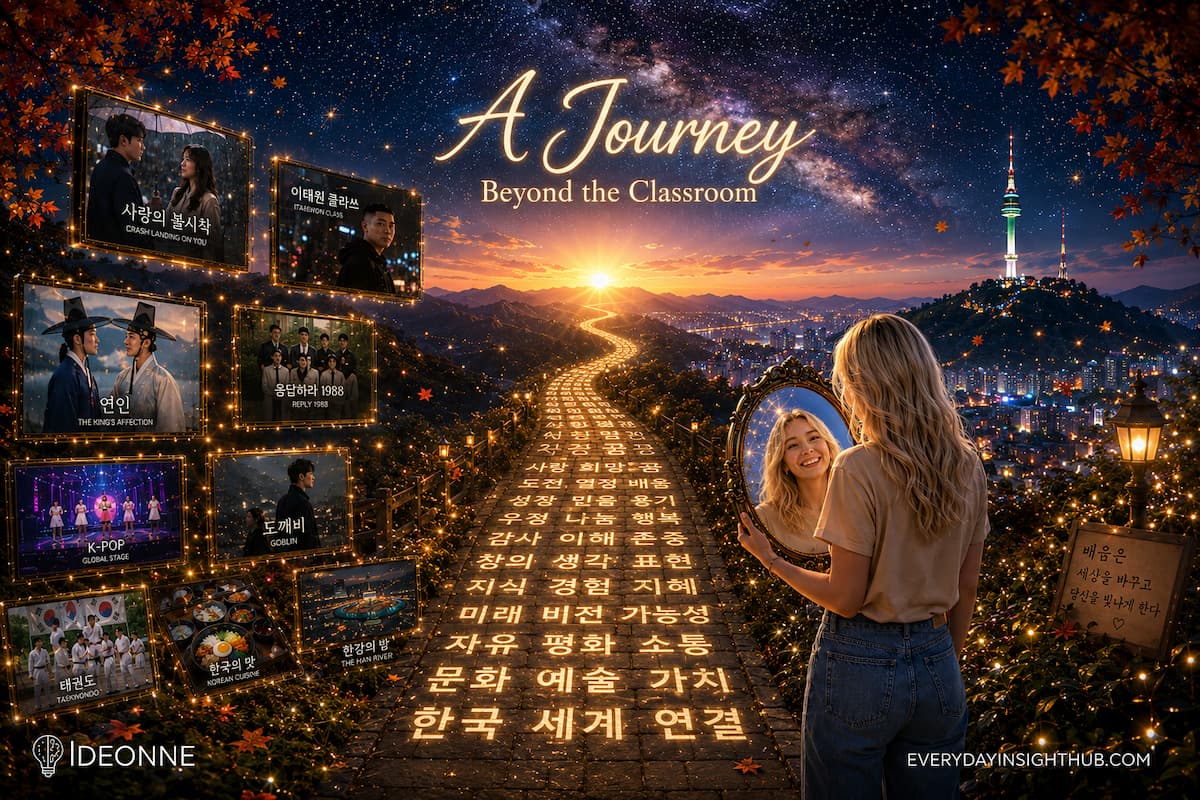
🧩 A Stranger Facing a Cipher: The Unexpected Garden of Hangeul
Around the globe, the desire to learn Korean is expanding at an unprecedented pace. For some, it is driven by the heart-fluttering dialogues of K-Dramas; for others, the infectious melodies of K-Pop; and for many, the sheer, enigmatic charm of Korean culture itself.
Yet, a curious psychological phenomenon often occurs. Many learners freeze in fear before they even strike their first stroke, overwhelmed by an invisible wall. 🧩 “This doesn’t look like an alphabet; it looks like a complex geometric cipher!” This is a confession echoed by almost every foreigner encountering the intricate combination of circles, squares, and straight lines of Hangeul for the very first time.
However, the linguistic truth is quite the opposite. Hangeul is celebrated as one of the most intuitively structured writing systems in human history. It is so logical that it is often dubbed the “Morning Letter,” implying one can master its basics in a single morning. So, why the fear? The problem lies not within Hangeul itself, but in the rigid, intimidating methods we use to approach language.
👶 The Secret Whispered by a Linguistic Giant: See Letters Through a Child’s Eyes
When learning a new language, many adults mistakenly try to construct a flawless map overnight. They stack thick grammar textbooks like fortress walls, mechanically cram vocabulary lists until their fingers ache, and suffer under the suffocating pressure of trying to speak without a single mistake.
But consider the elegant, natural instinct through which humans acquire their native tongue. A child never starts with a grammar textbook. 👶 Instead, they first absorb sounds through their ears, awkwardly mimic them with their lips, make hundreds of mistakes, laugh through the process, and eventually—effortlessly—speak in full sentences.
The world-renowned linguist Dr. Stephen Krashen asserted that the absolute key to language acquisition is “Comprehensible Input.” The brain must receive accessible, digestible texts without feeling stressed. That is precisely where our playful journey into Hangeul should begin.
🧸 Matheus’s Secret Archive: The Miracles Wrought by Children’s Storybooks
A few years ago, Matheus, a university student from Brazil, arrived in Seoul with grand dreams. He was desperate to learn fluent Korean but simply could not afford the hefty tuition of a professional language institute. The standard online lectures on his laptop screen felt like a heavy dose of sleeping pills after just a few minutes.
Then, one fortunate afternoon, he stumbled upon dusty copies of old children’s storybooks—The Dangun Myth and The Rabbit and the Tortoise—tucked away in the corner of a neighborhood secondhand bookstore. 🧸 At first, it took him a solid hour just to painstakingly parse through a single page, tracing each syllable with his finger.
However, Matheus soon noticed a “secret rhythm” unique to children’s literature, and his eyes lit up. Instead of complex honorific systems or pedantic grammar, the books were filled with delightful, repetitive expressions that felt like a catchy nursery rhyme:
“The rabbit went hop, hop, hop.” (토끼가 깡충깡충 갔어요.) “The bear came thud, thud, thud.” (곰이 뚜벅뚜벅 왔어요.) “They met each other and smiled.” (그들은 서로 만나서 웃었어요.)
Through these echoing onomatopoeias, mimetic words, and crisp sentence structures, his brain began to organically map out the rules of the language. A month later, a miracle happened. While walking down the vibrant streets of Hongdae, he found himself unconsciously reading the street signs aloud. The children’s books had transformed from a tedious study room into his dearest, gentlest first language teacher.
✨ Mirror, Mirror on the Wall: Anna’s Morning Soliloquies
The second ingenious tool to master Hangeul is none other than the mirror hanging in your room. Bringing a mirror into language study might sound like a quirk, but neurologically and phonetically, it is a highly effective strategy.
Anna, an aspiring Korean speaker from Germany, stood in front of her vanity mirror every single morning, engaging in a rather peculiar 10-minute soliloquy. 🪞
“Hello. The weather in Seoul is beautiful today. I love a hot Americano.”
At first, her entire body cringed; she felt a wave of awkward embarrassment washing over her. Muttering in a foreign tongue while staring at her own reflection in an empty room felt utterly ridiculous. Yet, as the weeks rolled by, Anna unlocked a profound secret of Hangeul. She realized that Korean is not merely a language processed by the ears and calculated in the head—it is a physical script designed to mirror the actual shape of the human vocal organs (the lips, tongue, and throat).
The consonants like ㄱ, ㄴ, ㅁ, ㅅ, and ㅇ are artistic visualizations of the position of the tongue and the shape of the mouth. Through the mirror, Anna visually calibrated her pronunciation, checking how round her lips were or whether her tongue properly tapped the roof of her mouth. Above all, the mirror was a perfect conversation partner that never judged. Free from the paralyzing fear of making mistakes, Anna shed her anxiety and found her confidence.
🎨 Sakura’s Colorful Brain: How Comic Books Handed Over an Emotional Vocabulary
The third powerhouse tool is the comic book (or Webtoon). While many dismiss comics as mere entertainment, from a linguistic perspective, they are high-octane memory engines where text and imagery merge in a golden 50:50 ratio.
Sakura, an enthusiastic learner from Japan, boldly tossed her thick vocabulary flashcards into the recycling bin and chose to immerse herself in printed volumes of popular Korean webtoons instead. With a sparkle in her eye, Sakura explains: 🎨 “When you memorize a wordlist, the letters just float around vacuously. But when you read a comic, the word is permanently seared into your brain along with the character’s facial expression and the exact situation.”
Indeed, the human brain retains information far longer when it processes visual and verbal data simultaneously. For instance, a student who simply memorizes the word 정말 (Jeong-mal / Really) from a textbook will hesitate in real life, unsure of its emotional context.
Conversely, when Sakura sees a webtoon protagonist widen their eyes, sweating profusely as they gasp, “Really?!”, she absorbs the exact emotional temperature of the word—shock, disbelief, and frantic confirmation. Stored alongside crying faces, beaming smiles, and the expressive gazes of characters, the words become living entities in her mind, ready to leap out whenever needed.
🎬 Michael’s 12-Round Theater: Piercing the Ear with a Single Drama
Perhaps the most powerful method of all is taking a single K-Drama and watching it repeatedly until it is entirely worn out. The key here is not a shallow, wide-sweeping binge of dozens of shows, but a meticulous, microscopic obsession with just one piece you genuinely adore.
Michael, a passionate young man from Canada, had never once set foot inside a Korean language school. He was a 100% self-made, independent learner. Instead of formal classes, he took his ultimate favorite romantic K-Drama and rewatched it an astonishing twelve times. 🎬 His friends shook their heads, laughing, “You’re going to memorize the script! Why do you keep watching the same thing without getting bored?” Michael’s response was crystal clear:
“The first time, I was too busy reading subtitles. The third time, I turned them off and focused on the actors’ vocal tones. By the fifth time, hidden words I had completely missed started coming alive. And by the seventh time, I found myself mimicking the main character’s exact intonations unconsciously!”
The human brain reacts with stress when forced to repeat something dry, but it welcomes infinite repetition as a playful game when wrapped around characters we love and a narrative that excites us. There is no better simulator for capturing the real speed, rhythm, and raw essence of the living language spoken by native Koreans.
🍵 A Colossal Mountain, or a Secret Garden Tended Daily
Even in our current 2026 digital era, where flashy language learning apps are everywhere, A luminous commonality binds these four creative methods (storybooks, mirrors, comics, and dramas) together. 🍵 First, they require no expensive tuition or grand equipment—they can be initiated entirely ‘alone’ in the comfort of your own space. Second, they radically shift the language from a stressful ‘object of study’ into a thrilling ‘medium of experience.’
Too many people view a new language as a massive mountain to conquer—a steep, suffocating cliff where one must endure grueling pain just to reach the summit.
Yet, the Hangeul designed by King Sejong is less of a rugged mountain and more of an enchanting “Secret Garden.” It is a gentle space where you can stroll a little every day, admire the blooming flowers at your own pace, and slowly become intimately acquainted with the landscape.
Today, you unravel the secret of a single storybook page; tomorrow, you whisper a brave sentence to the mirror; the next day, you drift through the panels of a comic; and next week, you echo the sorrow of a drama protagonist. As you casually wander this garden, a magical day will come when Hangeul ceases to be a cold, geometric sign and begins to speak to your soul as a warm, meaningful language.
👑 The Most Beautiful Sight King Sejong Ever Dreamed Of
Hangeul possesses an incredibly sophisticated, scientific brilliance. Yet, the truest reason to learn Hangeul goes far beyond its technical design. 👑
The moment you open the door to Hangeul, you gain unmediated, raw access to over 500 years of accumulated human experience—the fiery thoughts, deep sentiments, sharp humor, and countless life records of the Korean people. Looking at someone else’s garden through the foggy window of translation is vastly different from opening the door with your own hands and breathing in the scent of the roses yourself.
Therefore, to all the travelers standing before the beautiful bridge of Hangeul, I have one urgent plea: “Please, do not try to be perfect from the start.” Just as a toddler stumbles countless times before finally learning to stand and walk upon the earth, you simply need to learn through joyful mistakes.
Language is not an object to be evaluated as a cold score on a standardized test. The true essence of language is a warm bridge that firmly connects one human heart to another. And Hangeul is a magnificent gift, engineered to let you cross that bridge in the easiest and most delightful manner imaginable.
Seeing someone in a faraway land burst into laughter over a webtoon, shed a tear with a drama, or smile at their own reflection in the mirror—rather than sighing under a dim desk lamp while forcing vocabulary into their head—is a beautiful sight. Watching them forge rich human connections through the colorful expressions of Hangeul is truly inspiring. Could there be any grander sight to bring a warm, paternal smile to King Sejong, who created this alphabet 580 years ago out of deep empathy for his people who could not express their hearts?
🔗 “Your Journey Continues Here 🗺️”
Now that you’ve mastered the art of learning, it’s time to take your first concrete step. If you’re ready to start reading, check out our masterclass: [Learn Hangeul in 1 Hour: A Simple Blueprint to Read the Korean Alphabet]. You’ll be decoding your favorite K-drama signs in no time!
If you want to look back at the previous step of our language journey, don’t miss our guide on The Hidden Subtitles of K-Drama: How Korean Honorifics Map the Galaxy of Human Connection. It serves as the perfect foundation before jumping into today’s creative methods!
Pingback: Korean Culture Gwaenchanayo - The Soul of Five Syllables
Pingback: Learn Hangeul: Turn a Monochromatic City to Color