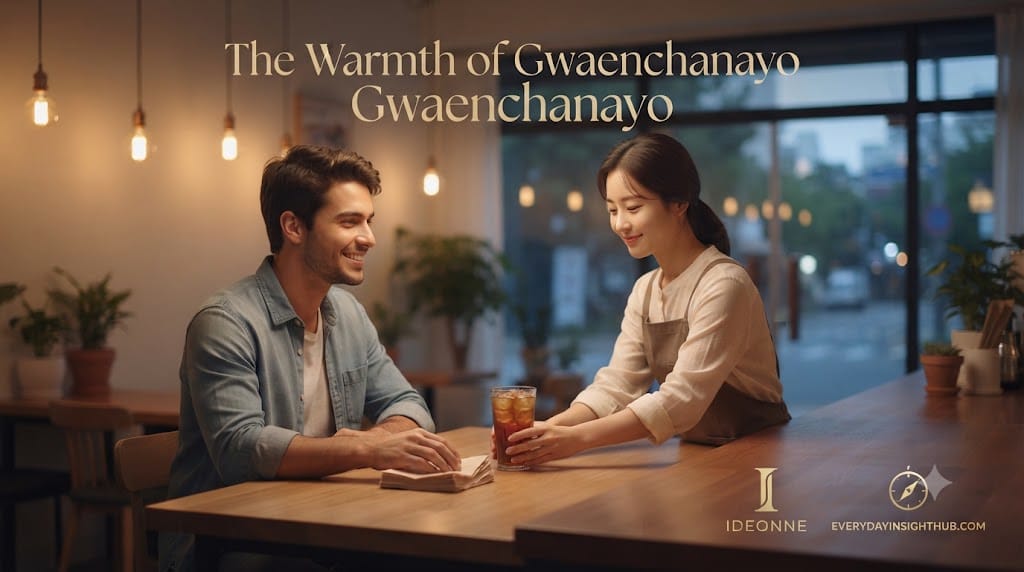
When Luca, an exchange student from Brazil, first arrived in Seoul, he spent his first week in a state of quiet bewilderment. In a local cafe, he accidentally knocked a stack of napkins to the floor. His heart did a quick stutter, and he instinctively bowed, blurting out, “Joesong-hamnida” (I’m sorry).
The barista just smiled—not a rehearsed, customer-service smile, but a genuinely warm one—and said, “Gwaenchanayo.” (It’s okay.)
The next day, he bumped into a stranger in the crowded subway station. Again, Luca apologized profusely. The stranger offered a soft nod and simply said, “Gwaenchanayo.” A few days later, he spilled a glass of water at a restaurant. Once again, the owner rushed over with a cloth, waving away his apologies with the same gentle phrase: “Gwaenchanayo.”
Finally, Luca cornered his Korean friend and asked in earnest, “Is everything here… actually okay all the time?” His friend laughed. “Not exactly,” he replied. “It’s not that the situation is perfect. It’s that we try to make the person feel okay.”
In that moment, Luca didn’t just learn a new phrase; he caught a glimpse into the heart of Korean culture.
🍵 The Warmth Behind the Words
While English equivalents like “No problem” or “It’s okay” are functional, the Korean “Gwaenchanayo” carries a different temperature. It feels softer, like a blanket thrown over a moment of awkwardness. It isn’t just about absolving guilt; it’s a deliberate effort to lower someone’s tension and bridge the gap of discomfort. It’s a gift of grace wrapped in five simple syllables.
🌟 A Moment of Truth: Marco’s Lesson
Marco, an Italian chef who once worked in a busy Seoul restaurant, shared a story that stayed with me. It was his first day, and the pressure was immense. CRASH! A plate shattered on the kitchen floor, and for a heartbeat, the room went silent. Marco froze, his face turning pale, bracing for the reprimand he was sure was coming.
The owner walked over slowly. Marco braced himself, but the owner’s first words were not about the broken dish. He looked straight at Marco and asked, “Are you hurt?”
Marco was stunned. The owner grabbed a broom and smiled, saying, “It’s okay. Plates can be replaced, but you cannot.” Years later, Marco told me, “That day, I didn’t just learn a word. I learned what people here value most.”
⚠️ The Two Sides of “Gwaenchanayo”
Gwaenchanayo can be a bit of a shapeshifter—its meaning depends entirely on the rhythm of the conversation.
- When choosing something: If a shopkeeper asks what you’d like, and you point to an item and say, “Igeo gwaenchanayo,” you’re saying, “This one is good; I’ll take it.”
- When declining an offer: If the same clerk asks if you need a plastic bag, and you wave your hand and say, “Gwaenchanayo,” you’re saying, “No, thank you; I’m fine without it.”
It’s a subtle dance. But if you spend enough time here, you’ll find yourself instinctively picking up the nuance.
💭 Finding Ease in the Rush
There is a curious shift that happens when you spend a long time in Korea. Someone steps on your feet, and before they can even apologize, you find yourself saying, “Gwaenchanayo!” It’s a gentle, subconscious reaction.
There is something deeply human about a society where the impulse to soothe someone else’s anxiety often outweighs the instinct to dwell on a mistake. It is not about being perfect, but about being kind to one another in the middle of a busy day.
🥄 A Spoonful of Culture
Learning Korean is so much more than memorizing vocabulary. It’s about learning a softer way to move through the world. Phrases like “Cheoncheonhi haseyo” (Take your time) or “Josim-hae-seo gaseyo” (Go home safely) are all cut from the same cloth—the quiet desire to protect the dignity of the person in front of you.
Tomorrow, when someone makes a small mistake around you—a cashier, a friend, or even a stranger—try offering them those five syllables:
“Gwaenchanayo.”
Watch their shoulders drop. Watch a smile return to their face. Perhaps the most profound thing we can offer each other isn’t a long, eloquent speech, but the simple, quiet assurance that everything is going to be alright.
Interested in more of these cultural bridges?
[Explore our 🔗[Learn Hangeul in 1 Hour: A Simple Blueprint to Read the Korean Alphabet] or follow our 🔗[The Easiest and Most Enjoyable Way to Learn Korean: A Journey Beyond the Classroom]


Pingback: The Art of Gratitude: Decoding the Korean Dining Ritual