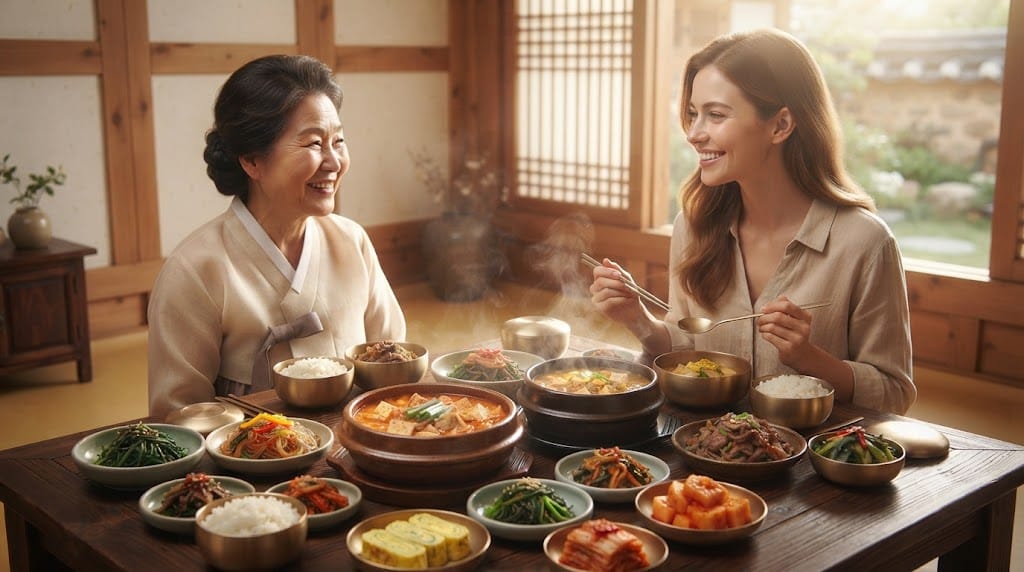
In a sunlit apartment in Seoul, Claire, a foodie from Lyon, found herself at a table that felt more like a warm embrace than a simple meal. Before her lay a spread of kimchi-jjigae, savory bulgogi, and vibrant namul—a feast prepared with quiet, persistent care.
As everyone reached for their spoons, a sudden, collective hush fell over the room. Then, as if tethered by a single heartbeat, they bowed their heads slightly and spoke in unison: “Jal meok-get-seumnida!”
Claire paused, spoon suspended in mid-air. It wasn’t just a phrase; it was a rhythmic anchor—a moment of profound mindfulness. She wondered, who were they thanking? The host? The invisible hands that had tilled the soil? As the meal drew to a close, the cycle completed with another soft chorus: “Jal meok-geot-seumnida!” In that moment, she realized that in Korea, a meal is rarely just the consumption of sustenance. It is a shared space where souls intersect, and gratitude becomes a common language.
🥣 More Than Just “Bon Appétit”
Translating “Jal meok-get-seumnida” into English is a challenge, as “I will eat well” feels a bit mechanical, stripping the phrase of its cultural marrow. It is, in essence, a five-syllable promise to appreciate the hands that prepared the food, the company kept, and the gift of the present moment.
💡 A Simple Guide: When to Share the Sentiment
If you find yourself at a Korean table, these phrases can help you bridge the gap between “guest” and “friend”:
- When you’re a guest at a home: As the food is set down, smile and say, “Wow, it looks delicious! Jal meok-get-seumnida!”
- Lunch with colleagues: As everyone gathers, a polite “Jal meok-get-seumnida!” signals you are ready to be part of the moment.
- At a local restaurant: The moment your meal arrives, breathe in the aroma and say it softly. It is a gesture of kindness that resonates deeply with the staff.
- After finishing your meal: Look at your host or the owner and say, “Jal meok-geot-seumnida! It was truly delicious.”
🗣️ The Rhythm of Connection
Don’t worry about perfection. The beauty of the phrase lies in the intent, not the accent. Try to connect the sounds—Jal-meok-get-seumnida—as if you are humming a single, gentle chord. It isn’t about the technical precision of your speech; it is about the sincerity behind your voice.
🍷 Cultural Note: The Chef’s Secret Ingredient
I remember Carlos, a photographer from Mexico, sharing a story about a small, weathered restaurant he found in a hidden alley. After finishing his meal, he shyly uttered the phrase he’d overheard earlier. The elderly owner beamed, her face creasing into a map of kindness. “Next time,” she whispered, “that phrase is the best seasoning you can add to the meal.”
Carlos later wrote in his journal: “In Korea, I learned that you feed the heart before you feed the stomach.”

🥄 A Spoonful of Culture: “Let’s Eat Together”
In Korea, the invitation “Let’s have a meal sometime” is often more than just a request for food. It is an open door, a gentle way of saying, “I would like to know your story. I would like to connect.”
Even when eating alone, many Koreans whisper the phrase to themselves. It serves as a personal ritual—a quiet acknowledgement of the day’s journey and the nourishment required to move forward.
🚀 A Small Invitation for Your Next Meal
Today, before you take your first bite, pause. Acknowledge the food, the moment, and yourself. Say it aloud: “Jal meok-get-seumnida.”
When you finish, offer a quiet “Jal meok-geot-seumnida.” You may find that these two sentences carry a quiet, transformative power. You aren’t just learning a language; you are learning how to live with a little more grace, one bite at a time.
💠 Learning Korean Culture ②: The Healing Power of “Gwaenchanayo’


Pingback: How to Call a Waiter in Korea: The Art of "Yeogi-yo"