🎬 “We’re in Big Trouble”: A Strange Jest Witnessed by a British Linguist
Thomas, a promising British linguist, had been living in Seoul for just six months as a researcher at a university institute when he experienced a cultural shock that would stay with him forever. It was a scorching summer afternoon, the cicadas buzzing fiercely outside, when he was having lunch with a Korean colleague at a quiet, unassuming local diner. Just as their stew began to bubble vigorously in the center of the table, his colleague’s pocket vibrated heavily. Answering the call, the colleague listened in silence, his brow gradually furrowing as he let out a low, heavy sigh. Hanging up, his first words were somber: “We’re in big trouble.”
Thomas set his spoon down, startled, and asked anxiously, “What happened? Has something terrible happened to your family back home?” To his utter surprise, the colleague replied with a gentle smile, “My wife just asked me to go with her to my mother-in-law’s house for dinner tonight.” At that exact moment, the other professors eating quietly at the next table, and even the beloved restaurant owner, burst into collective snickers and giggles.
Thomas was utterly bewildered. In his mental dictionary, “big trouble” was a term reserved for natural disasters or national crises. Believing it was a genuine emergency, Thomas wrote in his research journal that evening: “Koreans have a peculiar knack for packaging life’s minor ripples as monumental disasters using humor.”
However, after spending a few more seasons in Korea, he completely revised that sentence: “I was wrong. Koreans do not turn disasters into jokes; rather, they are a people who can only survive life’s disasters through the medium of a joke.” Perhaps the deepest starting point for understanding Korean humor lies precisely within this nuance.
🎭 Humanity Over Perfection: The Art of Lowering Oneself to Connect
Every culture possesses its own distinct comic DNA. British humor is rooted in bone-dry, biting satire; American humor shines in raw, unfiltered truths delivered on the stand-up stage; and German humor operates like a piece of precisely engineered wordplay. Where, then, does the laughter of Korea stand? The most unique texture of Korean humor lies in a peculiar coexistence of self-deprecation and haehak (traditional humor)—a profound generosity that lowers oneself to completely disarm others.
Foreign producers encountering K-content for the first time are often left scratching their heads while watching Korean variety shows or talk shows. Megastars who command an untouchable aura on screen, or prominent entrepreneurs leading highly valuable enterprises, think nothing of exposing their most embarrassing blunders or human flaws on camera, completely dismantling their own image. Anna, a television producer from Sweden, initially suspected this was a carefully orchestrated facade. “In Nordic elite culture, surviving means proving your absolute perfection,” she noted. “Why do these individuals choose to display their vulnerability so transparently before the public?”
It was only after living among Koreans and sharing bottles of soju into the early hours of the morning that she truly understood. Koreans are instinctively drawn not to cold perfection, but to a slightly flawed, accessible “humanity.” They do not open their hearts to the powerful who flawlessly conceal their mistakes; instead, they open them to those who can turn their own shortcomings into a side dish for laughter. Thus, Korean humor rarely begins as an imposing declaration, but rather as a quiet confession: “In truth, I am not that grand of a person either, just like you.”
🗣️ “Me?”: A Three-Syllable Theater of the Absurd
This phenomenon is deeply fascinating from an anthropological perspective. Classical psychology posits that laughter stems primarily from the “Superiority Theory”—we mock others when we see them fail, or when we feel intellectually superior. Yet, much of Korean laughter defies this gravity. By lowering oneself and laying one’s own inadequacies out in the open market first, it creates a town square where everyone becomes equal.
An anecdote shared by Michael, a cultural anthropology professor from Canada, perfectly illustrates this. During a seminar at a university in Seoul, he posed a rather serious question to his students: “What is the most definitive joke that captures the emotional psyche of Korean society?” In the heavy silence that followed, a student who had been dozing off in the back row suddenly caught the professor’s gaze. Startled, his eyes went wide, and he blurted out: “Je-ga-yo?” (Me?)
After a split second of absolute silence, the entire lecture hall erupted into a roaring wave of laughter. Professor Michael was initially baffled, wondering if he was being mocked. But later, as he grew to deeply grasp the subtle air of the Korean language and the social nuances of honorifics, he marveled at the sheer genius packed into those brief syllables. Within that short exclamation was a perfect compression of panic at being called upon, polite deference to the teacher, and a flexible wit that instantly transformed a tense moment into a brilliant situational comedy. At the semester-end party, Michael told his colleagues, “While the French require a sweeping satirical novel to critique human nature, Koreans complete an entire vibrant theater of comedy in just a single word.”
💻 Overtime Memes and Sharing Our Most Embarrassing Moments: A Spiritual Buffer Zone
The most remarkable characteristic of Korean humor is that it burns brightest when the frontline of life is at its darkest and most grueling. Sophie, an industrial psychologist from Denmark, discovered a bizarre statistical anomaly while studying stress-coping mechanisms among corporate workers in Korea. As project deadlines loomed and corporate pressure reached its zenith, the group chats of Korean employees did not fall into a grim silence; instead, they exploded with an overwhelming volume of jokes and internet memes (jjalbang).
At two in the morning amidst relentless overtime, they would share photos of each other’s thinning crowns, teasingly calling one another “vultures,” or parodying their manager’s unreasonable demands into lines from a historical palace drama, giggling away. Sophie initially diagnosed this as an “avoidance mechanism”—a cognitive retreat from a harsh reality. However, after tracking their lives for several months, she completely flipped the conclusion of her report. It was not an escape, but the most active form of psychological adaptation and a highly sophisticated survival skill. Laughter does not magically make the mountain of work disappear. However, it acts as a resilient buffer, ensuring that the sheer weight of that mountain does not crush one’s soul to pieces.
This unique resilience is vividly observable in Korea’s digital internet culture as well. While Western internet culture can occasionally drift into cynical, aggressive memes aimed at tearing others down, Korean netizens actively compete to share their own disastrous failures. A charred, unrecognizable mass that was supposed to be dinner, an absurd verbal slip-up made to the CEO on the first day of work, or a physical blunder committed in an interview room—these are hoisted onto the center stage of the internet to draw the comfort and laughter of millions.
Foreigners ask in bewilderment, “Why would you permanently archive such humiliating history in a space where the whole world can see?” But to Koreans, this is not shame. Rather, it is a warm festival of quiet comfort and solidarity that says, “You did that too? Thank goodness I’m not the only fool.” Korean laughter is never a lonely monologue delivered in a dark room; it is closer to a communal dance where everyone links arms in the public square.
🍲 The Shared Stew and the Funeral Hall: The Art of Purging Sorrow Together
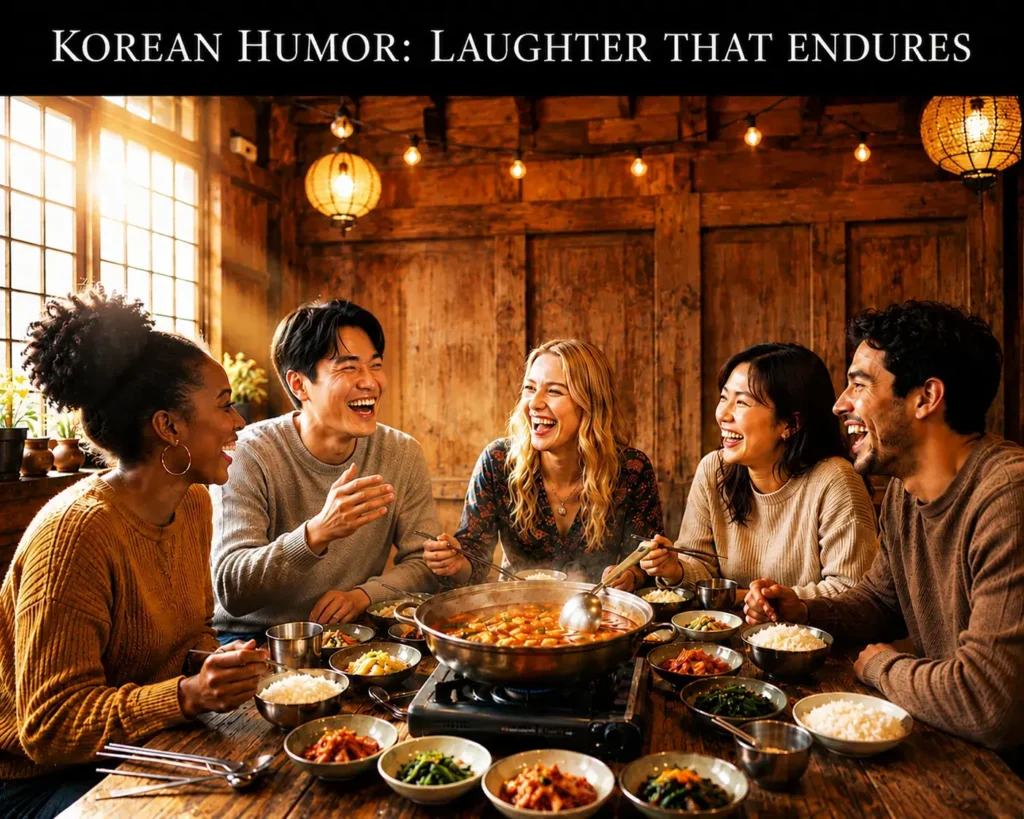
This emotional ecosystem aligns flawlessly with Korea’s unique culinary tradition of communal dining. Just as family and colleagues share the warmth of community around a single, bubbling pot of stew at the center of the table, Koreans scoop their sorrow, joy, and laughter into a large, collective bowl to consume together.
Because of this, even the atmosphere of a funeral hall strikes outsiders as extraordinary. Despite being a space ruled by the grandest of griefs, one corner of a Korean funeral hall will invariably echo with the low, yet ultimately hearty sounds of laughter as guests reminisce over the deceased’s most absurd past mistakes. To comfort grief with laughter, and to purify laughter through grief—this sophisticated capacity for emotional orchestration is the most poignant and beautiful legacy carved out by modern Korean history.
The trajectory of Korean society over the past century has been a breathtaking, dizzying whirlwind of turbulence. Passing through the ashes of war, grueling poverty, a suffocatingly compressed industrialization, and the relentless tunnel of hyper-competition, people had to wring out the very essence of their souls. Throughout those harsh years, humor was never a luxurious indulgence. It was the final breathing hole chosen because they simply could not afford to weep. Consequently, Korean humor always builds its nest right above the tear ducts, in the most tender, sorrowful corners of the heart.
This “sweet and salty” (dan-jjan) aesthetic is precisely what leaves global audiences so freshly shocked when watching Korean dramas or movies. At the absolute peak of a heartbreaking tragedy, an absurd piece of humor suddenly bursts through; behind a scene that has audiences clutching their sides with laughter, a heavy pathos silently rolls in. To those accustomed to rigid genre boundaries, this may feel jarring, but to Koreans, it is the most realistic portrayal of life. Even on the happiest of days, anxiety about tomorrow drifts like a fog in one corner of the mind; and on the most devastating, destitute days, a single rolling leaf on the street can still find a way to spark a smile. That is the true anatomy of life.
🤖 The Realm Beyond Replication: The Sacred Courage of Laughing Together
In our current 2026 AI era, Artificial Intelligence is swallowing human domains at a terrifying pace. Machines calculate cosmic orbits tens of thousands of times faster than us, memorize entire legal codes flawlessly, and derive answers without a single millimeter of error. Yet, if there remains one impregnable fortress that this seemingly omnipotent machine can never conquer, it is the act of genuinely laughing along with another human being.
Humor is not the mere technical assemblage of funny words. It requires inhaling the very air of an era, reading the depth of tears pooling in someone’s eyes, and above all, possessing the grand human courage to willingly expose one’s most fragile weaknesses.
Perhaps Koreans are not the most flamboyantly or elegantly witty people on Earth. However, they are undeniably a fierce and resilient people who refuse to lay down the weapon of laughter, no matter how barren the soil beneath them becomes, or even if the world threatens to collapse tomorrow. And perhaps, that hollow, unassuming laughter chosen instead of a grand weapon is the truest survival force that outlasts history itself.
Laughter cannot instantly dissolve the cold, harsh realities staring us down. Yet, it can grant us the sacred courage to look those solemn problems dead in the eye, completely unfazed, and offer a calm, steady smile. Thus, Korean humor is not a fleeting trick to stimulate the nervous system; it is a radiant wisdom that makes the biting winter of life just a little bit warmer to endure.
That wisdom continues quietly, yet powerfully today—in the alleyways of Seoul’s late-night taverns where the night wind blows, in the breakrooms of venture startups where the lights never go out, and over the humble dinner tables of ordinary families washing away the fatigue of the day. It lives among a people who choose to embrace a mistake with a generous laugh rather than slash at it with criticism; who choose to sustain a dead-end crisis with a witty jest rather than fill it with a heavy sigh; and who love a warm, flawed humanity far more than a cold, flawless perfection.
Is this not the very cultural heritage, so profoundly warm, that touches the hearts of people around the world today? It is not a fragile smile cultivated in a greenhouse where conditions are perfect and adversity is absent. Rather, it is the noble resilience of a spirit that refuses to let go of laughter, even on days that are far from happy, even when the sheer weight of life threatens to crush them completely. It is a heart of enduring hope—one that treasures the very act of being alive as a great blessing, and learns to look upon its weary, present self through the lens of a brighter tomorrow.
(To see how this witty, self-deprecating humor transforms into an unyielding survival instinct that allows people to start over from scratch, explore our previous guide on Korean Resilience: The Unsung Heroes Who Start Over.)