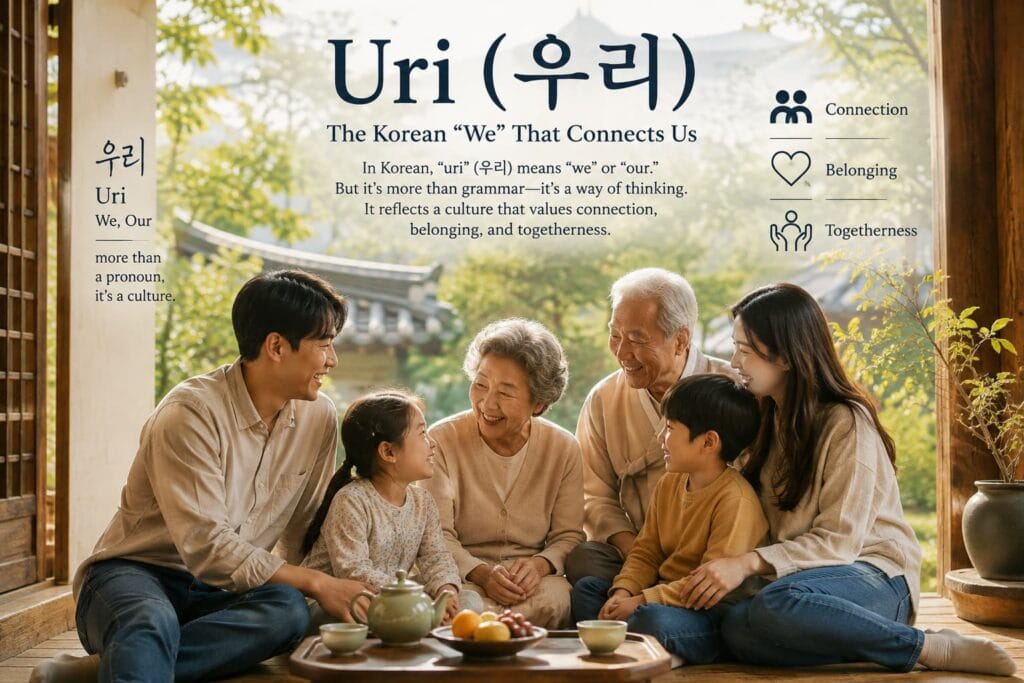
When learning Korean, many foreigners encounter a small word that often leaves them wondering: Uri (우리).
Imagine introducing your own mother by saying, “our mother.” For many English speakers, the phrase sounds almost impossible. A mother belongs to a family, but she is usually introduced as my mother, not our mother.
Yet in Korea, expressions like uri eomma (우리 엄마, our mom) are completely natural in everyday conversation.
A Korean speaker is not suggesting that everyone shares the same mother. Instead, the word reveals something deeper: a different way of understanding relationships.
To understand why a single word like uri carries so much meaning, it helps to look at the deeper cultural foundations that have shaped Korean society over centuries.
(Internal link: Beyond the Korean Wave: The Thousand-Year Cultural Foundations of Korea’s Global Influence)
In everyday English expressions, people often speak from an individual perspective:
- my family
- my home
- my country
- my opinion
In Korean, many expressions are often viewed through a relationship-based lens:
- uri family
- uri home
- uri country
The difference is not simply grammatical. It reflects a different way of recognizing the connection between people and the world around them.
Uri does not erase the individual. Rather, it highlights the invisible relationships that surround the individual.
More Than a Pronoun: The Hidden Meaning Behind Uri
At first glance, uri appears to be just the Korean word for “we” or “our.” However, translating it directly can create misunderstandings.
A dictionary may explain uri as a plural pronoun, but everyday Korean often uses it in situations where English would normally use “my.”
For example:
Uri eomma (우리 엄마)
Literally: our mother
Meaning: my mother
Uri jip (우리 집)
Literally: our house
Meaning: my home or my household
Uri hoesa (우리 회사)
Literally: our company
Meaning: the company where I work
The important point is that uri is not mainly about ownership. It is about connection.
When Koreans say uri, they often place themselves within a relationship rather than presenting themselves only as separate individuals.
This does not mean Koreans lack personal identity or private boundaries. Modern Korean society, especially among younger generations, increasingly values individuality and personal space.
Instead, uri reveals another layer of thought:
A person is not only an individual; a person is also someone connected to others.
Why “Our Mother” Sounds Strange to English Speakers
For many English speakers, the first reaction to uri eomma is confusion.
“If she is your mother, why do you say our?”
The reason comes from a difference in how languages often express relationships.
English frequently emphasizes the individual’s connection to something:
- my friend
- my parents
- my house
Korean often uses uri in expressions where the speaker wants to emphasize belonging or shared connection:
- uri parents (우리 부모님)
- uri school (우리 학교)
- uri neighborhood (우리 동네)
The difference is not that one language values relationships more than the other. Rather, the two languages often highlight different parts of the relationship.
The hidden message behind uri is often:
“This is something connected to my life and the lives of people around me.”
How Uri Appears in Everyday Korean Life
The meaning of uri becomes clearer through ordinary conversations.
Uri House: More Than a Building
A Korean person may say:
“Welcome to uri house.”
To an English speaker, this may sound like “our house,” suggesting multiple owners.
But the meaning is closer to:
“The place where my family and I live.”
The meaning of the house comes not only from ownership, but from the memories and relationships that have grown inside it.
Uri Company: A Sense of Belonging at Work
A Korean employee may casually say:
“Uri company is hiring.”
Literally, this means “our company.”
However, the speaker may not own the company or have any management authority.
The phrase expresses membership:
“This is the organization I belong to.”
This everyday expression shows how a workplace can become part of a person’s sense of belonging.
Uri Country: A Powerful Example
Perhaps the most meaningful example is:
Uri nara (우리나라)
Literally:
“Our country.”
English speakers usually say:
“My country” or “the country.”
Koreans often use uri when talking about Korea, creating a sense of emotional connection between the speaker and the nation.
This does not mean every Korean shares the same political opinions or experiences. Rather, the expression shows that language can carry a feeling of relationship and familiarity.
A country is not only a geographical place. It can also be a shared story.
The Warmth and the Challenge of an “Us” Perspective
The idea behind uri has many strengths.
It can create a strong sense of belonging. People may feel connected to family, workplaces, neighborhoods, and communities.
For some foreigners living in Korea, this feeling can become one of the most memorable parts of their experience.
This relationship-centered view is also connected to another important Korean concept: Jeong, the emotional bonds that develop through shared experiences and time.
(Internal link: What Is Jeong? Korea’s Invisible Language of Human Connection)
A neighbor checking on someone who is sick, colleagues helping each other during difficult moments, or people quickly finding common ground are examples of how relationship-centered thinking can appear in daily life.
This sense of belonging can also influence how everyday trust develops between people in Korean society.
(Internal link: A Country Where the Night Is Not Afraid: The Culture of Trust We’ve Built in Korea)
However, every cultural value also has another side.
An emphasis on “we” can sometimes create pressure to follow group expectations. Questions about personal life, such as marriage, age, or family, may feel caring to one person but intrusive to another.
Modern Koreans continue to negotiate this balance:
How can a society maintain connection while respecting individuality?
This is one of the ongoing conversations within contemporary Korea.
What Uri Can Teach a More Individualized World
Many societies today celebrate independence.
Being self-reliant, making personal choices, and protecting individual freedom are important values.
Yet many people also experience a growing sense of loneliness in an increasingly connected digital world.
This is where the small Korean word uri offers an interesting perspective.
It reminds us that human beings are not only independent individuals. We are also shaped by relationships, memories, and communities.
Belonging does not necessarily mean losing ourselves.
It can also mean recognizing the connections that make our lives richer.
This idea is closely connected to another Korean value: Hyo, a tradition of expressing respect and care across generations.
(Internal link: Understanding Hyo: The Korean Way of Expressing Respect and Care Across Generations)
The word uri is only two syllables long, but it carries a much larger idea:
A meaningful life is not built only by what we possess.
It is also built by what we share, who we connect with, and the relationships that quietly become part of who we are.


Great content! Keep up the good work!
Pingback: how Koreans redefined competition
Pingback: Culture of Trust in Korea: Why It’s So Safe