The Quiet Moments Where Hyo Appears
Understanding Hyo begins with noticing the quiet moments where this Korean value appears in everyday life. Many visitors to Korea encounter Hyo (효) before they ever learn the word.
They may notice it on a Seoul subway platform when a younger passenger quietly offers a seat to an older person. They may see it at a restaurant when a younger family member waits until an older relative begins eating before picking up their own spoon. They may observe an adult child helping an elderly parent navigate a hospital visit or explaining how to use a new smartphone.
These moments are often brief.
There is no sign explaining their meaning.
No one announces, “This is Hyo.”
Yet for many Koreans, these small actions represent a familiar way of expressing respect and care.
To an international visitor, such behavior may look like simple politeness. Some may interpret it as a traditional expectation that younger people should always follow older generations.
But Hyo is more complex than that.
It is not simply about obedience.
It is not only about parents.
And it is not a rule that requires younger generations to sacrifice their entire lives for older ones.
At its heart, Hyo is about recognizing the connection between generations and expressing gratitude through actions.
It reflects a cultural belief that people are not completely separate individuals. They are also part of relationships that connect the past, present, and future.
This raises an interesting question:
Why has the idea of Hyo continued to exist in one of the world’s most modern and rapidly changing societies?
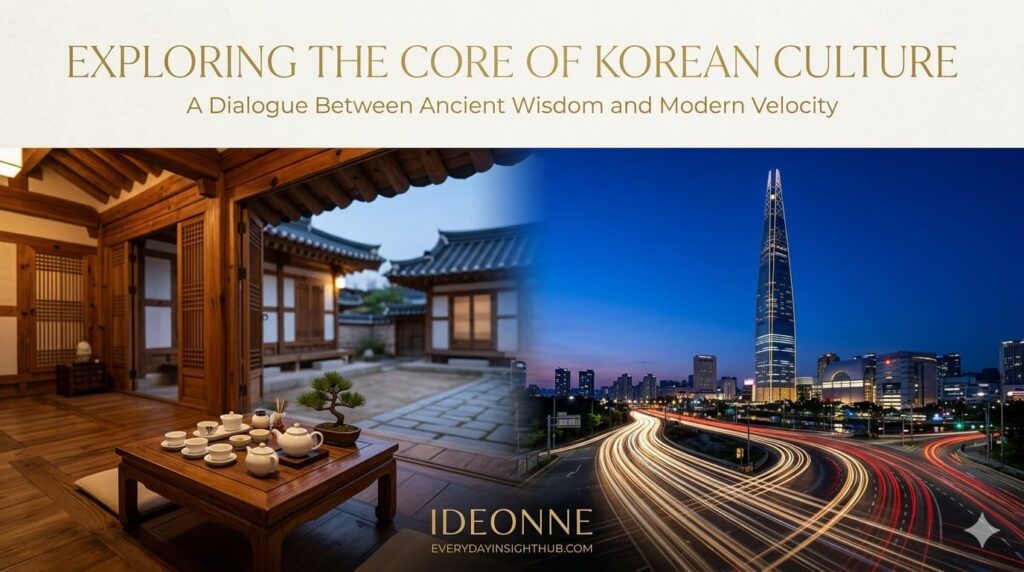
Today, Korea is known worldwide for technology, entertainment, innovation, and dynamic cities. Seoul represents speed, creativity, and global influence.
At the same time, many traditional ideas about family relationships continue to shape everyday life.
Understanding this contrast provides a deeper way to understand Korea.
Hyo is not simply an old custom preserved from the past.
It is a living value that continues to change with Korean society.
What Does Hyo Really Mean?
The word Hyo is often translated into English as “filial piety.”
However, this translation only captures part of its meaning.
For many English speakers, filial piety may sound like an old-fashioned concept focused mainly on children obeying their parents. While respect for parents is certainly an important part of Hyo, the Korean concept includes broader ideas of gratitude, responsibility, and emotional connection.
A more complete understanding of Hyo is:
the effort to maintain respect, care, and connection between generations.
This difference is important.
Imagine two situations.
In one situation, an adult child follows every decision their parents make even when they disagree.
In another situation, an adult child chooses a different path in life but continues to care for and support their parents.
Both situations involve relationships with parents, but the second example is closer to how many Koreans today understand modern Hyo.
Respect does not always mean agreement.
Care does not always mean giving up personal freedom.
A relationship between generations requires communication and adjustment from both sides.
A Different Way of Viewing Family Relationships
Every culture has its own answer to an important human question:
What responsibilities do we have toward the people who came before us?
Many modern societies place strong importance on independence. Becoming an adult often means developing one’s own identity, making personal choices, and building an independent life.
This does not mean family relationships are weak.
In many countries, including many Western societies, parents and children maintain deep emotional connections while also respecting personal boundaries.
Korean society has traditionally placed a stronger emphasis on maintaining involvement between generations.
Growing up has often meant not only becoming independent but also understanding one’s relationship with family.
The question is not only:
“Who am I?”
but also:
“Who are the people connected to me, and how do we support each other?”
This relationship-centered perspective helped shape the cultural foundation of Hyo.
However, modern Korea is not simply repeating the past.
The meaning of Hyo continues to be discussed and redefined.
The Historical Roots of Hyo: Beyond a Simple Confucian Explanation
More Than a Confucian Tradition
When international readers first learn about Hyo, they often encounter a familiar explanation:
“Korean Hyo comes from Confucianism.”
This explanation contains an important truth, but it does not tell the whole story.
Confucian philosophy had a major influence on Korean ideas about family relationships, social responsibility, and respect for elders. However, the values behind Hyo did not suddenly appear when Confucian teachings reached Korea.
The foundation of Hyo developed through a much longer historical process.
For centuries, Korean communities depended on cooperation between generations. In agricultural societies, families worked together, shared resources, and supported one another through difficult periods.
Older generations carried experience and knowledge.
Younger generations provided energy and labor.
The relationship between generations was not only an emotional connection. It was also essential for survival.
Respect and responsibility developed naturally within this environment.
Over time, these existing traditions interacted with Confucian ideas and became more clearly expressed as a cultural value known as Hyo.
Confucian Influence and the Meaning of Responsibility
During the Joseon Dynasty (1392–1910), Confucian philosophy became a major influence on Korean society.
Confucian thinkers emphasized the importance of relationships and responsibilities between people.
Among these relationships, the connection between parents and children was considered especially significant.
The reasoning was that the family was the first place where people learned how to treat others.
A person who learned gratitude, responsibility, and respect within the family would also be prepared to contribute to society.
This idea shaped many aspects of Korean life:
- Education
- Family traditions
- Ancestral ceremonies
- Social etiquette
- Expectations between generations
However, Korean society did not simply copy Confucian principles.
It adapted them according to its own history, circumstances, and cultural experiences.
This is why understanding Hyo requires looking beyond philosophy alone.
It is a combination of historical conditions, social relationships, and emotional connections.
Hyo and Xiao: Shared Roots, Different Expressions
Readers familiar with Chinese culture may notice similarities between Korean Hyo and the Chinese concept of Xiao (孝), often translated as filial piety.
The two concepts share Confucian roots.
Both emphasize respect and responsibility toward parents and ancestors.
However, their cultural expressions developed through different historical experiences.
In Korea, Hyo has often been strongly associated with everyday emotional relationships within the family.
For many Koreans, caring for parents is not only a social responsibility.
It is also an expression of appreciation:
“My parents sacrificed for me, and I want to care for them.”
This emotional dimension has played an important role in how Hyo is understood in daily life.
At the same time, it is important to recognize that Korean families are diverse. Not everyone experiences Hyo in exactly the same way, and younger generations continue to debate what healthy family responsibility should look like.
A cultural value is not defined only by tradition.
It is also shaped by how people discuss and reinterpret it.
Hyo Through Korea’s Modern History
To understand why Hyo remains meaningful today, it is important to consider Korea’s modern history.
The twentieth century brought enormous challenges:
- Colonial rule
- The Korean War
- Economic hardship
- Rapid industrialization
During these periods, family often became one of the strongest sources of security.
Especially after the Korean War, many parents devoted much of their lives to creating better opportunities for their children.
Education became one of the clearest examples of this sacrifice.
Many parents worked long hours and saved money because they believed their children’s future could be better than their own past.
For this generation, Hyo was closely connected to gratitude.
Children were expected to remember the effort and sacrifices made by their parents.
However, the meaning of Hyo has continued to evolve.
Younger generations who grew up in a different social environment often appreciate their parents’ sacrifices while also seeking a different balance between family responsibility and personal goals.
This change does not necessarily mean Hyo is disappearing.
It means the conversation around Hyo is changing.
From Duty to Relationship
One of the most interesting developments in modern Korea is the shift from understanding Hyo mainly as duty toward understanding it increasingly as relationship.
In previous generations, Hyo was often expressed through responsibility:
“I should take care of my parents because it is my duty.”
Today, many people also express it through emotional connection:
“I want to maintain a meaningful relationship with my parents.”
This change reflects a broader global transformation.
Around the world, younger generations are reconsidering how family relationships should work in societies where people live longer, move farther away, and pursue more individual paths.
Korea is experiencing the same process.
The central question is no longer only:
“What should children do for their parents?”
It is becoming:
“How can different generations respect and support each other?”
A Historical Lesson From Hyo
The history of Hyo reveals an important characteristic of culture:
Traditions survive not because they remain frozen.
They survive because people continue to find meaning in them.
Hyo has lasted for centuries because each generation has interpreted it according to its own circumstances.
For one generation, it represented sacrifice.
For another, gratitude.
For another, mutual understanding.
The expression changes, but the desire to maintain meaningful human connections remains.
How Hyo Appears in Everyday Korean Life: The Quiet Actions Behind the Value
Hyo Is Often Experienced Before It Is Explained
Many cultural values are difficult to notice because they appear in ordinary moments.
Hyo is one of them.
A visitor to Korea may spend several days in Seoul and observe many small interactions without realizing that they are connected to a deeper cultural idea.
A young person carries an elderly parent’s belongings.
A daughter rearranges her schedule to accompany her parents to a hospital appointment.
A family prepares a meal together when grandparents visit.
A younger person listens patiently as an older relative shares memories from the past.
None of these actions are dramatic.
They rarely attract attention.
Yet they reveal something important about Korean relationships:
Care is often expressed through action rather than words.
This is one reason Hyo can be difficult for outsiders to understand.
The visible behavior is simple.
The cultural meaning behind it is deeper.
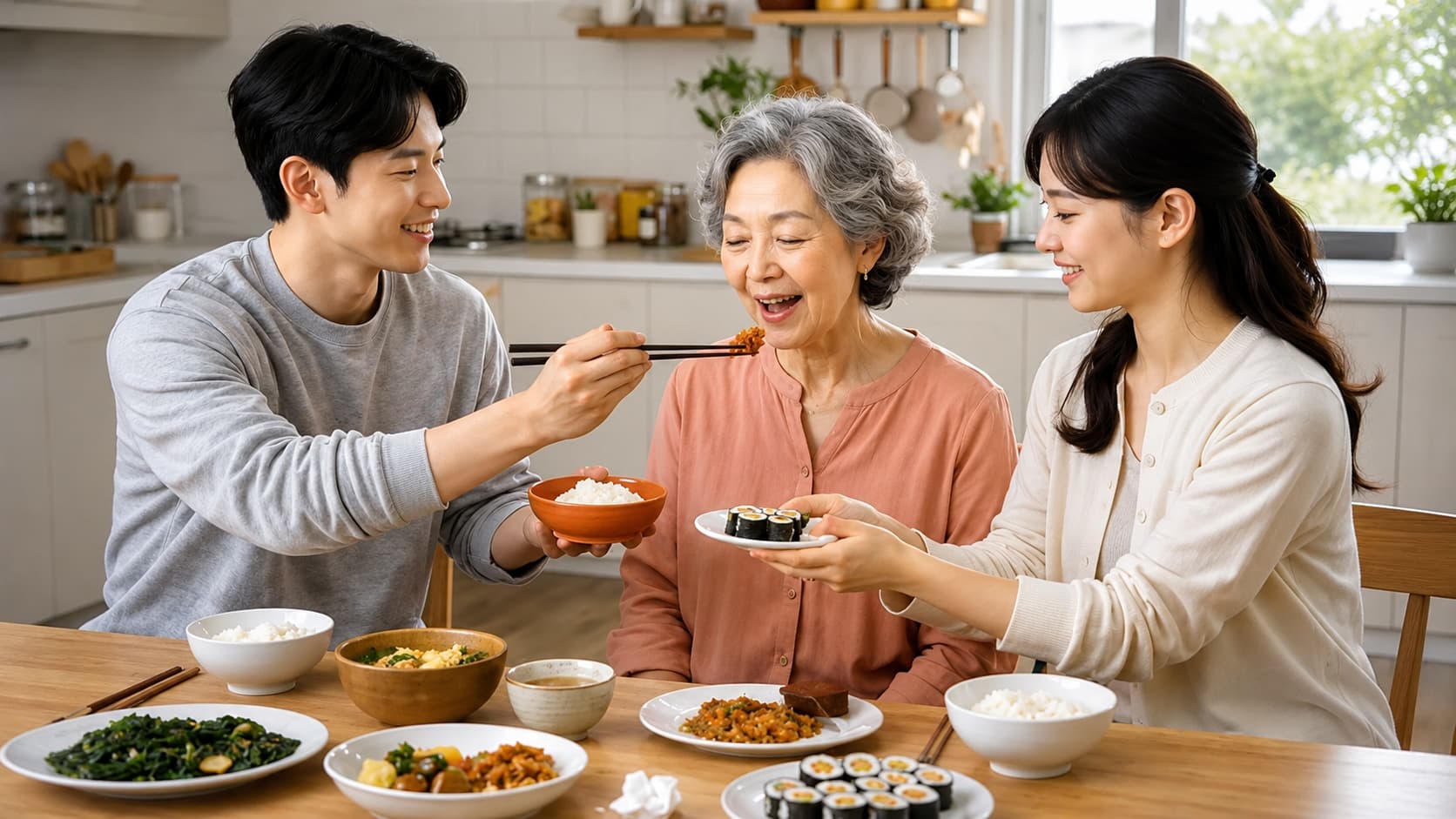
At the Korean Dining Table: Respect Before Eating
One of the most common places to observe Hyo is the Korean dining table.
Imagine a family gathering.
The food is already prepared.
Everyone is sitting together.
But younger family members may wait until older relatives begin eating before starting their own meal.
To an outsider, this may appear to be a small rule of etiquette.
However, the meaning is not simply about following a rule.
It communicates awareness:
“I recognize your presence.”
“This moment belongs to all of us.”
Food has a special role in Korean relationships.
A meal is not only a time to eat.
It is a time to maintain a connection.
For many Koreans, asking about someone’s meal is one of the most natural ways of showing concern.
Caring for Parents in Daily Life
Another place where Hyo appears clearly is in the relationship between adult children and aging parents.
In some cultures, adulthood is strongly associated with complete independence.
Once children become adults, both generations may expect separate lives with limited practical involvement.
Korean families have traditionally approached adulthood somewhat differently.
An adult child may have their own career, home, and personal goals while still feeling connected to parents’ daily lives.
This support can appear in simple but meaningful ways:
- Helping parents use digital technology
- Accompanying them to appointments
- Assisting with paperwork
- Sharing important family decisions
- Visiting regularly
For someone from a culture that emphasizes independence, these actions may sometimes appear unusual.
A visitor might ask:
“Why does an adult child still handle these things for a parent?”
The answer is connected to different cultural ideas about relationships.
One approach may express love by saying:
“I respect you enough to let you handle your own life.”
Another approach may express love by saying:
“I care about you, so I want to remain involved.”
Both come from a desire to support family members.
The difference lies in how that support is expressed.
The Hospital Experience: Family as a Support Network
Healthcare provides another example of how Hyo appears in modern Korea.
It is common to see adult children accompanying older parents during medical visits.
They may help by:
- Explaining information
- Asking questions
- Organizing documents
- Providing transportation
This reflects a broader cultural view:
An individual’s experience is often connected to the family around them.
When one person faces difficulty, family members may naturally become involved.
However, modern Korea is also reconsidering this tradition.
As the population ages and family structures change, many people are discussing new questions:
Should elderly care always remain mainly a family’s responsibility?
How can families provide support without creating excessive pressure?
What role should society and public systems play?
These discussions do not mean Hyo has lost importance.
They show that Korean society is actively redefining what responsible care should mean.
When Respect and Personal Freedom Meet
A balanced understanding of Hyo requires recognizing that every cultural value has both strengths and challenges.
The positive aspects of Hyo are clear:
- Strong emotional bonds between generations
- A sense of gratitude
- Support during difficult times
- Respect for experience and wisdom
However, traditional expectations have sometimes created pressure.
Some younger Koreans have questioned whether family responsibility should require giving up personal dreams or choices.
A young person may ask:
“How can I care for my parents while also building my own life?”
This question represents an important change.
The discussion is no longer simply about whether people should value their families.
Most people do.
The discussion is about finding a healthy balance between responsibility and individual well-being.
A Cultural Comparison: Different Expressions of Care
Comparing cultures helps explain why Hyo can sometimes be misunderstood.
In many societies, including many Western countries, parents often express love by encouraging children to become independent.
A parent may think:
“I want my child to create their own future.”
In Korean culture, parents have often expressed love through continued involvement.
A parent may think:
“I want to continue helping my child whenever I can.”
Children may express appreciation differently as well.
One person may show love by maintaining emotional closeness while respecting distance.
Another may show love through frequent contact and practical support.
Neither approach represents a stronger or weaker form of family love.
They are different cultural languages for expressing the same human desire:
to care for the people who matter.
What Visitors Can Learn From Everyday Hyo
The most valuable lesson of Hyo is not learning a Korean custom.
It is learning how to look beyond visible behavior.
A young Korean person helping an elderly family member is not simply following an old tradition.
They may be expressing gratitude.
They may be remembering past sacrifices.
They may be maintaining a relationship that gives meaning to both generations.
Understanding Hyo allows visitors to see Korean culture beyond the surface.
It reveals the invisible connections behind everyday actions.
Hyo in Modern Korea: Tradition, Change, and the Search for Balance
Is Hyo Disappearing in Modern Korea?
When people look at today’s Korea, they may wonder:
“Does Hyo still matter to younger generations?”
This question is understandable.
Korea has experienced one of the fastest social transformations in modern history.
Within only a few generations, the country has moved from a largely agricultural society to a global leader in technology, entertainment, and innovation.
Family structures have changed.
More people live alone.
Young adults often move away from their hometowns for education and careers.
Ideas about personal identity and individual choice have become increasingly important.
Compared with previous generations, many younger Koreans place greater emphasis on personal happiness, career goals, and emotional well-being.
At first glance, these changes may appear to challenge traditional ideas of Hyo.
But a closer look reveals something more interesting.
Hyo is not simply disappearing.
It is being reinterpreted.
From Sacrifice to Mutual Respect
For many older Koreans, Hyo is deeply connected to sacrifice.
This understanding was shaped by historical experience.
Many parents who grew up during periods of economic hardship worked long hours and invested much of their energy into creating better opportunities for their children.
Education was especially important.
A parent might sacrifice personal comfort because they believed:
“My child should have opportunities that I never had.”
For this generation, Hyo often meant remembering those sacrifices and showing gratitude through responsibility.
However, younger generations grew up in a different environment.
They experienced:
- A more globalized society
- Greater access to information
- More diverse career possibilities
- Different ideas about personal fulfillment
As a result, many young Koreans are not rejecting Hyo.
They are asking a different question:
“How can we respect our parents while also respecting our own lives?”
This represents a major change in the meaning of Hyo.
The New Meaning of Hyo: Respect Goes Both Ways
One of the most significant changes in modern Korean society is the growing idea that respect should exist between generations, not only from younger people toward older people.
Traditional views often emphasized the responsibility of children.
Today, many people also emphasize mutual understanding.
For example:
A parent may learn to respect a child’s different career choices.
A child may recognize a parent’s sacrifices while communicating their own needs honestly.
An older generation may adjust to new ideas about work, marriage, and lifestyle.
A younger generation may find new ways to remain connected despite living far away.
Modern Hyo is increasingly becoming a relationship built on two-way respect.
The question is shifting from:
“What should children do for parents?”
to:
“How can parents and children understand each other?”
Technology and the Changing Expression of Care
Modern technology provides an interesting example of how Hyo continues to adapt.
In the past, caring for parents often required physical closeness.
Living nearby.
Visiting frequently.
Sharing daily routines.
Today, families are often separated by distance.
A child may work in another city or even another country.
Yet technology creates new possibilities.
A person can show care by:
- Video calling parents regularly
- Helping them use digital services
- Assisting with online tasks
- Staying involved in important decisions
The form of connection has changed.
The desire to maintain connection remains.
This reveals an important characteristic of cultural values:
They do not survive because the outside appearance stays the same.
They survive because people discover new ways to express the same underlying meaning.
The Challenge of an Aging Society
Modern Korea also faces a challenge shared by many countries:
An aging population.
As people live longer, societies must reconsider how elderly care should work.
Traditionally, Korean families often carried a strong expectation that children should care for aging parents.
This expectation created many positive outcomes:
- Strong family support
- Close relationships
- A sense of responsibility
However, it also created difficult questions.
Some adult children feel pressure when family expectations conflict with career demands, financial limitations, or personal circumstances.
Korean society is increasingly discussing questions such as:
- Should elderly care remain mainly a family responsibility?
- How can society better support older adults?
- How can families maintain closeness without creating excessive burden?
These discussions do not represent the failure of Hyo.
They represent a society trying to redefine what care should look like in a changing world.
A Conversation Between Two Generations
The changing meaning of Hyo can be understood through a simple conversation.
A parent might say:
“I worked hard and sacrificed so much because I wanted you to succeed.”
A child might respond:
“I am grateful for everything you did. I also hope we can understand each other’s lives.”
This conversation captures the transition happening in many Korean families.
The younger generation is not necessarily turning away from the past.
Instead, it is seeking a new balance.
They want to honor their parents without losing their own identity.
They want family connection without ignoring personal choices.
This is one of the central questions facing modern Hyo.
A Broader Cultural Perspective
The discussion surrounding Hyo is not unique to Korea.
Many societies today are facing similar questions:
How much responsibility do adult children have toward parents?
How can families balance independence and connection?
How should societies care for aging populations?
Korea’s experience provides one perspective on these universal challenges.
It shows that modernization does not automatically erase traditional values.
A society can embrace global culture, advanced technology, and individual choice while still searching for meaningful ways to maintain relationships.
The challenge is not choosing between tradition and modernity.
The challenge is creating a relationship between them.
Why Hyo Matters Beyond Korea: A Universal Question About Human Connections
More Than a Korean Tradition
At first glance, Hyo may seem like a value that belongs specifically to Korean culture.
It developed through Korea’s history, family structures, and social experiences.
However, the deeper meaning of Hyo reaches beyond Korea.
Every society eventually faces a similar question:
How should we care for the people who cared for us?
Different cultures answer this question in different ways.
Some emphasize independence.
Some emphasize family responsibility.
Some express love through giving freedom.
Others express love through continued involvement.
These differences do not mean one culture values relationships more than another.
They reveal different ways that human beings create connection.
This is why understanding Hyo is meaningful for international readers.
It does not require anyone to adopt a Korean way of life.
Instead, it offers another perspective on how generations can remain connected in a rapidly changing world.
Looking Beyond the Visible Actions
When visitors encounter Hyo in Korea, they often notice visible behaviors:
A younger person using respectful language with an older person.
An adult child helping a parent.
A family gathering across generations.
A person showing patience toward an elderly relative.
But culture is not only found in what people do.
It is also found in the meaning behind those actions.
The same behavior can be understood differently depending on cultural background.
A child visiting parents frequently may be seen as unnecessary involvement in one society.
In another society, it may be understood as an expression of gratitude and care.
The important lesson is not deciding which interpretation is correct.
The important lesson is learning that human relationships can be expressed in different cultural languages.
Hyo helps visitors look beyond the action itself and recognize the values underneath.
The Future of Hyo
The future of Hyo will not look exactly like its past.
Korea continues to change.
Families are becoming smaller.
People are living longer.
More individuals are creating independent lives.
Technology is transforming communication.
Because of these changes, the expression of Hyo will continue to evolve.
Future generations may not practice Hyo in the same ways as previous generations.
They may live farther away from parents.
They may express care through different methods.
They may define responsibility in new ways.
However, the central question will remain:
How can we maintain meaningful connections between generations?
That question is not limited to Korea.
It is becoming one of the most important social questions around the world.
A Living Tradition That Continues to Change
One of the most important things to understand about Hyo is that traditions do not survive because they remain unchanged.
They survive because people continue to find meaning in them.
For older generations, Hyo may represent sacrifice and responsibility.
For younger generations, it may represent communication, mutual respect, and emotional connection.
For future generations, it may take another form.
The value remains alive because each generation participates in redefining it.
A tradition that can adapt is often stronger than one that cannot change.
Final Reflection: Understanding Korea Through Human Relationships
To understand Korea, it is not enough to look only at its visible achievements:
The technology.
The entertainment industry.
The modern cities.
Behind these global images are everyday relationships that continue to shape Korean society.
Hyo is one of those invisible foundations.
It helps explain why ideas of family connection, respect between generations, and responsibility toward others remain meaningful in many parts of Korean life.
But perhaps the most valuable lesson of Hyo is not about Korea alone.
It is about a question shared by people everywhere:
In a world that is becoming faster and more individualistic, how do we continue caring for the people who connect us to our past while building our own future?
Hyo does not provide one simple answer.
Instead, it offers a way of thinking.
It reminds us that relationships require attention, gratitude, and effort.
And like every meaningful connection between generations, it must be renewed by each generation.
Further Reading on IDEONNE
Explore related aspects of Korean culture:
Beyond the Korean Wave: The Thousand-Year Cultural Foundations of Korea’s Global Influence
→ Discover the historical foundations behind modern Korean culture.
Jeong: The Invisible Bond Behind Korean Relationships
→ Explore the emotional connections that shape Korean social relationships.
Korean Honorifics: More Than Polite Lahttps://everydayinsighthub.com/honorifics-in-korean-the-linguistic-art-of-social-distance/nguage
→ Learn how respect is expressed through Korean speech.
Korean Dining Culture: Why Sharing Food Creates Connection
→ Understand why meals often become moments of relationship building in Korea.