🎬 How Korea’s ‘Jeong’ Creates Miracles in an Analog Way
No matter where you travel in the world, the general rhythm of human life often appears remarkably similar. Yet, foreigners who settle in the peninsula and try to understand the Korean concept of ‘Jeong‘ frequently find themselves confronted by a deeply mysterious spectacle—one that unfolds not in some grand cultural arena, but during the most ordinary of meals.
Imagine a group of four dining at a local restaurant. As if guided by an unwritten script, a subtle division of labor instantly takes place. One person picks up the tongs to grill the meat, another arranges the utensils and pours the water, while a third keeps a vigilant eye on everyone else’s empty side dishes. The true climax, however, arrives at the end of the meal by the cash register. Suddenly, as if on a synchronized cue, everyone flashes their wallets in a blur of motion, repeatedly chanting, “I’ll pay!” A polite yet intense scuffle ensues right in front of the card terminal, leaving the cashier caught squarely in the middle.
A friend from Sweden, where separate checks are the unquestioned cultural norm, confessed to being utterly bewildered when he first witnessed this display. He could not comprehend why close friends would engage in such a fierce disagreement over a bill. It was only after living in Korea for quite some time that he finally understood, noting with a nod: “That behavior wasn’t about money at all. It was an emotional thermometer showing just how warm their relationship truly was.”
🏷️ A Word That Confounded the Translators
For generations, a unique emotional texture has quietly governed these peculiar dining rituals in Korean society. We call it ‘Jeong’ (情).
The fascinating thing about Jeong is that it is a notoriously stubborn word, one that flatly refuses to be perfectly translated by even the most cutting-edge AI software. To call it ‘love’ feels far too broad; to describe it as ‘kindness’ is hopelessly shallow; and to label it ‘friendship’ overlooks how deeply it weaves itself into the mundane fabric of daily life. In truth, Jeong does not dwell within the lofty pages of moral philosophy. Instead, it plays hide-and-seek within the most trivial, everyday moments.
Consider the ubiquitous Korean greeting: “Have you eaten?” (Bap meogeosseo?)
When people from Western cultures first hear this, they often tilt their heads in confusion, wondering: ‘Why are they monitoring my private dining schedule? Are they offering to buy me lunch?’ Yet, as time passes, the deeper meaning reveals itself. This is not a data-driven survey tracking nutrient intake. It is the gentlest, most uniquely Korean way of asking, “Are you doing well today?” It is an expression of genuine care disguised as a casual inquiry.
[The Layered Significance of "Have you eaten?"]
  - Surface Meaning: Verifying meal consumption (X)
  - Hidden Meaning: A life-aligned attentiveness to your well-being and presence (O)
Foreigners who spend a significant amount of time in Korea often share a striking observation: “Korean people seem to measure relational distance with a rubber band.”
Upon a first meeting, they will maintain impeccable boundaries, treating you with the utmost courtesy and politeness. Yet, the moment a shared connection is forged, those boundaries dissolve with astonishing speed. Suddenly, they step into your life with the familiar warmth of an aunt or an uncle, naturally offering phrases like, “Did you get home safely?” or “It looks like you’re catching a cold, make sure to dress warmly.” The velocity of this transition can be quite breathtaking.
A colleague from the UK shared a vivid memory of his first days at a Korean workplace. For the first week, his coworkers were perfectly gentlemanly, yet an invisible glass wall of distance remained. One evening, however, after working late, they all gathered to grill Samgyeopsal (pork belly) and clinked Soju glasses. The very next morning, a quiet magic transformed the office.
When he arrived at his desk, someone had slipped a bottle of vitamin drink next to his keyboard. Another colleague recommended a traditional herbal tea excellent for fatigue, and the otherwise stoic manager silently dropped a small bag of tangerines onto his desk before walking away. He later recalled with a smile:
“In Korea, once you share the experience of grilling meat together over an open flame, your human relationship status instantly gets fast-tracked to the highest tier.”
🍎 The Illogical Kindness of Peeling Fruit
Jeong is a profoundly intriguing emotion. It operates on a wavelength entirely different from polished manners or mere hospitality. Rather, it resembles a ‘living fragrance’ or an ‘ambient temperature’ that naturally absorbs into people who share the air of a common space over time. Consequently, Jeong often visualizes itself in ways that are disarmingly small and entirely illogical.
Take, for instance, the way Korean people host guests or conclude a meal by meticulously peeling and slicing fruit. Foreign learners occasionally find this custom rather unfamiliar or unusual at first. They wonder: ‘Why go through the tedious trouble of peeling the skin, cutting it into neat pieces, and delivering it directly to my reach with a tiny fork, instead of simply handing me the whole fruit or a knife?’
Yet, within Korean culture, that minor inconvenience and labor is a quiet language of hospitality. The simple, rhythmic act of carving away an apple’s peel is not mere housework; it is a silent, gentle confession that says, “I want you to feel entirely comfortable and cherished in my space.”
Amusingly, Koreans themselves struggle to provide a clinical definition of what Jeong actually is. This is because Jeong is not a matter of logic to be parsed by the intellect; it is a territory of lived experience to be felt entirely by the body and heart.
An international student from the United States still remembers, with a slight warmth in his eyes, the time he fell severely ill with the flu while living alone in Korea. Nursing a fever in a foreign land, a wave of profound homesickness washed over him. However, the moment word spread that he was bedridden, his Korean acquaintances moved into action as if answering an unspoken call.
One friend brewed a hot pot of ginger tea and hung it on his doorknob. Another arranged for a delivery of soothing porridge, while his messaging app lit up with a barrage of anxious inquiries urging him to visit a clinic. Initially, he found this intensive barrage of attention a bit overwhelming, wondering if his privacy was being breached. Yet, he quickly realized that within this collective commotion lay a vast, fierce determination never to leave him isolated in his suffering. Upon returning home, he left behind a beautiful reflection:
“In Korea, when you are sick, it feels as though the people around you hurt and worry right along with you. Sadness and pain cease to be lonely, individual burdens; instead, they gently become a shared, communal responsibility.”
🍱 The Circular Economy of Banchan Containers and Affection Disguised as Nagging
Of course, Jeong does not always present itself in such sweet, romantic vignettes. At times, it can feel like an intrusive overstep or an invasion of privacy, coming across as somewhat burdensome. Yet, those who weather the seasons of life in this country eventually come to appreciate a fundamental truth: here, love and concern are rarely delivered in cold, perfectly polished phrases.
Instead, Jeong highly favors a more rustic vehicle: affection disguised as nagging—in persistent refrains like, “Make sure you dress warmly,” or “Why have you lost so much weight?”
This emotional landscape gives rise to some truly unique social scenery, such as the extraordinarily prolonged ritual of saying goodbye. Even if farewells have been thoroughly exchanged inside a restaurant, hosts will invariably accompany their guests to the elevator, follow them all the way out to the building’s main entrance to wave once more, and then—to bring the odyssey to a formal close—send a follow-up text message checking if they arrived home safely. A friend from Canada once jokingly remarked, “Korean people invest an immense amount of energy and devotion just to officially seal a goodbye.”
Modern Korean society is changing at a dizzying velocity. High-density urbanization and intense competition have triggered an explosion of single-person households, shifting human relationships into a hyper-individualized, digital paradigm. From a purely calculated standpoint, keeping to oneself and minding one’s own business is far more efficient and avoids emotional exhaustion.
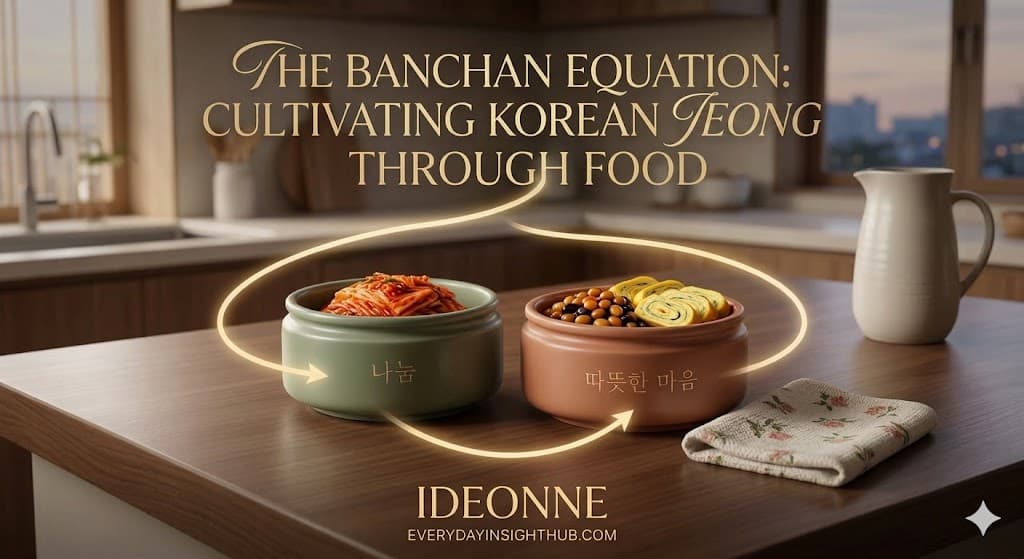
And yet, despite this modern shift, the stubborn, analog imprint of Jeong remains firmly anchored in the corners of Korean life. It endures in the way neighbors, after making a fresh batch of Kimchi, will pack it tightly into a plastic container and ring the doorbell next door. Remarkably, a banchan container is destined never to return empty. The recipient will invariably refill it with a delicacy or treat from their own kitchen before handing it back. A witty sociologist once lightheartedly dubbed this phenomenon “The Circular Economy of Banchan (Side-dish) Containers.”
🌸 The Most Beautiful Flower Humankind Can Cultivate
Ultimately, Jeong may simply be another name for the fierce refusal to let another human being slip into absolute, lonely isolation.
In Korean dramas and films, it is a common trope to see neighbors who share no blood relations looking after one another’s life events with the devotion of immediate family. Rational onlookers might ask, “Why do they expend so much of their own time and money to help someone else?” Yet, within the cultural grammar of Korea, the weight of shared time carries an immense gravity. Weathering hardships together is not viewed merely as a fond memory; it establishes a profound ’emotional solidarity’—a quiet vow not to abandon one another’s lives.
A journalist who returned to France after several years in Seoul summarized her experience with a moving sentiment:
“The Korean people I met were by no means perfect. At times, they were incredibly impatient, and at others, they pried into my life so deeply that boundaries blurred. Yet, ironically, during my years in that complex country, I felt the least vulnerable to that biting, universal dread of being utterly alone on this earth.”
Perhaps this is the true essence of this untranslatable emotion. It is far less about grand metaphysical philosophies or beautifully sculpted rhetoric, and far more about a tireless, everyday commitment to remind you that you are not alone. This ambient, unspoken warmth is the invisible pillar that holds the architecture of this culture upright.
Korea stands as an ultra-modern, hyper-digital global powerhouse. Yet, in the intimate spaces where human beings connect, it remains disarmingly, beautifully analog.
To spend time breathing within this subtle ecosystem of Jeong is to witness a quiet transformation within oneself. Inevitably, that ambient warmth takes firm root in the deeper soils of your own soul. Before you know it, it blossoms into a natural, unprompted kindness extended toward others.
Is this continuous chain of warmth, and the rounded solidarity born from it, not perhaps the most beautiful form of existence we can cultivate on this weathered earth? If our lives are indeed fragile things that linger for a brief moment before vanishing like morning mist, then filling our days by planting these quiet flowers of affection—like silently leaving a bag of tangerines on a coworker’s desk—is surely the wisest and most beautiful way to spend our journey.
If you want to explore more about Korea’s modern and traditional harmony, check out our previous post on Hangeul and Seoul’s vibrant identity.