A Quiet Feeling That Visitors Remember
When people visit another country, they often expect to remember the things they can easily see: famous landmarks, traditional architecture, local food, or modern technology. Yet sometimes the most lasting impression comes from something much quieter — a feeling that is difficult to photograph but easy to remember.
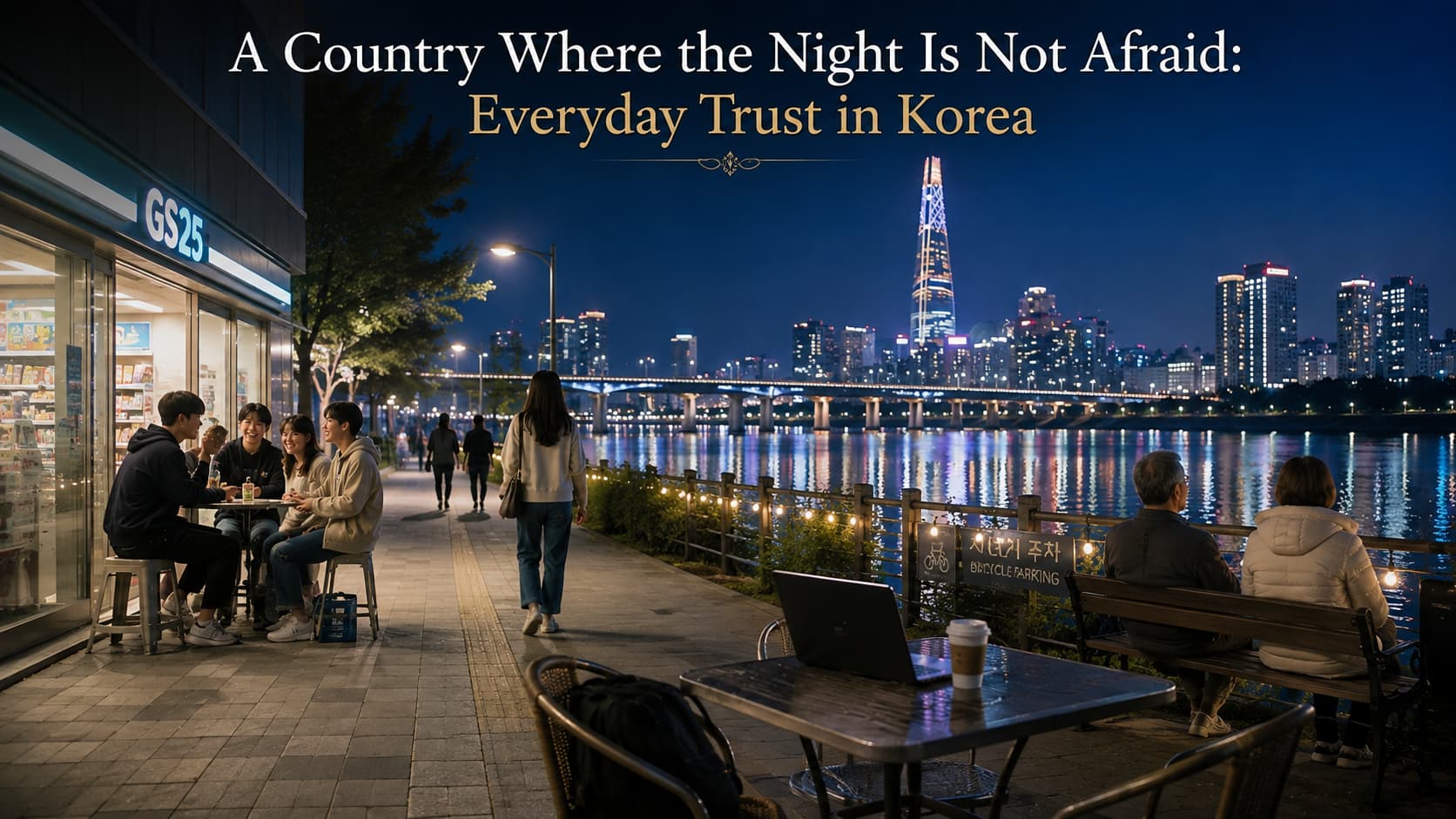
For many visitors to Korea, that feeling appears in ordinary moments rather than famous destinations. It may be the sight of a small restaurant still welcoming customers late at night, students sharing food and conversation outside a convenience store, an elderly couple taking an evening walk through a neighborhood street, or someone leaving a laptop on a café table while briefly stepping away.
These scenes rarely appear in travel guides. They are not dramatic events, and most local people may not even consider them unusual. However, when these small moments are observed together, they reveal something meaningful about everyday life: the presence of trust between people who may never meet.
This is not the dramatic kind of trust created by extraordinary acts of courage. It is a quieter form of trust — the expectation that others will respect shared spaces, personal belongings, and social boundaries even when there is no direct relationship between them.
For many visitors, this becomes one of the most memorable discoveries in Korea. Before they understand the language or the deeper history of Korean society, they often experience something simple: the feeling that daily life can continue with a certain level of confidence and comfort.
Why Do Visitors Notice Everyday Trust in Korea So Quickly?
Have you ever visited a place where you felt comfortable before you could explain the reason?
Culture is often discovered not only through museums, historical monuments, or official explanations. It is also revealed through ordinary routines that people repeat every day without thinking about them.
A person leaves a bag on a chair to save a seat. Someone returns an item that a stranger accidentally dropped. A commuter quietly makes room for another passenger. An older child uses public transportation independently as part of a normal daily routine.
Each moment seems small. However, when similar actions happen repeatedly over many years, they create an atmosphere that visitors can sense even before they fully understand its cultural background.
Many people do not arrive in Korea thinking, “I am going to study a culture of trust.” Instead, they simply notice small differences between what they expected and what they experience.
They may think, “I thought I would need to be more careful, but I feel more comfortable than I imagined.”
That gap between expectation and experience is often where cultural understanding begins.
For many visitors, this feeling is connected to a broader Korean understanding of relationships and belonging. The Korean language itself contains clues about how people view connection and shared identity. The idea of saying “our” in situations where English speakers might say “my” is explored further in [The Curious Case of “Uri”: Why Koreans Say “Our” Instead of “My”].
Trust Is Not the Same as Safety
When people talk about Korea, the word “safe” is often mentioned. Many visitors describe Korea as a place where they feel comfortable moving around, including during late hours.
However, safety and trust are not exactly the same thing.
Safety can be supported by systems. It can come from laws, public services, technology, and security measures. Trust is different. Trust exists when people expect others to act responsibly even when nobody is watching.
A security camera can record an event. A law can define consequences. But neither one fully explains why someone might feel comfortable leaving a laptop on a café table while ordering a drink.
That feeling comes from something less visible. It comes from shared expectations about behavior.
Culture is often found in the space between written rules and everyday choices. It appears when people quietly consider questions such as: “How will my actions affect others?” or “Should I respect a space that belongs to everyone?”
Over time, these small decisions become habits. Those habits shape the atmosphere that visitors often describe as trust.
The Laptop on the Café Table: A Small Cultural Moment
One of the moments that surprises many visitors is the café environment in Korea.
A person sits at a café, places a laptop or smartphone on the table, and walks away for a few minutes. For someone unfamiliar with this habit, the first reaction may be surprise.
“Is it really okay to leave it there?”
After seeing the same scene repeatedly, the surprise often fades. The visitor begins to understand that the action is not based on carelessness. It is based on confidence.
The person leaving the laptop is not thinking, “I hope nobody takes this.” They are thinking, “I will return shortly.”
That difference may appear small, but it reveals an important aspect of trust.
Trust works quietly because people rarely notice something when it functions well. We notice when trust is broken. We notice when something disappears. But we often overlook the countless ordinary moments when people choose to respect invisible boundaries.
A café table with an unattended laptop may seem like a simple everyday scene. Yet within that small moment exists a larger cultural question: what allows strangers to share the same space with a sense of mutual consideration?
The Unexpected Comfort of Ordinary Streets
Another experience that many visitors remember is the atmosphere of Korean neighborhoods after sunset. In many cities around the world, nighttime changes the relationship between people and public spaces. Streets may become quieter, daily activities move indoors, and people become more cautious about spending time outside.
In many Korean neighborhoods, however, the evening often continues as an extension of ordinary life. Convenience stores remain active, restaurants welcome late customers, friends meet after work, and families take evening walks. Public spaces continue to serve as places where daily routines unfold.
The important point is not simply that Korean streets remain busy at night. Many cities around the world share that characteristic. What stands out to some visitors is the relationship between people and those spaces. Neighborhoods, cafés, parks, and small shops are often experienced not only as places to pass through, but as places where everyday life continues naturally.
Familiarity grows through repeated interaction. A neighborhood where people regularly see one another, share common spaces, and follow similar expectations can gradually develop a sense of comfort. Over time, that familiarity becomes one of the foundations on which trust is built.
This does not mean that every person in Korea knows their neighbors or that every public space feels identical. Like any society, Korea has differences between communities and faces its own social challenges. The point is not perfection, but the way ordinary habits can influence how people experience daily life.
Why Do Some Visitors Misunderstand Korean Trust?
When visitors first notice this atmosphere, they often search for a simple explanation.
Some may think, “Korea has many security cameras, so that must be the reason.”
Others may assume, “People simply follow strict rules.”
These factors can influence behavior, but they do not fully explain everyday trust.
A camera may discourage certain actions. A rule may define what is acceptable. However, trust appears most clearly in moments when no one is forcing people to make the considerate choice.
It appears when someone returns a lost item.
It appears when people respect shared spaces.
It appears when strangers follow social expectations even without personal connections.
Culture is revealed not only by what people are required to do, but also by what they choose to do when nobody is asking.
This distinction is important because trust is not created only through control. It is created through expectation. People act in certain ways because they believe others around them are also trying to maintain a shared sense of order.
That invisible agreement is what makes trust different from simple rule-following.
A Simple Story About a Lost Umbrella
Small moments often reveal cultural values more clearly than large events.
A foreign visitor once recalled a rainy day in Korea. After leaving a café, the visitor realized that an umbrella had been forgotten inside. By the time the mistake was noticed, the visitor had already walked some distance.
When the visitor returned, a staff member was trying to find the owner.
The umbrella itself was not expensive or special. What remained memorable was the effort. Someone had taken time from their own day to return something that belonged to another person.
The moment was ordinary. But that was exactly why it mattered.
Trust is rarely built through dramatic actions that receive attention. More often, it is created through countless ordinary choices repeated over time.
These small acts also connect to another important aspect of Korean culture: the emotional bonds that develop between people through repeated care and consideration. To explore this deeper human connection, see [What Is Jeong? Korea’s Invisible Language of Human Connection].
The Cultural Background Behind Everyday Trust
Every society develops its own ways of creating social order. In Korea, everyday trust has been influenced by many historical and cultural experiences, including a strong awareness of relationships, social harmony, and the impact of individual behavior on others.
However, trust should not be understood as a single traditional value preserved unchanged from the past. Modern Korea continues to evolve. Generations communicate differently, workplaces are changing, family structures are changing, and social expectations are shifting.
Yet some everyday habits remain meaningful.
People continue to pay attention to shared spaces. They continue to consider how personal actions affect those nearby. They continue to recognize that individual choices can influence the atmosphere of a larger community.
These behaviors are not unique to Korea. Every society develops its own forms of trust. What makes Korea interesting is not that it has a completely different system, but that certain forms of everyday consideration are especially noticeable to many visitors.
For readers interested in how respect and care appear across generations in Korean culture, [Understanding Hyo: The Korean Way of Expressing Respect and Care Across Generations] offers another perspective.
The Challenge of Maintaining Trust in a Changing Society
Trust is valuable because it is fragile.
As societies become larger and more complex, maintaining trust becomes more challenging. Korea, like many countries, faces modern issues such as rapid urban development, generational differences, social pressure, and changing relationships between individuals.
A society cannot depend only on traditions from the past. Trust must be renewed by each generation.
The deeper question is not simply, “Does Korea have trust?”
A more meaningful question is:
“How does any society continue creating trust in a changing world?”
This is not only a Korean question. It is a human question.
Every society must find ways to balance individual freedom with shared responsibility. The methods may differ from culture to culture, but the challenge remains universal.
To understand how everyday values like trust connect with the larger story of Korean culture and history, explore [Beyond the Korean Wave: The Thousand-Year Cultural Foundations of Korea’s Global Influence].
The Quiet Power of Everyday Trust
Perhaps the most memorable part of visiting another country is not always something that can be photographed.
Sometimes it is a feeling that remains after the journey ends.
It may be the feeling of walking through a neighborhood at night, sitting in a café without constantly checking personal belongings, or realizing that strangers around you are quietly following the same invisible expectations.
Trust rarely appears in photographs. It has no monument and no location marked on a map. Yet it shapes countless moments of everyday life.
For many visitors, this may be one of the most meaningful discoveries in Korea: not only a country known for technology, speed, and modern cities, but also a place where ordinary people continue building trust through ordinary actions.
And perhaps that is why, in Korea, the night often feels less like something to fear and more like a time when everyday life continues.