If you spend enough time wandering through cities around the world, you notice a peculiar pattern. Some places boast breathtaking architecture and Michelin-star menus, yet carry a subtle, quiet chill that makes you want to turn on your heel and leave. Other places, however, are utterly ordinary—a modest neighborhood diner or a quiet family-run bakery—where the moment you slide the glass door open, the weight of the day simply melts off your shoulders.
What creates this dramatic divide? Surprisingly, the secret rarely lies in grand interior design. More often than not, it begins with the very first words spoken by the person behind the counter.
In Korea, whether you step into a bustling restaurant, a cozy café, a quiet convenience store, a crowded morning market, or even the corner dry cleaner’s, a familiar phrase greets you the second you cross the threshold:
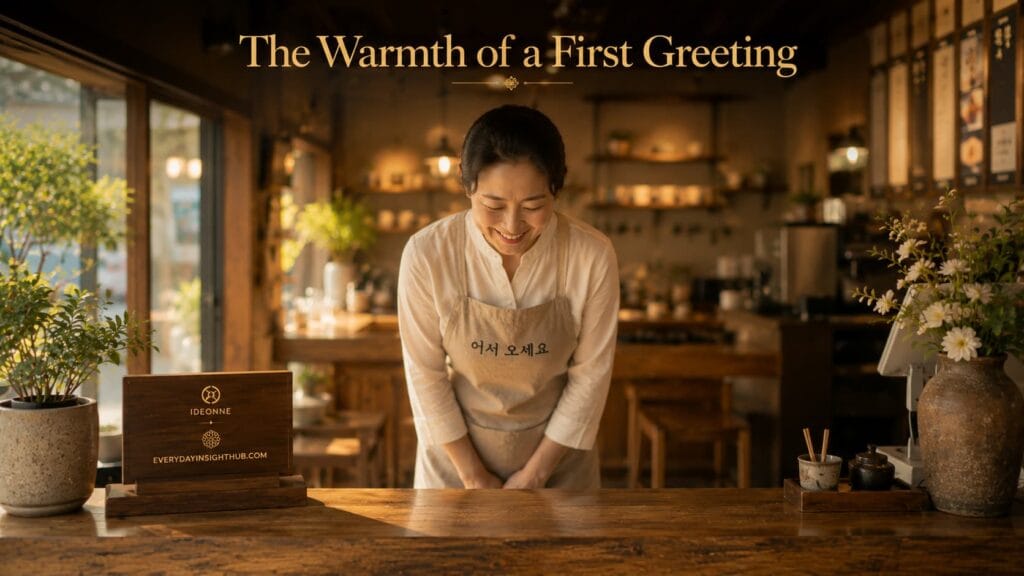
“Eoseo oseyo (어서 오세요).”
What makes this phrase so striking is that it isn’t a mechanical, transactional greeting designed merely to process a customer. The moment Koreans hear these two words, they instinctively feel a quiet, genuine warmth—the distinct sense of being welcomed. In fact, many travelers recall that eoseo oseyo—long before the standard annyeonghaseyo—was the very first Korean phrase that truly embedded itself in their hearts.
💡 Today’s Expression
🗣️ Eoseo oseyo (어서 오세요)
- Meaning: Welcome. / Come on in. / Please come in.
- The Nuance of the Word: If you look strictly at dictionary definitions, eoseo can sometimes be linked to notions of speed or urgency. Taken literally by a newcomer, it might momentarily sound like a nudge to “hurry along.” But in everyday life, its true heart is entirely different. It carries a profound spirit of hospitality, whispering, “We’ve been hoping you’d arrive,” and “Please, come in and make yourself completely at home.”
🎶 The Rhythm and Tone in Conversation
If you listen closely to native speakers, eoseo oseyo rarely drops from the lips as a stiff, segmented checklist of syllables. Instead, it flows with a gentle, welcoming cadence, as if riding a soft wave of genuine gladness.
The secret is not to drag out the final vowel, but to let it drop naturally, offering a friendly nod. Yet, there is something far more vital than pronunciation: when Koreans say this, their faces almost invariably soften into a genuine smile. That simple human expression transforms what could be a sterile phrase into something that genuinely warms the room.
📝 Daily Dialogues
Where will you hear this rhythm in the wild?
- At a restaurant:“Eoseo oseyo.” “Table for two?”
- At a convenience store:“Eoseo oseyo.” “Need a bag today?”
- At a friend’s home:“Eoseo oseyo!” (Or shortened affectionately to “Eoseo wa!”) “It’s been forever!”
- Welcoming a new colleague at the office:“Eoseo oseyo. We’re so glad to have you on the team.”
🌍 Culture Note: The Art of Greeting Before the Transaction
One of the details that often charms visitors in Korea is the sensation of being welcomed long before money changes hands or an order is placed.
Of course, every culture has its own version of a welcome. But in Korea, eoseo oseyo flows as effortlessly as breathing—not just in pristine department store lobbies, but in tiny alleyway snack shops, neighborhood bakeries, and stalls in bustling traditional markets.
This phrase isn’t a bait-and-switch sales tactic. It is a quiet social grace that creates a space saying, “While you are here, you are safe, unhurried, and entirely welcome to rest.” Little wonder, then, that if regulars walk into their favorite haunt and happen not to hear it, they feel a subtle, lingering chill of estrangement.
📸 A Snapshot from the Alleyways: Anna’s Seoul Journal
Anna, a freelance photographer from Helsinki, was wandering through a labyrinth of old alleyways in Seoul, her camera resting against her coat, when she caught the scent of sesame oil and steam rising from a matchbox-sized kimbap shop. She paused outside, debating whether to go in, her eyes tracing the handwritten menu on the windowpane.
Before her hand even brushed the door handle, a bright, cheerful voice rang out from the tiny kitchen:
“Eoseo oseyo!”
Anna froze. She hadn’t touched the door, and for all the owner knew, she was just another passerby lost in thought. Smiling with quiet amusement, she pushed the door open and stepped inside.
After finishing a warm, comforting meal, she went to pay and finally let her curiosity slip out:
“How did you know to call out? I hadn’t even touched the door, and you weren’t looking outside.”
The owner chuckled softly, her eyes crinkling at the corners.
“I could see you standing out there, looking like you were trying to make up your mind. I didn’t want to pressure you—I just wanted you to know you could come in out of the cold without a second thought.”
That brief, casual kindness stayed with Anna long after she left the shop. It became the quiet soundtrack of her journey.
On her very last day in the city, she happened to pass a small neighborhood flower shop. Without thinking, she smiled and pushed the glass door open.
The florist looked up, face breaking into a radiant grin:
“Eoseo oseyo.”
‘Eoseo oseyo’ is not merely a greeting; it is the warmest invitation a stranger can ever hope to receive.
🔍 Discovering the Korean Language: The Quiet Truth of ‘Eoseo’
Foreigners learning Korean often stumble over the word eoseo, occasionally misinterpreting it through the lens of hurry or impatience. Hearing eoseo oseyo, some beginners instinctively feel a phantom urge to quicken their step.
Yet, this is where language reveals its quiet poetry. In this context, eoseo is not a demand to rush. It is a gentle sigh of relief—a way of saying, “You’re finally here, now you can slow down and breathe.”
Instead of feeling hurried, Koreans hear this phrase and immediately let their guard down, realizing they are met not with hesitation, but with open arms. It is a striking reminder of how a single word can pivot entirely on the warmth of human intention.
🥘 A Spoonful of Korean Culture
For generations, the cultural thread running through Korean society has whispered a simple truth: A guest who steps across your threshold is a precious soul. While the modern rush of city life has inevitably frayed some of these old edges, that instinctive desire to enfold a stranger in a moment of genuine warmth still breathes quietly in alleyways across the country.
This is why eoseo oseyo refuses to be reduced to a corporate retail slogan. Compressed within those four simple syllables is a profound human embrace: “I am genuinely glad our paths crossed today.”
🎯 Today’s Small Mission
Today, take a quiet moment in front of the mirror—or simply within the quiet of your own mind—and say it softly to yourself with a gentle smile:
“Eoseo oseyo.”
Tonight, as you watch a Korean drama or film, listen closely when characters step through the doors of a restaurant or a small shop. You will hear it far more often than you expect, carried always on a remarkably tender note.
Learning a language is never just about stuffing vocabulary into the corners of your memory. The moment you begin to understand the invisible air and temperature a single phrase creates between two human beings, language ceases to be an academic chore and becomes a living, breathing culture. Eoseo oseyo just might be the shortest, yet most brilliantly illuminated doorway in the entire Korean language.
🔗🔗
📚“Cheon-cheon-hi haseyo (Take your time)”: The Most Frequent Words in the Land of “Ppalli-Ppalli”
📚 Continue Your Korean Culture Journey
- ☕ Next Step in Learning: Want to know more about everyday expressions that bridge cultures? Check out our previous guide on Mastering Essential Korean Etiquette and Greetings.
- 🎨 Explore More: Dive deeper into the nuances of daily life and language with our latest post on Unlocking the Cultural Secrets Behind Everyday Korean Words.