☕ “Cheon-cheon-hi haseyo (Take your time)”: The Most Frequent Words in the Land of “Ppalli-Ppalli”
If you were to quiz a traveler landing in Korea for the very first time, you might ask: “What is the phrase you hear most often here?”
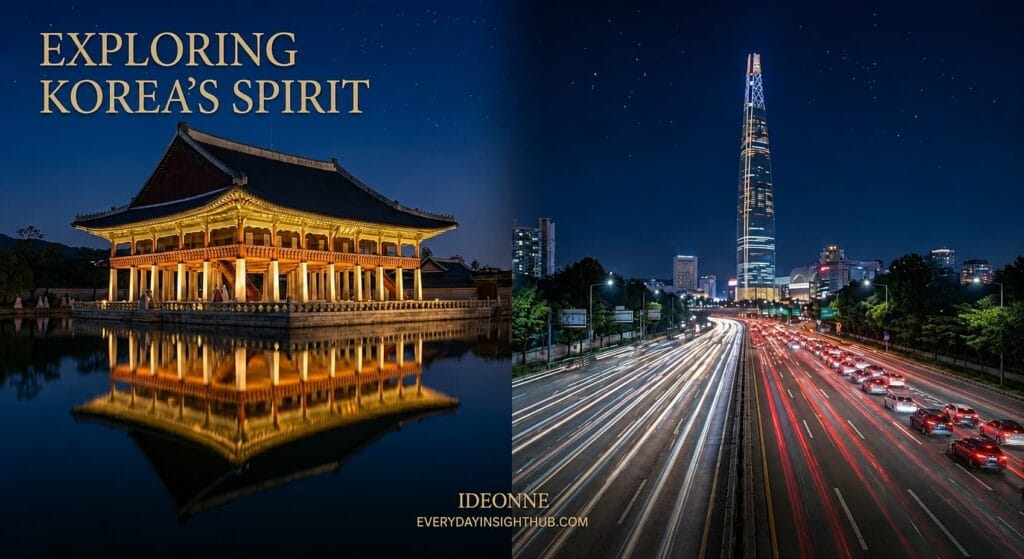
Most people wouldn’t hesitate to answer, “Ppalli! (Hurry!)” And for good reason. South Korea boasts some of the fastest internet speeds on the planet, food arrives at your table before you’ve even settled into your chair, and online orders reliably appear on your doorstep by dawn the next morning. It is entirely fair that the world remembers Korea as the kingdom of the ppalli-ppalli (hurry-hurry) culture.
Yet, spend just a few days living here, and you will inevitably encounter another, far gentler phrase with surprising frequency. Whether you are gingerly navigating a steep flight of subway stairs, taking your first cautious sip of scalding hot soup, dragging a heavy suitcase across a crowded station, or fumbling through something entirely new for the very first time, someone nearby will look at you with quiet warmth and say:
“Cheon-cheon-hi haseyo.” (Take your time.)
This small, recurring encounter tends to leave newcomers gently bewildered. Why is it that while the world around me hums with such dizzying speed, the people within it keep telling me to slow down? Perhaps because Koreans intuitively draw a line between accelerating a mechanical system and preserving the human pulse.
🎯 Today’s Expression
천천히 하세요 (Cheon-cheon-hi haseyo)
💡 Meaning
- Take your time. / No rush. / Slowly is fine.
- While literally translating to “Please do it slowly,” in daily life it operates as a warm cushion of reassurance: “Don’t rush yourself,” “There’s no need to hurry,” and “Make yourself comfortable.”
🗣️ Pronunciation Tip
- Don’t clip the words cheon-cheon-hi and haseyo apart like a textbook robot. Let them flow into each other naturally. Most importantly, soften the very first syllable—let go of any rigid tension in your jaw and breathe it out gently. That is where the native warmth lives.
🏙️ Real-life Encounters
- 🍜 At a restaurant“It’s hot, so take your time eating.”
- ☕ At a cafe“No rush at all. Look over the menu and take your time.”
- 🚪 In front of the elevator“No need to run. Take your time coming.”
- 🏥 At a hospital“Your leg must still be sore. Don’t push yourself, just walk slowly.”
🌿 Culture Note
Of course, telling someone who is struggling to take a breath isn’t exclusive to Korea. Across every culture on earth, people instinctively urge those they care about—or welcome as guests—not to rush.
What makes the Korean experience distinct, however, is how thoroughly “cheon-cheon-hi haseyo” weaves itself into the quiet hum of everyday life. You hear it in diners, traditional markets, subway stations, hiking trails, and even amidst the frantic choreography of convenience store counters.
It is a linguistic habit that stretches far beyond simple pacing. It carries a silent, unspoken vow: “It is completely fine if you make a mistake,” “Protecting yourself matters more,” and “Your rhythm is respected here.”
🎬 A Tuscan on Bukhansan: Marco’s Lesson in Slowness
Marco, a chef from Florence, learned this paradox of Korean speed firsthand during his early months in Seoul.
One afternoon, he ducked into a cramped, timeworn alleyway noodle shop. A steaming bowl of handmade kalguksu arrived, the broth still bubbling furiously in its earthenware pot. Blinded by a fierce hunger, Marco plunged his chopsticks in, scooped up a massive, smoking clump of noodles, and shoved them straight into his mouth.
The result was immediate disaster. With a sharp gasp of pain, he scorched the roof of his mouth and coughed violently. Without missing a beat, the elderly owner stepped out from behind the counter, beaming a broad, sympathetic smile as she slid a tall glass of ice-cold water across the table.
“Son, it’s boiling hot—eat slowly!”
A few days later, Marco found himself browsing through a quiet antique teashop in Insadong, gingerly handling a paper-thin celadon tea bowl. Terrified that a single twitch might shatter it, he held his breath and froze his fingers in place. Seeing his tension, the white-haired shopkeeper walked over, chuckled softly, and waved a reassuring hand.
“Relax. Even if you drop it, I won’t mind. Just take your time looking.”
The defining moment, though, came on a weekend hike up Bukhansan Mountain. Lungs burning and chest heaving on a steep granite staircase, Marco collapsed onto a boulder, wheezing for air. An elderly Korean man, clad in comfortable hiking gear, glanced back as he passed, paused for a moment, and offered a warm, crinkly-eyed grin.
“The mountain isn’t going anywhere, young man. Catch your breath and come up slowly.”
Before boarding his flight home, Marco jotted a final line into his journal: “Korea is a country driven by the fastest machines on earth, yet the phrase I heard more than any other was simply: Take your time.”
🔍 Linguistic Discovery: The Dual Rhythms of Speed and Temperature
The Korean language lives in the tension between two sharp, contrasting adverbs: ppalli (fast) and cheon-cheon-hi (slow). If you watch closely, how Koreans distribute these two words reveals a fascinating cultural rhythm.
When dealing with cold infrastructure—super-fast internet, lightning-quick delivery logistics, subways that run with metronomic precision—efficiency demands ppalli. But the moment the encounter shifts to flesh and blood—to human beings—the gears instantly shift. People are met with “Cheon-cheon-hi haseyo.”
Perhaps this explains why travelers navigating Korea’s relentless momentum so often find their anxieties melting away at the sound of an unexpected, unhurried human voice.
🥄 A Spoonful of Culture
Korea has an old saying: “The more desperate you are, the longer way around you should take.” This unique philosophy shows how korean culture slow down moments can balance out the pressure. It captures a profound truth—that when urgency presses down on you, forcing a frantic sprint usually leads you astray, whereas pausing to catch your breath remains a quiet wisdom.
When Koreans say “cheon-cheon-hi haseyo,” they aren’t just giving instructions on velocity. They are offering a subtle form of hospitality: “In this exact moment, your safety and your peace of mind matter more than any destination.”
🎯 Challenge for Today
Today, if you notice someone around you rushing, tangled in nervous tension or weighed down by haste, try offering them this simple gift:
“It’s okay. Take your time.”
Miraculously, those few syllables do more than just slow a person’s physical stride—they uncoil the tight spring inside their chest.
Perhaps the grace of daily life in Korea isn’t found in a society that pushes forward relentlessly, but rather in the quiet, stubborn patience with which people have always learned to wait for one another.
🔗
- 💼 Curious about other unique everyday expressions? Check out “Sugohaseotseumnida”: Why Do Koreans Say This When Leaving Work? to explore the deep appreciation behind Korea’s favorite workplace farewell.
- ✋ Discover how a tiny phrase can bridge connections in “Jamkkanmanyo”: The Smallest Word That Opens a Human Heart to see how patience and politeness shape daily interactions in Korea.