Sometimes, the memories that linger longest from a journey have very little to do with grand monuments or famous tourist sites. Instead, they cling to smaller, quieter moments—a chance phrase spoken in a narrow alleyway café, or a parting word tossed over a shoulder in a neighborhood shop. If you read travel logs written by foreigners who have spent time exploring Korean etiquette daeume tto bwaeyo, a remarkably similar scene surfaces again and again.
You finish paying for a meal at a local restaurant, settle your bill at a small neighborhood hair salon, or pick up a single book at an independent bookstore, and turn toward the door. As you step out, the clerk smiles—not with mechanical retail polish, but with genuine brightness—and offers a parting phrase.
“Da-eum-e tto bwaeyo (다음에 또 봬요).”
For a newcomer, this moment often brings a quiet, fleeting pause of amusement. Did I just sign up for something? I’m leaving this neighborhood forever, and I might not even be in this country next week—why are they talking about seeing me again?
Yet, after a few days of wandering through Korea, you hear this phrase so often that your curiosity naturally deepens. Is it just a casual linguistic reflex, or do they genuinely expect our paths to cross twice?
The truth is that this simple sentence holds a window into how Korean culture views human connection. In Korea, encounters are rarely treated as disposable, one-off transactions. Instead, human relationships are quietly imagined as threads that can always be picked back up. Even at the exact moment of parting, rather than emphasizing a firm and final end, the language naturally reaches forward toward a future possibility.
💡 Today’s Expression
🗣️ Da-eum-e tto bwaeyo (다음에 또 봬요)
- Meaning: See you again. / Hope to see you next time.
- The Nuance of the Word: If translated with rigid, literal precision, it sounds like a concrete calendar commitment—“Let’s meet each other again next time.” But its everyday emotional temperature is entirely different. It acts less like a schedule-bound promise and more like a soft, lingering sentiment: “It was genuinely wonderful meeting you today,” and “I hope the invisible thread between us doesn’t snap just because we’re walking out the door.”
🎶 The Rhythm and Tone in Conversation
If you listen to native speakers conversing on the street, da-eum-e tto bwaeyo rarely drops from the tongue like a strict grammar textbook exercise. Instead, it flows together naturally, sounding closer to da-eume tto bwaeyo.
The key lies in the word bwaeyo, which is the contracted form of boe-eoyo. It is thoughtful not to substitute it with the casual bwayo (let’s see) when writing or speaking politely, keeping the subtle, respectful polish intact. When delivered with a slight lift at the end of the sentence and a warm, unhurried smile, it transforms a routine goodbye into an act of quiet grace.
📝 Daily Dialogues
Where will you encounter this rhythm out in the world?
- At a local neighborhood restaurant after a meal:“Eumsik jeongmal masitge jal meogeotseumnida.” “The food was truly delicious.” “Gamsahamnida. Josimhi gasigo da-eum-e tto bwaeyo!” “Thank you. Get home safely, and see you again next time!“
- After a haircut at a local salon:“Oneul seutail-i mam-e sseuk deuneyo. Gobaenhasseoyo.” “I really love how my hair turned out today. Thank you for your hard work.” “Mam-e deusinani dahaeng-ieyo. Da-eum-e tto bwaeyo!” “I’m so glad you like it. See you again next time!“
- Leaving the office elevator with a coworker:“Oneul yageun-gaji gosaeng man-eusyeotseoyo. Meonjeo deureogagesseumnida.” “You worked so late today. I’m going to head out first.” “Ne, josimhi deureogayo. Naeil hoesa-eseo tto bwaeyo!” “Alright, get home safely. See you again at the office tomorrow!“
- Parting ways with a friend after a long chat:“Oneul jeongmal jeulgeowosseo.” “I had such a wonderful time today.” “Nado. Jomangan sigan namyeon tto bwaeyo!” “Me too. Let’s meet up again whenever we have free time!”
🌍 Culture Note: A Future-Tense Farewell
Every culture has its own linguistic rituals for departure—the English “See you,” the French “À bientôt.” Yet, the Korean da-eum-e tto bwaeyo carries a fundamentally different emotional current.
This expression is not a calculated prediction based on logistics or probability. It stems from a shared emotional baseline: Even if our paths never cross again after today, I want the time we spent sharing this space to feel like a welcome chapter rather than a closed book.
In a society where even brief encounters with strangers are softened by mutual courtesy, parting ways is rarely treated as a sharp severance. Instead, it is softened by a cultural instinct that prefers to leave doors unlocked rather than bolted shut.
✨ A Snapshot from the Alleyways: Emily’s Busan Cookie Shop Reunion
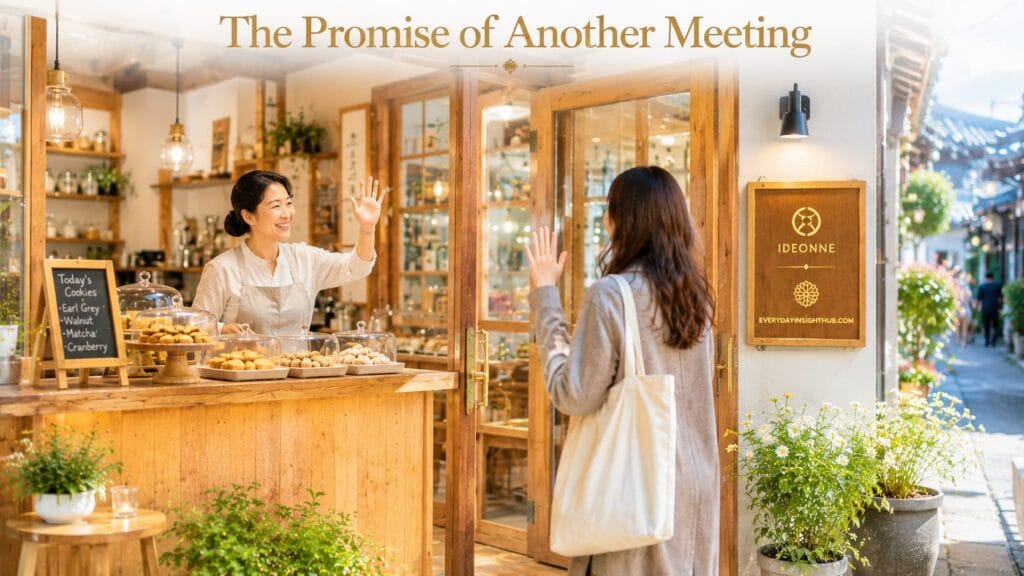
Emily, an elementary school teacher from Auckland, New Zealand, found herself wandering through a quiet neighborhood in Busan during a solo trip. Tucked away in a narrow alley was a tiny artisan cookie shop, filling the damp air with the rich, buttery scent of freshly baked pastry.
As she paid for a small box of treats and turned to pull open the glass door, the owner didn’t offer the detached, robotic nod of a corporate clerk. Instead, she looked up with absolute sincerity and spoke clearly:
“Gamsahamnida. Da-eum-e tto bwaeyo!” (Thank you. See you again next time!)
Walking back out into the cool street air, Emily smiled to herself. I’m flying all the way back to New Zealand the day after tomorrow. I am quite literally never coming back to this exact block.
Yet, for reasons she couldn’t entirely explain, those parting words stayed with her. They bounced quietly around her mind throughout the long, grueling flight home, leaving a faint, comforting warmth in their wake.
A full year later, fate brought Emily back to Korea for another vacation, and she found herself wandering down that exact same Busan alleyway. Half-joking to herself, she pushed open the door. The shop looked identical, wrapped in the exact same sweet aroma. Naturally, amidst the steady stream of travelers who passed through her doors every day, the owner had no reason to remember a random foreign tourist from twelve months prior.
The owner greeted her with a bright, familiar smile: “Eoseo oseyo!” (Welcome!)
With her heart fluttering slightly against her ribs, Emily selected a few cookies and set them on the counter. She looked up and spoke softly: “You know… I was actually here last year.”
The owner blinked, her eyes widening in surprise before softening into a delighted grin. “Oh, really? You’ve come back to visit us!”
Emily smiled back, leaning slightly over the glass counter. “Yes. When I walked out the door last year, you told me, ‘Da-eum-e tto bwaeyo.’ That phrase stayed with me the whole year, and I knew I had to come back.”
The owner let out a warm, joyful laugh that echoed off the tiled walls. “Well, look at that—you actually remembered!”
That evening, sitting cross-legged on her guesthouse bed, Emily opened the digital notes app on her phone and tapped out a few quiet lines:
In Korea, a casual goodbye is never truly just an end. It is a gentle bridge built across the unknown—a quiet promise that even a fleeting stranger’s presence mattered.
🔍 Discovering the Korean Language: Why Do We Speak Toward Tomorrow?
Foreign language learners often experience a quiet marvel when examining the sheer variety of Korean parting phrases. Depending on the relationship and the context, you might wish someone safety (“Annyeonghi gaseyo”), urge them to take care on the road (“Josimhi deureogaseyo”), or explicitly look toward tomorrow (“Da-eum-e tto bwaeyo”).
While many Western partings focus on clearing the air and making a clean, independent break for the exit, Korean farewells frequently tether the two speakers to one another just a fraction longer. By leaning into the idea of a future meeting, the language cushions the natural friction of separation. The subtext is clear: our connection takes precedence over the immediate convenience of a final cutoff.
☕ A Spoonful of Korean Culture
There is a well-known Korean proverb that says, “Even the brushing of sleeves against another person is born of a past connection (옷깃만 스쳐도 인연이다).” It suggests that bumping shoulders with a stranger on a crowded street is never entirely accidental; it carries the weight of a quiet, unseen destiny.
If a brush of the shoulder holds such poetic significance, then an afternoon spent sharing a meal, browsing a shop, or exchanging polite smiles carries even deeper meaning. Even if statistical reality dictates that you will likely never see that person again, the act of wishing them a future reunion transforms a routine parting into a moment of pure human goodwill.
🎯 Today’s Small Mission
Today, take a quiet moment by yourself—perhaps standing in front of the mirror, or simply inside the quiet sanctuary of your own thoughts—and say the phrase softly with a gentle, relaxed smile:
“Da-eum-e tto bwaeyo.”
Tonight, as you watch a Korean drama or film, pay close attention when characters begin to part ways. You will likely start noticing how effortlessly and tenderly this phrase anchors their goodbyes.
Language is never merely an operational tool for trading information. The moment you begin to feel the quiet emotional architecture hidden inside a single parting phrase, words stop being a mechanical study task—they transform into a comforting companion that adds depth, texture, and genuine warmth to everyday life.
🔗🔗
📚 Continue Your Korean Culture Journey
- ☕ Next Step in Learning: Want to explore more everyday expressions that capture the warmth of human connection? Read our previous guide on Learning Korean Culture Through Language: Eoseo Oseyo.
- 🎨 Explore More: Dive deeper into the nuances of daily life and social etiquette with our post on Mastering Essential Korean Etiquette and Greetings.