✈️ Prologue: Language Is Not Memorization, But a Door to Meeting People
The fastest way to learn a new language is not by endlessly memorizing vocabulary, but by first picking up the expressions you actually use the most. When you dive into essential Korean etiquette for beginners, you quickly realize that Korean is no different. Whether you are traveling, studying abroad, or starting a new chapter of your life in Korea, certain phrases will greet you over and over again, multiple times a day.
In this series, we will explore 100 essential expressions that native Koreans use in everyday life, woven into natural and engaging situations. Rather than blindly committing sentences to memory, we will look into why Koreans speak the way they do, discovering the cultural nuances woven right into their words. Language is, after all, much more than a tool for communication—it is the most tender window through which we can glimpse one another’s hearts.
Shall we take our very first step into this journey with a light and fluttering heart?
🧳 Part 1: First Encounters in Korean at Incheon Airport
For anyone visiting Korea, one of the places that lingers longest in memory is undoubtedly Incheon International Airport. The moment the aircraft door slides open and you follow the arrival signs down the corridor, your very first conversation in Korea begins.
Feeling a bit nervous? Don’t worry. Surprisingly, that first exchange is rarely complicated; it consists mostly of short, effortless phrases. Yet, the moment you let those few words slip past your lips, the tense air gives way to comfort, and Korea feels instantly, warmly close.
Today, we will look at five core expressions that work like magic during the opening scene of your Korean journey.
🎯 Essential Expressions (Top 5)
① 안녕하세요 (Annyeonghaseyo). — The warmest beginning of a greeting.
② 여권입니다 (Yeogwon-imnida). — The essential phrase for immigration.
③ 한국에 처음 왔어요 (Hanguk-e cheoeum wasseoyo). — A confession carrying your quiet excitement.
④ 감사합니다 (Gamsahamnida). — A heart that shares gratitude.
⑤ 잘 부탁드립니다 (Jal butakdeurimnida). — Magic words that open the door to a good connection.
🗣️ Tune Your Ears: Lively Pronunciation Tips
If you read the letters strictly as they are printed on the page, they might sound a bit stiff. Let’s peek at how native speakers actually shape these sounds in real life:
- 안녕하세요 →
Annyeonghase-yo(If you gently lift the pitch of the final syllable ‘yo’, it sounds much more affectionate.) - 여권입니다 →
Yeogwon-imnida(The final consonant ‘n’ of the first word flows seamlessly into the next, blending smoothly together.) - 처음 왔어요 →
Cheoeum wasseoyo(In actual conversation, the ‘was’ hardens naturally with a subtle bounce.) - 감사합니다 →
Gamsahamnida(The ‘h’ and ‘b’ meet to create a soft, nasal humming sound on ‘ham’.) - 잘 부탁드립니다 →
Jal butakdeurimnida(Don’t rush or cram it. The secret is letting the words melt gently into one another.)
💬 Stepping into Real Conversation
Let’s do a light simulation for that slightly nerve-wracking moment at immigration control:
Immigration Officer: 안녕하세요 (Hello).
Traveler: 안녕하세요 (Hello). 😄
Immigration Officer: 여권 부탁드립니다 (Passport, please).
Traveler: 네, 여기 있습니다 (Yes, here it is).
Immigration Officer: 한국에 처음 오셨나요 (Is this your first time in Korea)?
Traveler: 네, 한국에 처음 왔어요 (Yes, it’s my first time here)!
Immigration Officer: 한국에서 좋은 시간 보내시길 바랍니다 (I hope you have a wonderful time in Korea).
Traveler: 감사합니다 (Thank you). ✨
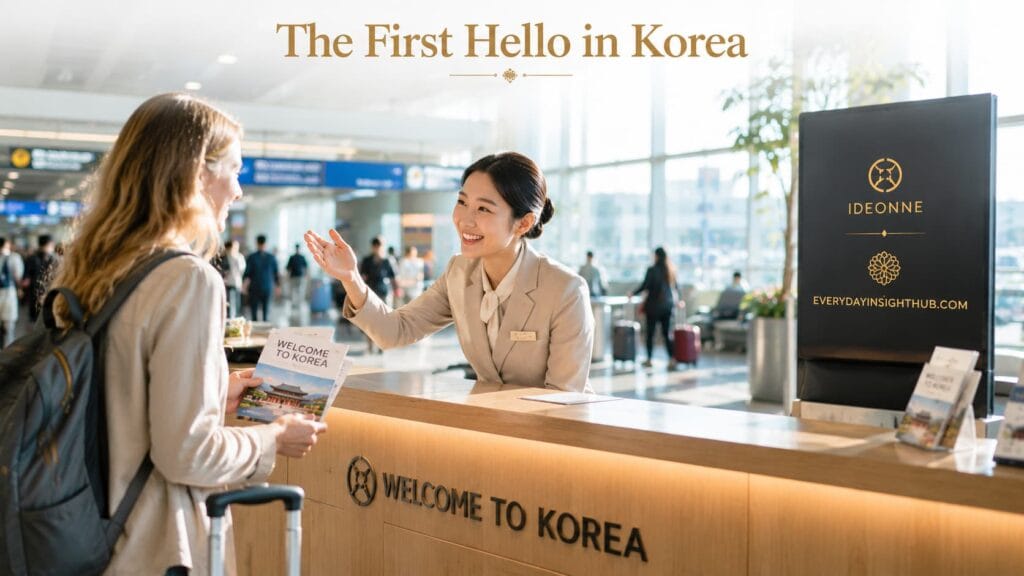
A little while later, having safely collected their luggage, the traveler heads toward the airport information desk.
Staff Member: 안녕하세요! 무엇을 도와드릴까요 (Hello! How can I help you)?
Traveler: Um… 서울역에 가려면 어떻게 가야 하나요 (How do I get to Seoul Station)?
(The kind staff member carefully explains the airport railroad routes and directions.)
Traveler: 정말 감사합니다 (Thank you so much)!
Staff Member: (With a warm smile) 즐거운 여행 되세요 (Have a wonderful trip)!
Traveler: 네, 잘 부탁드립니다 (I’ll be in your good care) 😊
🏮 Today’s Cultural Story: The True Meaning of “잘 부탁드립니다”
One phrase that foreign learners often tilt their heads at is “잘 부탁드립니다 (Jal butakdeurimnida).” That’s largely because English doesn’t have an exact equivalent. While it is often awkwardly translated as “Please take good care of me,” its true resonance is much wider and richer.
- When greeting someone for the first time → “I hope we can build a wonderful relationship moving forward.”
- In a workspace or collaborative setting → “I’m looking forward to working well together.”
- When asking for someone’s guidance → “I appreciate your patience and help as I find my footing.”
What’s fascinating is that this phrase is never meant to burden the listener. Instead, it is a modest, considerate Korean greeting born from the desire to say, “I hope we can start a warm connection.” That is why Koreans use this expression so naturally whenever a new chapter or relationship begins.
⚠️ Common Traps for Travelers
- Overusing “Gamsahamnida” for Everything “Thank you” is, without a doubt, a wonderful phrase. But in Korea, naturally blending “Annyeonghaseyo” (Hello), “Gamsahamnida” (Thank you), and “Jal butakdeurimnida” to match the moment creates a much warmer and more refined impression.
- Freezing Up from Over-Nervousness We often practice “This is my first time in Korea” hundreds of times in our heads, only to freeze the moment someone looks at us. It is completely okay to speak slowly and a bit clumsily. In fact, when you speak with unhurried sincerity, Koreans are more than happy to meet you halfway with an open heart.
🎁 Bonus Expressions to Keep in Your Pocket
Three magical phrases that will instantly clear your path at the airport and make your first day infinitely smoother:
- 네 (Ne): A clear, confident “Yes.”
- 잠시만요 (Jamsimanyo): When you need a brief moment to think or catch your breath.
- 죄송합니다 (Joesonghamnida): A polite, smile-backed apology when catching someone’s attention or making a small mistake.
✍️ Today’s Review Quiz
The five sentences we learned today are like little treasures you will reach for first and most often during your time in Korea. Shall we read them out loud together one last time?
- 안녕하세요 (Annyeonghaseyo).
- 여권입니다 (Yeogwon-imnida).
- 한국에 처음 왔어요 (Hanguk-e cheoeum wasseoyo).
- 감사합니다 (Gamsahamnida).
- 잘 부탁드립니다 (Jal butakdeurimnida).
If you can let these five sentences roll off your tongue with a little bit of comfort, you are well on your way to opening the door to your new journey in Korea!
🚀 Coming Up Next
In Part 2, we will step out of the airport together and dive into five essential expressions you’ll find helpful when riding the airport railroad and the subway. As you gather these phrases one by one, you’ll find that Korean is no longer a challenging puzzle to be memorized, but a living, breathing language that connects you heart-to-heart with the people around you. See you in the next chapter!
📚 Continue Your Cultural Journey
- ☕ Previous Insight: Want to explore how everyday language shapes warm connections? Read our guide on Learning Korean Culture Through Language: Da-eum-e tto bwaeyo.
- 🎨 Explore More: Discover the deeper nuances of daily life and social manners with our post on Mastering Essential Korean Etiquette and Greetings.