🏪 Part 4. The Convenience Store: Your Everyday Oasis in Korea 🍙
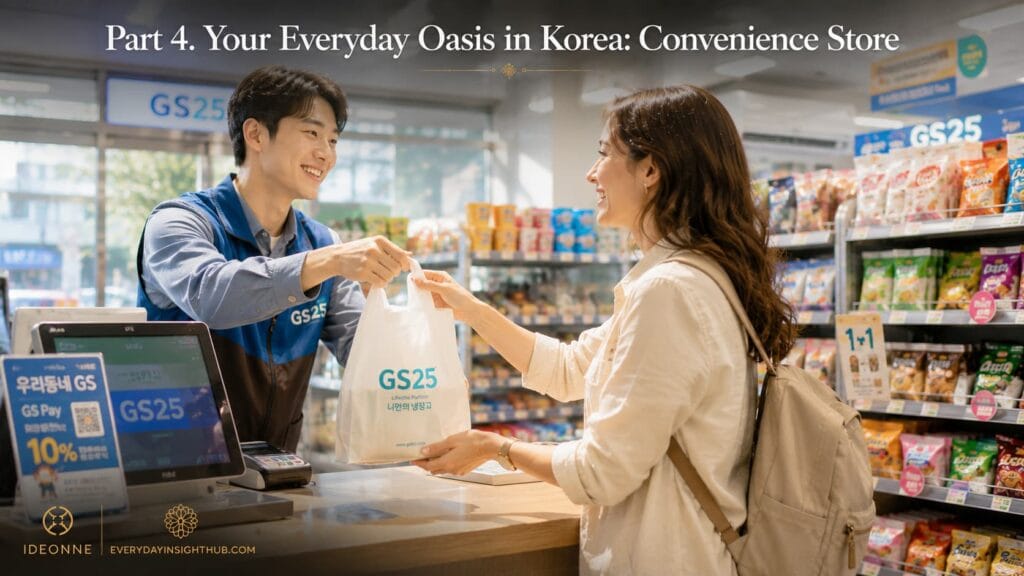
If there is one place you will find yourself stepping into most frequently while figuring out how to use convenience stores in Korea, it is the neighborhood convenience store (pyeon-ui-jeom). Whether you are craving a warm cup of ramen late at night, suddenly needing a mobile charger, or simply looking for a cold bottle of water, a convenience store is always just around the corner.
In Korea, these shops are far more than mere retail stores; they are cozy resting spots for travelers. You can easily watch people paying for items, warming up meals in microwaves, sending parcel deliveries, or resting for a moment at a window-side counter. Mastering just a few essential expressions here will make your journey through Korea instantly smoother and more comfortable. Today, let us dive into the top five phrases you will use most often.
🎯 Top 5 Essential Expressions
① 이거 주세요. (Please give me this.)
② 봉투 주세요. (Please give me a bag.)
③ 카드로 계산할게요. (I will pay by card.)
④ 전자레인지 사용해도 될까요? (May I use the microwave?)
⑤ 영수증 주세요. (Please give me the receipt.)
🗣️ Phonetic Guide: Breathing Life into the Sounds
- 이거 주세요
- Pronounced:
i-geo ju-se-yo - Note: Speak it gently and evenly; a relaxed, natural cadence makes this most inviting.
- Pronounced:
- 봉투 주세요
- Pronounced:
bong-tu ju-se-yo - Note: Articulate the initial consonant sound of
bongclearly.
- Pronounced:
- 카드로 계산할게요
- Pronounced:
ka-deu-ro gye-san-hal-ge-yo - Note: In casual, everyday speech, the ending
-halgeyooften blends smoothly into a soft rhythm.
- Pronounced:
- 전자레인지 사용해도 될까요?
- Pronounced:
jeon-ja-rae-in-ji sa-yong-hae-do doel-kka-yo? - Note: Though it is a slightly longer sentence, saying it slowly and smoothly makes it completely clear.
- Pronounced:
- 영수증 주세요
- Pronounced:
yeong-su-jeung ju-se-yo - Note: Pronounce each syllable with a clean, light finish.
- Pronounced:
💬 Real-World Dialogue Sketch
Inside a neighborhood convenience store.
Staff: 안녕하세요. 어서 오세요. (an-nyeong-ha-se-yo. eo-seo o-se-yo.)
Staff: 안녕하세요. (an-nyeong-ha-se-yo.)
(The traveler steps up to the counter with a bottle of water and a triangle kimbap.)
Traveler: 이거 주세요. (i-geo ju-se-yo.)
Staff: 네, 모두 4,300원입니다. (ne, mo-du sa-cheon-sam-baek-won-im-ni-da.)
Traveler: 카드로 계산할게요. (ka-deu-ro gye-san-hal-ge-yo.)
(After payment is complete.)
Staff: 봉투 필요하세요? (bong-tu pil-yo-ha-se-yo?)
Traveler: 네, 봉투 주세요. (ne, bong-tu ju-se-yo.)
(A moment later, the traveler returns to the counter holding a cup of ramen.)
Traveler: 전자레인지 사용해도 될까요? (jeon-ja-rae-in-ji sa-yong-hae-do doel-kka-yo?)
Staff: 네, 물론입니다. (ne, mul-ron-im-ni-da.)
(After finishing their meal.)
Traveler: 영수증 주세요. (yeong-su-jeung ju-se-yo.)
Staff: 네, 여기 있습니다. (ne, yeo-gi i-sseum-ni-da.)
Traveler: 감사합니다. (gam-sah-ham-ni-da.)
Staff: 좋은 하루 보내세요. (jo-eun ha-ru bo-nae-se-yo.) ✨
🏮 Cultural Note: The Heartbeat of Korean Convenience Stores
Convenience stores in Korea frequently astonish international travelers. Open 24 hours a day, they offer everything from light meals to everyday necessities. Many locations even feature built-in dining spaces equipped with hot water dispensers, allowing customers to cook and enjoy their instant ramen right inside the shop.
Another interesting nuance is that cashiers will often ask, “Do you need a bag?” (“봉투 필요하세요?”). This practice reflects local environmental policies and everyday habits aimed at reducing single-use plastics. If you need a bag, simply say, “Yes, please give me a bag” (“네, 봉투 주세요”). If not, you can reply with “It’s okay” (“괜찮습니다”) or “You don’t need to give me one” (“안 주셔도 됩니다”). It is a small interaction, but one that offers a glimpse into everyday ecological mindfulness in Korea.
⚠️ Common Pitfalls and Travel Tips
- The Habit of Pointing and Saying “This One”Many travelers fall into the habit of pointing at an item and saying “This one!” or just blurting out the item’s name. While the meaning usually gets across, using a complete, polite phrase like “Please give me this” (
이거 주세요) changes the atmosphere entirely. It is a short, magical phrase that works in almost any shop across the country. - Standing in Silence After PaymentAnother common habit is standing in silence after a transaction wraps up. In Korea, offering a warm “Thank you” (
감사합니다) as you finish paying often prompts the cashier to warmly respond with “Thank you” or “Have a wonderful day” (좋은 하루 보내세요). It is a brief exchange of kindness that brightens both people’s day.
🎁 Bonus Expressions to Keep Close
Beyond the core five, here are three high-utility phrases that are exceptionally useful in convenience stores:
- 🔥 따뜻하게 데워 주세요. (ttat-teut-ha-ge de-wo ju-se-yo) – Please warm this up for me. (Very handy when buying lunch boxes or burgers!)
- 💳 현금도 되나요? (hyeong-geum-do doe-na-yo) – Do you take cash as well?
- 📍 물은 어디에 있어요? (mu-reun eo-di-e iss-eo-yo) – Where is the water?
📝 Today’s Review Quiz
Let us read our five essential convenience store expressions aloud one final time, letting them settle quietly into your memory:
- 이거 주세요.
- 봉투 주세요.
- 카드로 계산할게요.
- 전자레인지 사용해도 될까요?
- 영수증 주세요.
Hesitating slightly before speaking up at a counter for the first time is entirely natural. Yet the moment you utter that short, polite phrase, “Please give me this” (이거 주세요), you cease to be a mere observer. You step gently into the living rhythm of everyday life in Korea. Language is rarely about flawless perfection; it begins with a small spark of courage.
🚀 Coming Up Next
In Part 5, we step into one of the greatest joys of traveling in Korea—the vibrant local cafe culture—to learn five essential conversational phrases for ordering your favorite drinks with ease. Until then, keep these expressions close at heart.