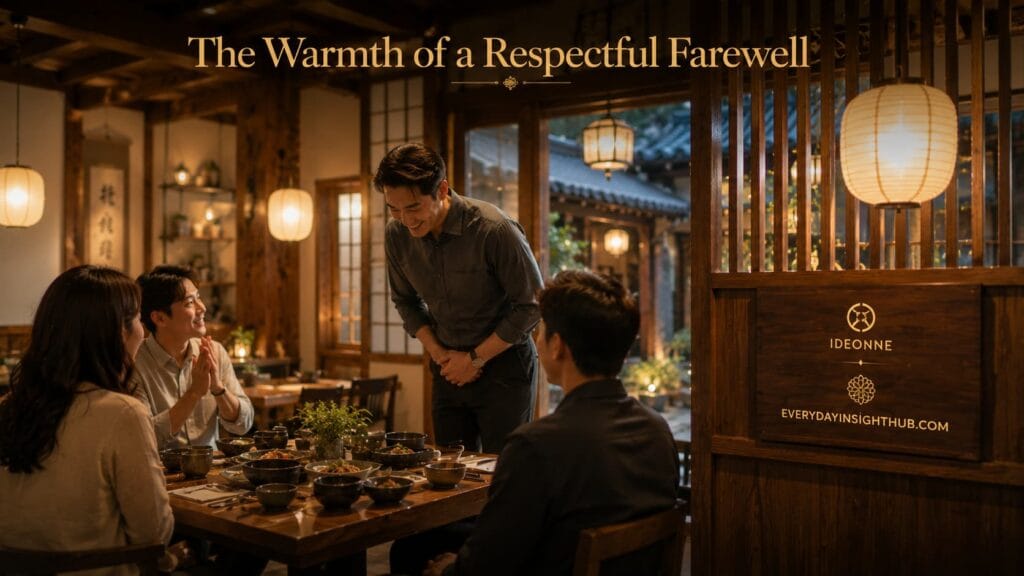
If you spend enough time watching Korean films or dramas, you inevitably encounter a peculiar, quiet choreography. A meeting is in full swing, or a lively dinner conversation is flowing effortlessly around a sizzling table. Suddenly, someone glances down at their watch. The hour has arrived. They quietly gather their things, stand up, and offer a polite bow to the room.
“Meonjeo sillyehagesseumnida (먼저 실례하겠습니다).”
For newcomers to Korea, this moment often brings a gentle pause of confusion. Did someone just step on someone else’s toes? Did a grave social misstep just occur right before our eyes?
Yet, what happens next is even more striking. No one looks offended or tries to block the exit. Instead, the faces around the table soften into warm, reassuring smiles.
“Yes, have a safe trip home.”
In truth, saying meonjeo sillyehagesseumnida is not an admission of guilt or wrongdoing. Rather, it is a graceful, deeply considerate way of announcing that one must step away from the group ahead of the others. When Koreans part ways, they have an instinctive habit of putting the feelings of the people remaining behind ahead of their own schedules. Consequently, this phrase functions less as a heavy apology and more as a tender expression of respect.
💡 Today’s Expression
🗣️ Meonjeo sillyehagesseumnida (먼저 실례하겠습니다)
- Meaning: Excuse me, I’ll leave first. / Please excuse me for leaving before you.
- The Nuance of the Word: If you break it down strictly by its dictionary parts, it translates awkwardly to something like, “I will commit a rudeness first.” To a newcomer, hearing that can feel momentarily startling. But in everyday life, its true heart is entirely different. It whispers, “I’m so sorry to break away early,” and “Please forgive me for leaving this wonderful circle before it’s over.” It is a masterclass in social grace.
🎶 The Rhythm and Tone in Conversation
If you listen closely to native speakers, meonjeo sillyehagesseumnida rarely drops from the lips as a rigid, clinical checklist of syllables. Instead, it glides naturally, often softening into a smooth, conversational breath.
The secret is not to pronounce every single syllable like a marching band drum, but to let the ending flow with a gentle warmth. When opening a meeting room door or standing up from a restaurant booth, a slight nod of the head accompanies the words, turning a routine departure into an act of quiet elegance.
📝 Daily Dialogues
Where will you hear this rhythm in the wild?
- At a company dinner:“Naeil achim iljjik iljeongi isseoseo meonjeo sillyehagesseumnida.” “I have an early schedule tomorrow, so please excuse me as I leave first.” “Of course, get home safely. See you tomorrow!”
- During a business meeting:“Daeum oebu miting sigan-i da doeeo meonjeo sillyehagesseumnida.” “My next outside meeting is coming up, so I’ll take my leave first.” “Understood. Thank you for your hard work today.”
- With friends at a gathering:“Oneul neomu jeulgeowosseumnida. Makcha sigan-i da doeeo meonjeo sillyehagesseumnida.” “I had such a great time today. The last train is approaching, so I must excuse myself.” “Leaving already? It’s a shame, but get home safe!”
- Passing through a crowded public space:“Meonjeo sillyehagesseumnida.” “Excuse me for cutting through.” “Please go ahead.”
🌍 Culture Note: The Gentle Gaze of the One Who Leaves
Every culture has its equivalent of “Excuse me” or pardon, used when carving a path through a crowd or stepping away from a conversation. Yet, the Korean meonjeo sillyehagesseumnida carries an entirely different emotional frequency.
This phrase isn’t a mere get-out-of-jail-free card designed to whisk someone away to their next appointment without friction. It stems from a delicate, communal sensitivity: “By slipping away before the rest of you, I am breaking the shared rhythm of our time together, and for that small disruption, I offer my apologies.”
In a society that prizes shared meals, group harmony, and collective warmth—whether across a barbecue grill, a classroom, or a late-night project room—leaving early can carry a subtle weight. By offering this phrase, the departing person acknowledges the collective bond, and those remaining gladly release them, stitching the tear in the group fabric with a warm send-off. It acts as an emotional cushion, softening the edges of everyday life.
✨ A Snapshot from the Alleyways: Sophie’s Seoul Dinner Journal
Sophie, an interior designer from Vancouver, was experiencing her very first company dinner at a bustling, smoke-filled Korean restaurant in Seoul. The air was thick with the scent of grilled pork belly, laughter echoed off the walls, and a river of lively conversation was flowing between the tables.
Right in the middle of a spirited story, the senior team leader across from her glanced down at his wrist, stood up quietly, and addressed the table with a courteous bow:
“Meonjeo sillyehagesseumnida.”
Sophie froze, her chopsticks hovering mid-air. A moment later, a junior manager on the opposite side repeated the exact same phrase with an apologetic smile.
“Meonjeo sillyehagesseumnida.”
Inside, Sophie’s mind raced. Did someone just commit a massive blunder? Why is everyone apologizing and fleeing the scene like they’ve done something wrong?
That night back at her guesthouse, she lay awake, utterly perplexed.
Two days later, while waiting by the office coffee machine, Sophie finally confessed her confusion to a Korean colleague. “I have to ask… why do people at dinner always sound so apologetic when they leave? Did something go wrong?”
The colleague burst into laughter. “Oh! Not at all. They haven’t done anything wrong. It’s just a polite way of saying, ‘Please excuse me for stepping away from our group early.’ When Koreans leave a gathering while others are still enjoying it, they like to express a bit of mindfulness and respect for the people staying behind.”
Sophie blinked, a quiet understanding dawning on her. It wasn’t an admission of guilt; it was a tender nod that meant, “The time we spent together was so precious, and I genuinely regret having to cut mine short.”
Weeks later, the tables turned. Sophie had an evening commitment and needed to slip away early from a team get-together. Her heart fluttered nervously, but she pushed her chair back, offered a gentle bow, and spoke the words:
“Jeo… meonjeo sillyehagesseumnida!”
Instantly, the faces around her broke into warm, understanding grins. The team leader waved affectionately and replied:
“Sophie, you did great today! Get home safe!”
Sophie realized something profound in that moment. In Korea, even the person walking away extends a hand of warmth back to those who stay, carrying a deep, quiet consideration for everyone at the table.
🔍 Discovering the Korean Language: Why Lean Into Regret?
Foreign language learners often stumble over this phrase with a lingering sense of bewilderment. Why should the person who has to leave early feel sorry? After all, it’s my own life and my own schedule.
In Western contexts, individual schedules reign supreme, and parting ways is usually handled with an upbeat, brisk “I’ve got to run, see you later!”
Conversely, Korean expressions like meonjeo sillyehagesseumnida are woven from a deeply relational fabric. By acknowledging that your departure alters the shared atmosphere, you soften the transition. The underlying message is clear: our connection matters more than my individual convenience. It is a brilliant reminder that language can bridge the invisible gaps between people simply by anticipating their feelings.
☕ A Spoonful of Korean Culture
For generations, Korean culture has embraced the proverb that how a gathering ends matters just as much as how it begins.
Even amidst the hurried pace of modern city life, where keeping up with schedules is a constant race, the simple act of pausing to say meonjeo sillyehagesseumnida before disappearing into the night remains deeply rooted. In return, those left behind offer a comforting blessing for the road: “Get home safely,” “See you tomorrow.”
These brief verbal exchanges are far more than idle noise. They serve as small, invisible bridges across the chilly, isolating currents of modern life, reminding us that we are seen, valued, and connected.
🎯 Today’s Small Mission
Today, take a quiet moment in front of the mirror—or simply within the quiet of your own mind—and say it softly to yourself with a gentle smile:
“Meonjeo sillyehagesseumnida.”
Tonight, as you watch a Korean drama or film, listen closely when characters slip away from a restaurant or a meeting. You will notice how naturally and tenderly this phrase slips from their lips.
Language is never just a tool for exchanging information. The moment you begin to understand the invisible warmth a single phrase creates between two human beings, words cease to be an academic chore and become a comforting companion that adds depth to everyday life.
🔗🔗
📚 Continue Your Korean Culture Journey
- ☕ Next Step in Learning: Want to explore more everyday expressions that capture the warmth of Korean human connection? Read our previous guide on Learning Korean Culture Through Language: Eoseo Oseyo.
- 🎨 Explore More: Dive deeper into the nuances of daily life and social etiquette with our latest post on Mastering Essential Korean Etiquette and Greetings.