🥄 The Moment a Single Phrase Shifts the Room
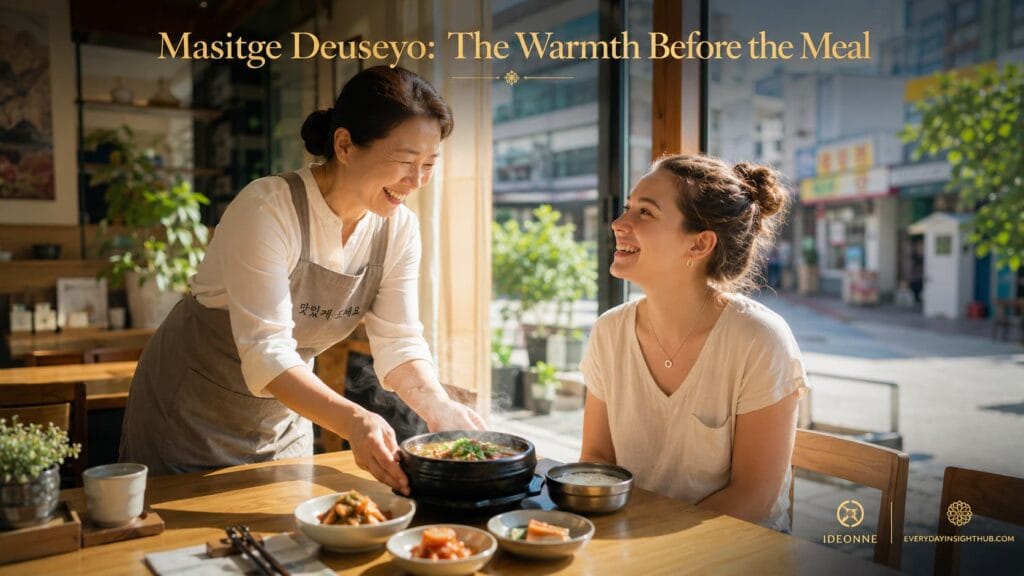
In a narrow, winding alleyway in Seoul, tucked away inside a small restaurant built from a converted old hanok, Maria—visiting Korea for the very first time—sat alone, waiting for her kimchi jjigae. A gentle bubbling sound rose from the table, carrying a rich, spicy aroma that brushed against her senses just as a heavy, steaming earthenware bowl was set down before her.
As she instinctively reached for her chopsticks, the owner leaned in with a soft, genuine smile and murmured,
“Masitge deuseyo.”
Maria froze, her fingers hovering mid-air. Her mind scrambled to translate the words, but something didn’t quite line up.
‘Literally, it means “eat deliciously.” But… why say that? The food is right here. I’m about to eat it anyway.’
Yet hidden beneath those two simple words was something far richer than a mere procedural announcement. It was an unspoken invitation: “I hope your meal brings you genuine comfort,” and “May this quiet moment leave a trace of warmth in your day.”
In Korea, a meal is rarely treated as a mere transaction to refuel the body. It carries the quiet devotion of the person who cooked it and the shared pulse of the people gathered around the table. That is why, on a Korean table, warmth always arrives long before the food itself. Right alongside that single phrase.
🇰🇷 The Core Expression: Masitge deuseyo (맛있게 드세요)
“Masitge deuseyo” is perhaps the most familiar—and the warmest—greeting you will hear in any Korean home or restaurant.
- Masitge (맛있게) = Deliciously, with a sense of gladness and pleasure
- Deuseyo (드세요) = The polite, elevated imperative form of “to eat”
Direct translations like “Enjoy your meal” or “Have a good meal” capture the function, but miss the subtle texture. It isn’t a command to finish your plate; it is a gentle blessing cast over someone else’s time and peace of mind.
💡 The Decisive Line Between “Meogeo” and “Deuseyo”
The Korean language carries a delicate, living web of respect and relational distance.
- Spoken to a close friend or someone younger: “Masitge meogeo.” (맛있게 먹어)
- Spoken to an elder, a guest, or a colleague: “Masitge deuseyo.” (맛있게 드세요)
In choosing one word over the other, you reveal an entire social compass—one built on an inherent awareness of boundaries, care, and mutual regard.
🔊 Pronunciation Note: Why Does “Masitge” Sound Like [Masit-kke]?
One of the first gentle shocks for any learner of Korean is the quiet gap between how a word is spelled and how it actually lives on the tongue.
- On paper: Mas-it-ge (맛 + 있게)
- In the mouth of a native speaker: [Masit-kke]
Korean phonology loves a smooth current, often hardening or blending sounds when consonants meet certain vowels.
- 🍳 Close Cousins:
- Masitda (맛있다) $\rightarrow$ Sounds like [Masit-tta]
- Meositda (멋있다) $\rightarrow$ Sounds like [Meosit-tta]
At first, it feels like stumbling over smooth stones in a stream. But don’t let it trouble you; native speakers glide over these shifts without a second thought. After all, learning a language isn’t just about reading inked letters on a page—it’s about catching the rhythm of breathing lips.
💬 Mastering the Nuance Through Living Contexts
Let’s step into everyday spaces to feel how this phrase actually breathes.
1. At a Restaurant
- The Server: “Here is your kimchi jjigae. Masitge deuseyo!“
- The Guest: “Thank you.”
When a server sets down a bowl, it isn’t an automated script. It is a quiet gesture of hospitality, welcoming a stranger into their space for a brief, shared moment of the day.
2. Around the Family Table
- Mother: “Hey, come on out and eat.”
- Son: “Just one more level of this game!”
- Mother: “It’ll get cold. Come eat while it’s warm. Masitge meogeo.“
Among family or close friends, “masitge meogeo” feels entirely natural. It’s the casual, loving nudge of a parent or an older sibling—steeped in familiarity and affection.
3. Invited to a Korean Home (The Cultural Crescendo)
- The Host’s Mother: “You must have traveled so far to get here. I didn’t make anything fancy, but manhi deuseyo, masitge deuseyo!“
This is the exact moment foreign travelers often feel the pulse of Korean jeong (정, affection/attachment) settle deep into their bones. This isn’t just an invitation to clear your plate. It translates to:
- “I am genuinely overjoyed you’re in my home, so please let go of your shyness and rest easy.” In Korea, feeding someone is often an act of laying a piece of one’s own heart onto the table.
🏮 Cultural Sketch: The Unspoken Grace of “Jeong” and Shared Air
Foreign visitors stepping into a Korean gathering often notice a quiet, subtle grace in how people share a table.
In many Western traditions, a meal is primarily a space for individual culinary appreciation or lively conversation. By contrast, a Korean dining table tends to breathe with a collective awareness—an understated mindfulness that ensures everyone around the table feels included and at ease, without ever feeling crowded or overly watched.
Before lifting a spoon or as a meal comes to a close, it is common to catch someone glancing across the table, offering a soft nod or a fleeting smile. It requires no formal liturgy; it is simply a human acknowledgment whispered across the bowls: “I am glad we are sharing this moment together.”
In this light, a Korean meal stops being a mere physical routine of [food $\rightarrow$ consumption] and transforms into a quiet cycle of [person $\rightarrow$ care $\rightarrow$ food $\rightarrow$ belonging].
🏃♂️ An Everyday Twist: Saying It Even When You Aren’t Eating
There is a charming linguistic detour that often catches language learners off guard: Koreans will regularly use this phrase even when they aren’t sharing the meal with you.
It’s lunchtime at the office. A colleague has to stay behind to finish an urgent errand while you head out. As they rush toward the door, they throw a wave over their shoulder and say,
Colleague: “I’ll head out a bit later!”
You: “Alright, masitge deuseyo!“
‘Wait,’ you might think, ‘they aren’t even eating with me. Why are they worrying about my lunch?’
This is where the unique texture of Korean emotional syntax reveals itself. The care doesn’t lie in the physical act of eating together; it lives in the desire for the other person’s time to be peaceful and unhurried.
The Korean language is rich with these atmospheric kindnesses:
- When parting ways in a rush $\rightarrow$ “Joshimhi gaseyo.” (Go safely.)
- To a tired coworker $\rightarrow$ “Pyeonhi swiseyo.” (Rest comfortably.)
- As a morning unfolds $\rightarrow$ “Joheun haru bonaeseyo.” (Have a good day.)
“Masitge deuseyo” belongs precisely to this family of phrases—expressions designed to gently wrap around another person’s ordinary hours.
⚠️ A Common Misconception
“Is ‘masitge deuseyo’ a critique of how the food tastes?”
Because the root word begins with mas (맛, taste), beginners often assume the phrase is entirely about flavor.
Yet its true magic has little to do with evaluating a recipe and everything to do with shaping the atmosphere of the room. The phrase carries an invisible emotional subtext:
- May your heart be light.
- May your mind settle down.
In that sense, “masitge deuseyo” is less about gastronomy and more about a quiet form of emotional shelter.
📌 One Line to Carry With You
The next time someone sets a steaming plate before you in Korea, offering a gentle smile and saying,
“Masitge deuseyo.”
remember that they are offering far more than a prompt to clear your plate. Hidden inside those syllables is a quiet wish:
“May this brief fragment of your day be filled with quiet warmth and comfort.”
Sometimes, language doesn’t need grand declarations to reach deep; it simply needs a handful of well-chosen syllables to cradle another human being’s day. And that is precisely what you hear in those three words.
Masitge deuseyo.
📝 Core Expression Cheat Sheet
| Expression | English Equivalent | When to Use |
| Masitge deuseyo (맛있게 드세요) | Enjoy your meal | With elders, guests, superiors, or in polite company |
| Masitge meogeo (맛있게 먹어) | Enjoy your food | With close friends, family, or trusted peers |
| Jal meokgesseumnida (잘 먹겠습니다) | Thank you for the meal | Right before beginning to eat |
| Jal meogeotseumnida (잘 먹었습니다) | Thank you for the meal | Right after finishing a meal |
To learn a language is never merely to collect vocabulary like stones on a beach. It is to inherit the rhythms by which a group of people soften the edges of the world. The phrase you learned today—“Masitge deuseyo”—is perhaps one of the gentlest human welcomes we have: a piece of warmth that arrives long before the food ever touches the table.
🔗 Internal Link
🏡 Related Post: “Deul-eo-gaseyo”: Why Do Koreans Tell You to “Go Inside” When You Say Goodbye? →