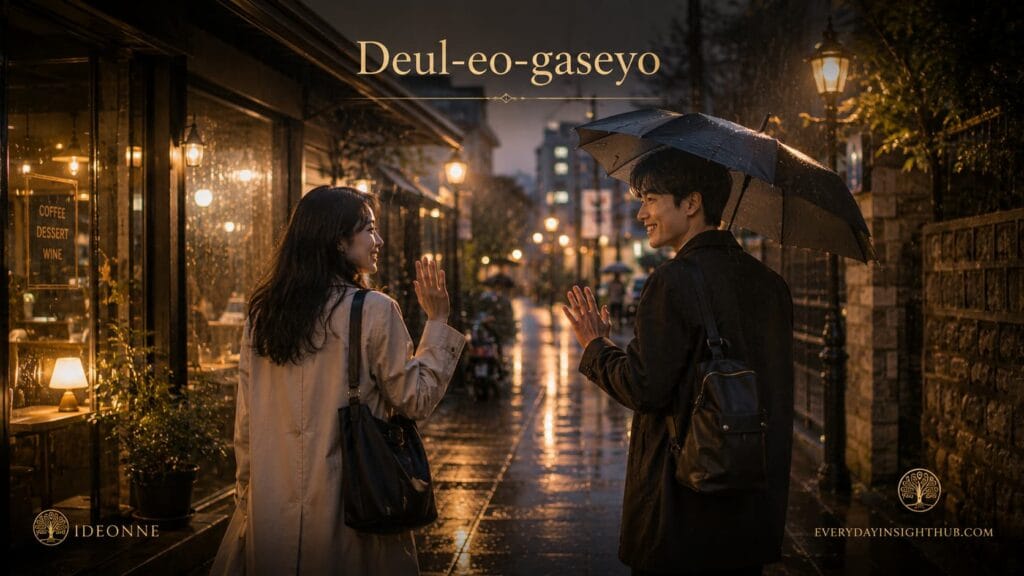
Chloe, a marketing specialist from Paris, found herself in the middle of a cultural puzzle during her second week living in Seoul. At the end of a lively dinner party, as goodbyes filled the air, her team lead flashed a bright smile and offered a warm farewell:
“Chloe, you worked so hard today. Deul-eo-gaseyo!”
As she hopped into a taxi and rolled down the window, her remaining colleagues waved enthusiastically, echoing the same words: “Goodbye! Deul-eo-gaseyo!”
Chloe blinked in quiet confusion. ‘I’m just walking toward the subway station right now,’ she thought. ‘Why are they telling me to go inside a house? I’m not even home yet.’ It felt almost like an urgent order, as if she were expected to sprint straight to her front door immediately.
It wasn’t until a rainy evening three months later—when a friend handed her an umbrella and murmured a gentle, “Get home safely, deul-eo-gaseyo”—that the true weight of the phrase finally clicked. This parting phrase is never a literal command to step indoors. Instead, it is a deeply tender wish for a person’s day to end in comfort and safety, shielding them even after the parting handshake has ended.
When Koreans say “Deul-eo-gaseyo,” they are not merely closing a conversation. They are offering a quiet blessing that your journey home will be peaceful and protected.
💡 The Layered Soul of “Deul-eo-gaseyo”
Every language has its own way of wrapping up an encounter. Most global farewells focus on the present moment or a future meeting—Goodbye, See you later, or Have a nice evening.
In contrast, the Korean phrase “Deul-eo-gaseyo” lifts its gaze away from the immediate street corner and looks ahead to your future trajectory.
- Beyond Physical Walls: Even though you might be standing on a bustling concrete sidewalk or waiting at a crowded subway platform, the speaker’s heart walks with you, hoping you will reach your ultimate sanctuary safely.
- The Sanctuary of Rest: To “go inside” (deul-eo-gada) carries a deeper emotional resonance. It evokes the moment you finally shed the armor of the outside world, cross the threshold of your personal space, and let your spirit exhale.
This is why you hear it everywhere—exchanged between office coworkers, whispered among friends, and even spoken by a taxi driver as you step out into the evening mist. It reaches far beyond a standard polite greeting, wrapping the listener in a blanket of unpretentious care.
🎬 Real-Life Portraits: An Architect’s Awakening in Amsterdam
Elias, an architect from Amsterdam, spent his first few months in Seoul feeling quietly perplexed whenever he parted ways with Korean acquaintances. Outside the subway station entrance, right as they were about to separate into different directions, his friends would invariably chime in:
“Elias, deul-eo-gaseyo!”
Elias would smile and wave, but privately wondered, ‘I am literally about to go underground into a subway station. Do they think my home is magically hidden down the tracks?’
A few days later, curiosity getting the better of him, he asked a local colleague: “Why do Koreans always tell me to ‘go inside’ when we say goodbye? My apartment is still a thirty-minute ride away.”
His friend paused for a moment, smiling thoughtfully. “Well, I suppose we don’t think about it logically. But even when we separate, we still worry a little bit about you. Until you unlock your front door, turn on the lights, and finally rest, our day doesn’t quite feel finished either.”
That simple, unscripted explanation stayed with Elias for months. On the day his Korean assignment ended and he headed to Incheon Airport with heavy bags, his friends gathered for a final farewell. Before anyone else could speak, Elias found himself smiling and calling out first:
“Everyone, deul-eo-gaseyo!”
Looking out the airplane window at the glittering expanse of Seoul fading into the clouds, he wrote a final line in his travel journal:
“In Korea, a farewell is never an abrupt ending. It is a quiet promise that someone hopes you arrive safely, wrapped in protection until the very end. I learned what a truly tender parting feels like.”
🧐 Navigating the Map: “Annyeonghi gaseyo” vs. “Annyeonghi gyeseyo”
For language learners, navigating Korean farewells can feel a bit complex because the choice of words depends entirely on who is moving and who is staying:
- Annyeonghi gaseyo: Used when you are staying put and the other person is leaving. (“Go in peace.”)
- Annyeonghi gyeseyo: Used when you are the one leaving and the other person is staying behind. (“Stay in peace.”)
These distinctions require a bit of conscious mental math. However, “Deul-eo-gaseyo” offers a much more graceful and intuitive path.
- The Universal Key: As long as the other person is heading home or retreating to their personal space, this phrase flows naturally. Whether you are parting ways with a close friend, a coworker, or a departing guest, it requires no complex calculations—just a genuine heart.
🥄 Culture Note: The Art of the “Safe Arrival” Check-In
The cultural architecture of “going inside” doesn’t stop the moment physical partings occur. It extends naturally into the digital space through a universal evening ritual.
- The Post-Journey Text: Once an evening gathering wraps up and everyone scatters to their respective homes, a familiar notification lights up phone screens across the city:
- “Did you get home safely?”
- “Yes, just walked through the door. Take care getting home too!”
These brief exchanges carry very little factual news. Yet, both sender and receiver feel a deep sense of relief upon reading them. Knowing that another person has successfully navigated the hazards of the day and reached safety brings a quiet closure to human connection.
Perhaps saying “Deul-eo-gaseyo” is simply a way of pre-sending that final reassurance. It whispers: “Please make it home without trouble, so we can both rest easy.”
🚀 An Invitation: Offering Your Own Quiet Grace
The next time you part ways with someone at the end of a long day, perhaps you might gently offer a variation of this thought:
“Get home safely.” (Or, to someone close: “Have a safe trip inside.”)
It doesn’t call for grand speeches or poetic flourishes. In those few syllables lies a rare, beautiful recognition: “I see the day you’ve carried, and I wish you peace until it ends.”
Those who spend time immersed in Korean culture often note that minor grammatical structures fade from memory, but the emotional cadence of phrases like this remains etched in the heart. Words can be memorized from a textbook, but true warmth is only ever caught from person to person. May your own evening be softened by someone else’s gentle care.
💼 Curious about other unique everyday expressions? Check out “Sugohaseotseumnida”: Why Do Koreans Say This When Leaving Work? to explore the deep appreciation behind Korea’s favorite workplace farewell.
✋ Discover how a tiny phrase can bridge connections in “Jamkkanmanyo”: The Smallest Word That Opens a Human Heart to see how patience and politeness shape daily interactions in Korea.
Korea.net – Official Website of the Republic of Korea