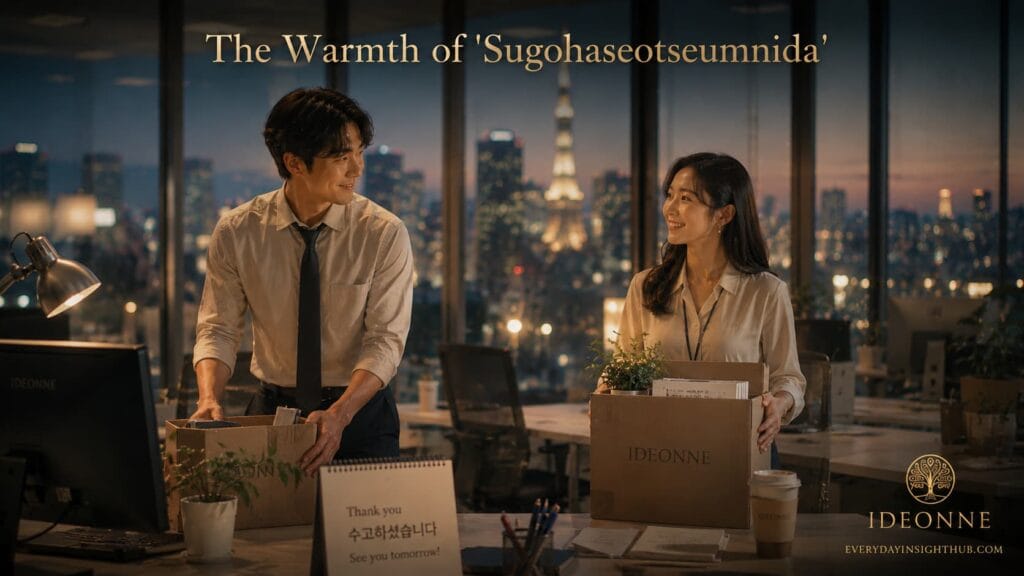
Sophie, a marketing specialist from Sydney, Australia, was spending her first week at an office in Seoul. Finally, at 6:00 PM on a Friday, the computer screens dimmed and the office tension began to lift. Packing her things, Sophie stood up and gave a bright farewell to her colleagues.
“Goodbye, everyone!”
As she turned toward the door, her steps hesitated upon hearing the most popular Korean expression sugohaseotseumnida echoing across the room.
From the youngest entry-level employee to a senior executive with silver hair, the exact same phrase was being passed around. It was offered to the security guard who held the elevator and the cleaning staff in the hallway, too. Sophie found herself quietly wondering, ‘Why say this instead of just a simple goodbye? Why does everyone offer this specific phrase at the end of the day?’
On the elevator ride down, a colleague smiled and gently explained, “In Korea, it’s a natural part of our culture to acknowledge and honor the effort someone has poured into their day.” That evening, Sophie learned far more than a routine office exit; she discovered a profound culture of mutual respect rooted in everyday human warmth.
💡 The Layered Soul of “Sugohaseotseumnida”
Every language has phrases that resist a neat, one-to-one translation. “Sugohaseotseumnida” is precisely one of those gems. It doesn’t map cleanly onto an English Good job, Thank you, or Have a good evening.
Instead, it carries a richer layering of meaning: “You poured your heart out today,” “Because of your dedication, we made it through,” and “I see the sweat and effort you left behind.” That is why you hear it echoing not only in corporate offices, but across school hallways, volunteer sites, post-workout gyms, and even right after the final curtain call of a bustling concert.
🎤 The Rhythm of Speech: Melting into “Sugohaseotseumnida”
When foreigners first encounter the phrase, they tend to pronounce it with careful, mechanical isolation: su-go-ha-seot-seup-ni-da. But when it passes through the lips of a local, the syllables soften into a single, flowing wave.
- Tip: Let the sounds melt into one another, softening the transition into “Sugohaseotseumnida.” In particular, if you let the middle syllables breathe with a gentle, relaxed cadence, the phrase sheds its rigid formality and takes on an authentic, comforting warmth.
🎬 Real-Life Portraits of Connection
- The Office Exit: “Today was hard work, see you tomorrow!” A beautiful, lingering full stop to the workday.
- School & Study Groups: “Thanks for working so hard on the presentation.” / “Thanks, you too.” A mutual cheer between peers.
- Project Wraps: “Everyone, truly great work today.” A collective anthem celebrating a shared finish line.
- Post-Workout: “We really pushed through today.” A silent nod of camaraderie shared among those who sweated side by side.
🏛 Culture Note: Honoring the Journey Over the Destination
Javier, a designer from Barcelona, experienced a quiet culture shock during his first Friday at a Korean firm. Even on a peaceful Thursday afternoon devoid of any major crises, his colleagues would unfailingly bow slightly to one another and offer the familiar closing phrase.
Unable to contain his curiosity, Javier finally asked his team lead, “Why do we say ‘great work’ even when the day has been relatively calm?”
The team lead set down his coffee cup and smiled. “We don’t say it because the day was heavy. We say it simply because we shared the day together.”
Months later, when a nervous new foreign recruit was fumbling through their first evening departure, Javier was the first to offer a bright, reassuring smile. “Sugohaseotseumnida!” At that moment, a quiet thought crossed his mind: ‘Ah, I suppose I’m starting to carry a bit of this city’s warmth myself.’
🧐 A Common Trap: “Sugohaseyo” vs. “Sugohaseotseumnida”
One of the most frequent missteps for learners of Korean is confusing these two closely related phrases:
- Sugohaseyo: Used for someone who is currently in the middle of working, offering a cheerful push to keep going.
- ⚠️ A Quick Warning About Superiors: The root word sugo historically carries a nuance of “an inferior exerting effort for a superior.” Therefore, saying “Sugohaseyo” to a boss or client can inadvertently sound a bit presumptuous, as if you are telling someone senior to keep grinding away. It can feel awkward and out of place when directed upward, so gentle care is required.
- Sugohaseotseumnida: Used after a task has concluded, honoring the effort spent. Because it focuses on shared exhaustion and mutual respect across social hierarchies, it can be used safely and warmly with anyone, including senior colleagues.
- Tip: When heading out the door or wrapping up a shared moment, sticking to “Sugohaseotseumnida” is always the safest and most graceful choice.
🚀 An Invitation: Carrying the Warmth Forward
Take a quiet look around you today. If someone near you has quietly weathered their share of the day—whether a coworker, a friend, or family—perhaps you might gently offer this simple thought:
“You truly worked hard today.” (Or, to a close friend: “Great job today!”)
It doesn’t require a grand speech. In those few syllables lies a rare, beautiful recognition: “I see the time you spent, and I honor it.” May your own evening be softened by someone else’s quiet grace.
📖 Dive Deeper into Korean Culture
(Editor’s Note: The world moves fast, but taking a moment to acknowledge each other’s quiet efforts changes everything. Your work today was extraordinary, too.)