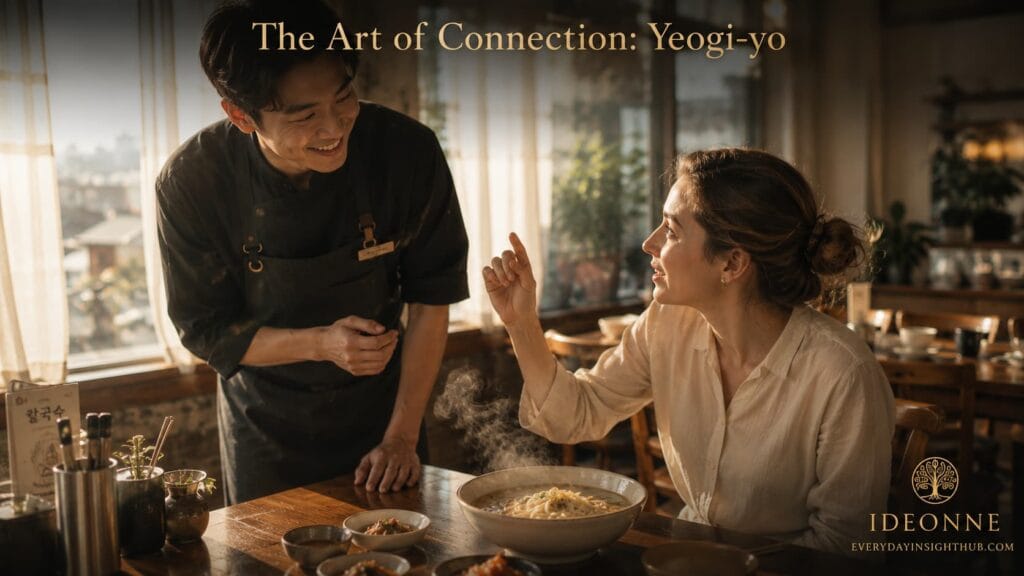
Olivia, a traveler from London, once found herself in a small kalguksu (knife-cut noodle) shop in the heart of Seoul. The broth was rich and the noodles were perfectly chewy, but she soon found herself needing another glass of water. She caught the eye of the server, gave a polite nod, and whispered, “Excuse me!” But the shop was alive—a chaotic symphony of clattering bowls and the roar of midday chatter—and her voice simply vanished into the din.
Then, an elderly woman at the next table leaned over, flashed a warm, crinkly-eyed smile, and let out a bright, rhythmic, “Yeogi-yo!” Instantly, as if the phrase held a magnetic pull, the server turned, beamed back, and hurried over. Olivia sat there, puzzled. ‘Yeogi’? Doesn’t that just mean ‘here’? How can a location turn into a person?
By the end of her meal, she realized she hadn’t just learned a word; she had stumbled upon a secret key to the Korean heart.
🔍 The Magic of a “Human Signal”
For those exploring the Korean language, “Yeogi-yo” is often the first, most confusing, and eventually, the most delightful hurdle. If you translate it strictly as “Here,” you’ll miss the soul of the phrase. In the context of a bustling Korean life, it isn’t a geographical marker—it is a social nudge. It is the polite way of saying, “Excuse me, could you spare a moment for me?” It bridges the gap between the busy staff and the guest, turning a noisy, anonymous room into a place of connection.
📝 Today’s Expression: “Yeogi-yo!”
- The Nuance: It is not a demand; it is an invitation for service.
- The Vitality: While it stems from yeogi (here) and the honorific -yo, it has evolved into a dedicated “human signal”—a way to make oneself visible in a crowd.
🎙️ Mastering the “Melody” of a Korean Call
Beginners often sound like robots, chopping the word into three distinct, flat syllables: Yeo-gi-yo. But to sound more like a local, you have to lean into the melody. Aim for a gentle upward lilt at the end—“Yeogi-yo↗?”—as if you are asking a friendly question. Don’t shout; let the word float above the noise with a smile. When you speak it with kindness, you aren’t just calling for water; you are acknowledging the humanity of the person on the other side.
🍴 The Art of the “Yeogi-yo” Life
- At the Restaurant: “Yeogi-yo! May I please have some more water?”
- At the Cafe: “Yeogi-yo! Could I trouble you for an extra fork?”
- On the Street: Use “Jeogi-yo” (Excuse me / Over there) when approaching a stranger for directions.
💡 Cultural Note: A Quiet Ritual of Respect
You might wonder: Why not call them by name? Or wave my hand aggressively? In Korea, calling a server by name might feel startlingly intimate, and waving frantically can feel dismissive. “Yeogi-yo” is the great equalizer. It is a shared rhythm that everyone in the room understands. It turns the fast-paced nature of a Seoul restaurant into a dance of mutual respect.
[A Lesson in Grace] I once watched Mika, an engineer from Finland, sitting alone in a crowded diner. He was dying for a side of kimchi but spent ten minutes silently staring at his plate, waiting for the staff to “notice” him. An older gentleman across from him eventually chuckled and gestured. “Don’t wait for them to look,” he said. “Just say ‘Yeogi-yo’.” Mika hesitated, worried it might be seen as rude.
The gentleman smiled. “Not at all. In Korea, we are all busy, but we are all human. Asking for help isn’t an inconvenience; it’s part of the rhythm.” Mika took a breath, whispered a soft “Yeogi-yo,” and when the server arrived with a smile and a fresh bowl of kimchi, Mika realized: he hadn’t just learned a phrase for service—he’d learned that asking for help is a bridge, not a burden.
🥄 A Spoonful of Culture
In Korea, there is a profound, subtle kindness in how we address one another. We don’t command; we call out with a soft, melodic respect. Perhaps the true mark of someone who feels at home in Korea isn’t their vocabulary size, but their ability to sense the rhythm of a room and offer that single, well-timed, “Yeogi-yo.”
🎯 A Small Step Forward
Find a mirror, take a breath, and try it three times:
“Yeogi-yo. Water, please.”
Once you master that, you are no longer just a traveler passing through; you are part of the scenery. You are someone who understands that in this fast, digital world, the most powerful thing we can do is bridge the distance with a single, polite, and human sound. Go on—give it a try at your next meal!
Curiosity-Driven
Calling a server is just the beginning! Beyond the call, there is a beautiful, unspoken language of appreciation in every Korean meal. Curious about the true meaning behind “Jal-meok-get-seum-nida”?
✨ Deepen your cultural journey: The Art of Gratitude: Decoding the Korean Dining Ritual


Pingback: What Does the Korean Expression Jamkkanmanyo Really Mean?
Pingback: What Does the Korean Expression Sugohaseotseumnida Mean?