Have you ever experienced kindness from someone who was not yet a close friend, a family member, or even someone you barely knew?
Perhaps a coworker quietly left a warm drink on your desk because you looked tired. A neighbor shared homemade food without expecting anything in return. Or someone you had only recently met asked a simple question:
“Did you get home safely?”
For many visitors to Korea, these moments create a fascinating cultural puzzle.
The action itself may seem ordinary, yet the emotional meaning behind it feels unexpectedly deep. Why would someone spend time, effort, or personal energy caring about another person’s daily life?
In Korean culture, there is a word often used to describe this invisible connection:
Jeong (정).
However, Jeong is one of the most difficult Korean concepts to translate into English.
It is sometimes explained as affection, warmth, attachment, or emotional connection. These translations are not wrong, but they capture only parts of the meaning.
Jeong is not simply kindness.
It is not just a pleasant feeling between people.
It is a bond that slowly develops through shared time, repeated experiences, and countless small moments of care until another person’s well-being begins to feel personally meaningful.
This is why Jeong can be difficult for outsiders to immediately understand.
A single act of generosity does not automatically create Jeong. A stranger helping you once may show kindness. A professional providing excellent service may show hospitality. But Jeong usually emerges through continuity.
It grows when people eat together repeatedly, work through difficulties side by side, remember each other’s habits, and become familiar with each other’s lives.
A person who was once simply “a coworker” may gradually become someone who reminds you to dress warmly when the weather changes.
A neighbor who was once only a familiar face may become someone who leaves homemade food at your door.
A friend who was once an acquaintance may become someone who worries when you are sick.
The relationship changes gradually.
There is no official moment when people decide that they have become close.
Instead, the connection forms through accumulated experiences.
This gradual transformation is one of the most distinctive aspects of Jeong.
Many visitors to Korea notice that relationships can sometimes appear to move through two different stages.
At first, people may seem formal and careful. Korean language itself reflects this awareness through honorific expressions and attention to social relationships.
But after enough shared experiences, those boundaries can soften.
A person who once spoke very politely may later ask:
“Did you eat?”
“Are you feeling better?”
“Why do you look tired?”
To someone unfamiliar with this cultural pattern, these questions may feel surprisingly personal.
Yet within the framework of Jeong, they often represent a simple message:
“I have noticed you.”
“Your life matters to me.”
A Korean Word That Does Not Translate Easily
Some words describe objects.
Some words describe ideas.
But a few words describe an entire way of experiencing life.
Jeong belongs to this rare category.
When people search for an English equivalent, they often encounter words such as:
- affection
- attachment
- warmth
- care
- friendship
Each word offers a useful clue, but none completely explains Jeong.
The reason is that Jeong is not only an emotion.
It is also a process.
It describes how emotional connection can develop between people over time.
A helpful way to understand Jeong is to imagine a path created by repeated footsteps.
The first person walking across an empty field leaves only a faint trace.
But when the same path is used again and again, it becomes clearer and easier to follow.
Jeong develops in a similar way.
Every shared meal, every conversation, and every moment of helping one another adds another step to that invisible path.
Eventually, two people who were once strangers become connected by a history they have created together.
This is why Jeong often appears in ordinary situations rather than dramatic ones.
It is found in:
- a neighbor sharing extra food
- a colleague remembering your difficult day
- a friend checking whether you arrived home safely
The action may be small.
The meaning comes from the bond behind the action.
Understanding Jeong therefore requires looking beyond individual behavior.
The question is not:
“Why did this person do something kind?”
The deeper question is:
“What kind of connection has developed that makes this care feel natural?”
That is where Jeong begins.
What Jeong Is Not: Beyond Simple Kindness and Hospitality
One reason Jeong is difficult to explain is that people naturally try to understand unfamiliar concepts through ideas they already know.
A visitor may see a Korean neighbor sharing homemade food and think:
“This is hospitality.”
Someone may receive frequent messages asking if they are feeling well and think:
“This is kindness.”
A coworker leaving a drink on someone’s desk may simply appear thoughtful.
These interpretations are understandable.
However, they describe only the visible action.
To understand Jeong, we need to look at the invisible connection behind the action.
Jeong Is Not Simply Politeness
Politeness creates respectful interactions between people.
Every culture has its own ways of showing courtesy: greeting others properly, respecting personal space, and following social expectations.
Korean culture also places great importance on respectful communication, especially through language.
However, Jeong goes beyond politeness.
Politeness says:
“I respect you.”
Jeong often says:
“Because our lives have become connected, I naturally care about you.”
This difference explains an experience that many foreigners notice after spending more time in Korea.
A relationship may begin with careful formality.
People may choose words carefully. They may maintain a certain distance. They may interact mainly through their social roles.
But as shared experiences accumulate, the connection can gradually change.
The same coworker who once only discussed work may later ask whether you are eating properly.
The same neighbor who was once only a familiar face may later save some food for you.
The connection has moved from social distance toward personal care.
Related: As Jeong deepens relationships, the way people speak often changes as well. Learn how language reflects respect, distance, and growing closeness in Honorifics in Korean: The Linguistic Art of Human Connection
Jeong Is Not Simply Hospitality
Hospitality usually focuses on welcoming someone and creating a pleasant experience.
A host preparing a comfortable home.
A restaurant providing excellent service.
A hotel employee helping a guest.
These are meaningful forms of care.
But Jeong is different because it often continues after the formal interaction has ended.
A host does not only prepare a meal.
They may continue wondering:
“Did they arrive home safely?”
“Was the food enough?”
“Should I send something else next time?”
The connection continues beyond the original event.
This is why Jeong is often found in ordinary, repeated moments rather than special occasions.
It is not only about making someone feel welcome.
It is about gradually making someone feel included.
Jeong Is Not the Absence of Boundaries
Another common misunderstanding is that Jeong means Koreans do not value privacy.
This is not accurate.
Modern Korean society increasingly values individuality, personal choice, and emotional boundaries.
Especially among younger generations, ideas about privacy and independence continue to change.
The interesting point about Jeong is not that boundaries disappear.
Rather, it shows how boundaries can become more flexible as trust grows.
For example, a Korean friend asking:
“Why have you lost weight?”
may feel uncomfortable to someone from a culture where personal appearance is considered private.
However, depending on the connection, the question may carry genuine concern rather than criticism.
Of course, good intentions do not automatically remove discomfort.
Jeong can sometimes become excessive when concern crosses personal boundaries.
This tension is part of what makes Jeong a real cultural concept rather than an idealized image.
It contains both warmth and complexity.
How Jeong Grows: From Strangers to Meaningful Connections
One of the most fascinating aspects of Jeong is that it usually does not appear immediately.
It is rarely created through one impressive moment.
Instead, it develops quietly.
A person becomes familiar.
Shared experiences accumulate.
Small acts of care are repeated.
Eventually, a connection reaches a point where helping one another feels natural rather than forced.
This explains a pattern many foreigners experience in Korea.
At first, Korean society may seem formal and reserved.
People may appear careful about age, position, and appropriate behavior.
Then, after spending more time together, the atmosphere changes.
A coworker invites you to dinner.
A friend introduces you to their family.
A neighbor remembers something you mentioned weeks earlier.
The connection has entered a different stage.
When a Meal Becomes More Than a Meal
A foreign visitor once described his confusion while having dinner with Korean friends.
At the end of the meal, everyone suddenly reached for their wallets.
“I’ll pay.”
“No, I invited you.”
“Next time, you can pay.”
The discussion became a friendly but determined competition.
Coming from a culture where splitting bills is often considered fair and practical, he initially wondered why people were making such an effort over a simple payment.
Later, he understood.
The moment was not really about money.
Paying for the meal was a way of expressing:
“I value this connection.”
“I want to take care of this moment.”
“I want us to meet again.”
The payment was only the visible action.
The deeper meaning was the bond between people.
This is one reason shared meals are so important in Korean social life. Eating together creates repeated opportunities for connections to deepen.
And repeated connection creates the environment where Jeong can grow.
From Coworkers to People Who Care
A similar transformation can happen in workplaces.
An international employee working in Korea once described his first weeks at a company as polite but distant.
His coworkers were respectful and helpful, but the connection remained professional.
There was an invisible boundary.
After working together for a longer period, that boundary gradually became softer.
Following a late workday, colleagues invited him to share a meal. They talked about their personal lives and spent time together outside the office.
The next morning, small changes appeared.
A drink was placed on his desk.
Someone recommended a tea because he seemed tired.
A colleague left some fruit nearby.
None of these actions were dramatic.
No one announced that the connection had changed.
But the message was clear.
He was no longer simply a coworker.
He had become someone included within a circle of concern.
That quiet transition is one of the clearest examples of Jeong.
Small Actions That Reveal Jeong
Jeong is rarely expressed through dramatic speeches or extraordinary gestures.
More often, it appears in ordinary moments that seem too small to attract attention.
A simple question.
A prepared meal.
A small reminder.
A container of homemade food.
To someone unfamiliar with Korean culture, these actions may seem insignificant. But within the context of Jeong, their meaning comes from something deeper:
Someone noticed.
Someone remembered.
Someone cared.
Jeong often appears through small actions rather than direct emotional expressions. In many cultures, care is commonly communicated through clear statements: “I care about you,” “I miss you,” or “I am worried about you.” In Korean culture, care is often expressed through actions. Someone remembers that you were having a difficult week. A coworker leaves something useful on your desk. A neighbor shares food they prepared at home. These gestures may appear ordinary, but their meaning comes from the personal attention behind them. The message is simple: “I noticed you.” “I remembered you.” “You matter to me.”
Related: Small gestures of care continue even when people part. Learn why saying goodbye in Korea often becomes another expression of connection in Learning Korean Culture Through Language: “Da-eum-e tto bwaeyo”—Why Do Koreans Promise to Meet Again When Saying Goodbye?
The Quiet Meaning Behind Preparing Fruit
Another small example appears in Korean homes when welcoming guests.
A host may peel an apple, cut fruit into comfortable pieces, and arrange them neatly on a plate.
To some visitors, this may seem unnecessary.
Why not simply place the fruit on the table and let everyone prepare it themselves?
The answer is found in the effort.
The host is not only providing food.
They are providing attention.
The extra time spent peeling, cutting, and arranging communicates:
“I want you to feel comfortable here.”
“I prepared this specifically for you.”
The action itself is small.
But the care behind the action is what gives it meaning.
This is one of the defining characteristics of Jeong.
The value is not only in what is given.
It is also in the personal effort invested in giving.
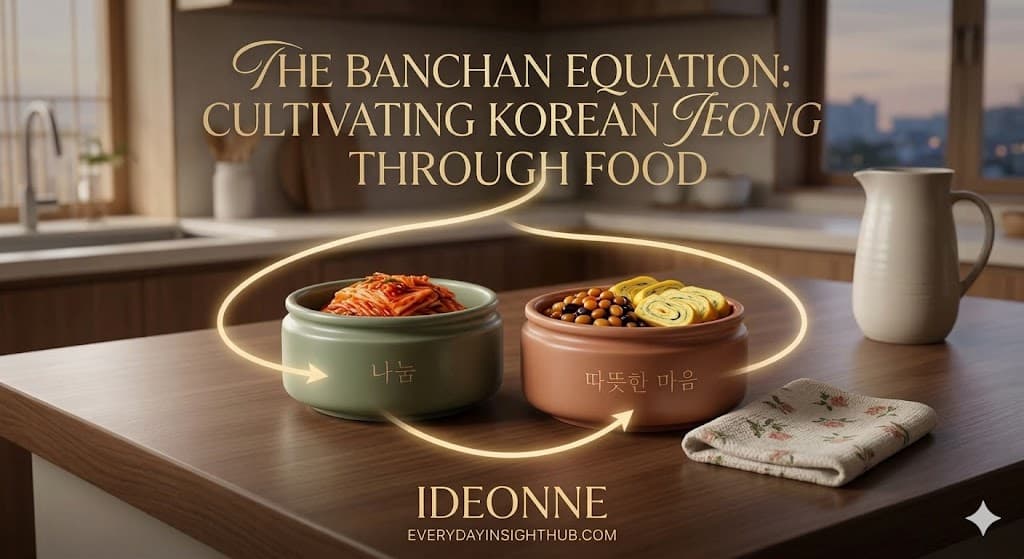
The Circular Economy of Banchan Containers: How Jeong Keeps Connections Moving
Perhaps one of the most unique everyday examples of Jeong can be found in something surprisingly ordinary:
A small container of homemade food.
A neighbor prepares kimchi or side dishes and places them into a container before bringing them next door.
The recipient does not simply wash the container and return it empty.
The container comes back with something inside.
Perhaps another dish.
Perhaps fruit.
Perhaps something homemade from their own kitchen.
The container continues moving between people.
At first glance, this may look like simple food sharing.
But the deeper meaning is about maintaining connection.
A Container That Creates Continuity
The interesting feature of this exchange is that the container naturally creates another interaction.
If someone gives food on a plate, the exchange may end after the meal.
But a container creates a future moment.
It needs to return.
And when it returns, another opportunity for connection appears.
Giving leads to receiving.
Receiving creates another chance to give.
The connection continues.
This is why the banchan container can be understood as a kind of “circular economy of affection” — not an economy of money, but a cycle of care, memory, and connection.
The value being exchanged is not financial.
It is attention.
It is thoughtfulness.
It is the quiet message:
“I remembered you.”
“I wanted to share something with you.”
“Our connection continues.”
A transaction asks:
“What is the value of what I received?”
Jeong asks:
“How can this connection continue?”
The returned container is not a payment.
It is an invitation for another interaction.
Related: Food in Korea is about more than eating. Discover how shared meals strengthen relationships in Korean Dining Culture: Why Koreans Share the Same Pot
Why This Can Feel Different to Foreign Visitors
For people from cultures where independence and clear personal boundaries are strongly emphasized, this exchange may feel unfamiliar.
Some visitors find it deeply touching.
Others may initially wonder:
“Why did this person go through so much effort?”
“Do I need to return something of equal value?”
These questions are natural.
Many modern societies carefully separate generosity from obligation.
Jeong operates through a different assumption:
A connection itself has value.
The purpose is not to create pressure.
The purpose is to maintain a relationship.
Of course, as Korean society changes, these traditions are also changing.
Younger generations living in cities, managing busy schedules, and living more independently may practice these customs differently.
Yet the underlying idea remains:
Small acts can keep connections alive.
Why Jeong Still Matters in Modern Korea
Korea today is a highly modern, digital, and fast-moving society.
People communicate instantly through smartphones. Many live alone. Work environments have become increasingly competitive, and personal independence is valued more than ever.
These changes raise an interesting question:
Is Jeong disappearing?
The answer is not simple.
Jeong is changing.
But it has not disappeared.
A Traditional Value Adapting to a Modern World
In the past, Jeong may have appeared through frequent neighborhood visits, shared homemade meals, and close community relationships.
Today, it may appear differently.
A friend sends a message asking whether you arrived safely.
A coworker orders food for someone working late.
A family member regularly checks on someone living far away.
The form has changed.
The human desire behind it remains the same.
People still want to feel that they matter to others.
Related: Jeong often grows beyond individual relationships into a broader sense of belonging. Learn more in The Curious Case of “Uri”: How Koreans Reimagine the World
The Strength and Challenge of Jeong
Jeong has a powerful strength.
It can reduce loneliness by reminding people that they are part of a larger human network.
In a world where many interactions become increasingly digital and temporary, this sense of connection can be meaningful.
However, Jeong also has challenges.
Sometimes concern can become interference.
Sometimes closeness can develop faster than personal comfort.
Sometimes people may feel pressure to maintain relationships they would prefer to keep more distant.
Recognizing both sides is important.
Jeong is not a perfect cultural ideal.
It is a human relationship pattern with both warmth and complexity.
Conclusion: The Quiet Power of Jeong
Jeong cannot be fully understood through a dictionary definition.
It is understood through experience.
Through shared meals.
Through remembered conversations.
Through small actions repeated over time.
A neighbor returning a food container with something prepared inside.
A coworker leaving a drink on a desk.
A friend asking:
“Did you get home safely?”
Each action may seem ordinary.
But together, these moments create something much deeper.
They create connection.
Jeong is not about Koreans being more caring than people from other cultures.
Every society has its own ways of expressing concern and maintaining relationships.
Jeong represents one Korean way of understanding human connection:
Relationships become meaningful through time, shared experiences, and accumulated care.
In a world that often values speed and efficiency, Jeong offers a quiet reminder.
Human relationships are rarely built through one extraordinary moment.
They are built through ordinary moments that people choose to remember.
Perhaps that is why Jeong continues to matter.
Because beneath every culture, beyond language and tradition, there is a universal human hope:
To feel that we are not completely alone.
If you want to explore more about Korea’s modern and traditional harmony, check out our previous post on Hangeul and Seoul’s vibrant identity.