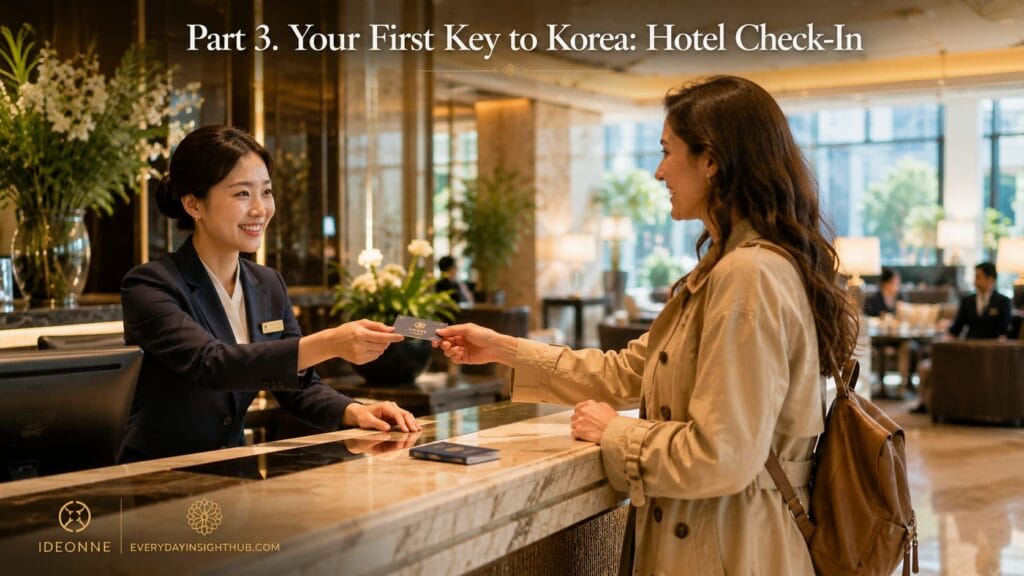
🏨 Part 3. Hotel Check-In: The Moment You Receive the First Key to Your Journey 🗝️
Travel holds a quiet, unmistakable excitement. While stepping out of the airport arrival gate brings its own rush, the true realization that “my journey has finally begun” usually settles in when you open the door to your reserved hotel room.
In a strange city wrapped in unfamiliar air, the room key handed to you is never just a piece of plastic. It is a small magic key that unlocks a temporary home—a quiet sanctuary meant to shelter you for the next few days. Fortunately, hotel staff in Korea are exceptionally skilled in welcoming international guests, and the expressions needed for check-in are far simpler than you might expect.
Master just these five essential expressions we share today, and you will navigate any hotel check-in with a warm smile and quiet confidence.
🎯 Top 5 Essential Expressions
① 예약했습니다. (I have a reservation.)
② 체크인하려고 왔습니다. (I’m here to check in.)
③ 여권입니다. (Here is my passport.)
④ 조식은 몇 시예요? (What time is breakfast?)
⑤ 감사합니다. (Thank you.)
🗣️ Phonetic Guide: Breathing Life into the Sounds
When learning a foreign language, the most nervous moment is often speaking aloud. Rather than reading words mechanically by the textbook, tuning into the natural rhythm of native speech makes listening and speaking flow effortlessly.
- 예약했습니다
- Pronounced:
yeyak-hae-sseum-ni-da - Note: The consonants ‘ㄱ’ and ‘ㅎ’ meet to form a crisp ‘ㅋ’ sound, and the final batch of consonants flows smoothly together.
- Pronounced:
- 체크인하려고 왔습니다
- Pronounced:
che-keu-in-haryeogo wa-sseum-ni-da - Note: The closing cadence settles with a grounded, comfortable weight as the ending consonants align naturally.
- Pronounced:
- 여권입니다
- Pronounced:
ye-gwon-im-ni-da - Note: When the final batch of ‘권’ meets the following vowel, the sound naturally shifts and hardens into a tight
gwonrhythm before closing with a soft nasal resonance.
- Pronounced:
- 조식은 몇 시예요?
- Pronounced:
josigeun myeot-si-ye-yo - Note: The final consonant of ‘몇’ meets ‘시’, causing the latter to sharpen into a crisp, tense sound like
ssi.
- Pronounced:
- 감사합니다
- Pronounced:
gam-sah-ham-ni-da - Note: A classic warmth that lingers softly on the lips with a gentle nasal finish.
- Pronounced:
💬 Real-World Dialogue Sketch
In the lobby of a business hotel in Seoul.
Traveler: 안녕하세요. 어서 오세요. 😊 (an-nyeong-ha-se-yo. eo-seo o-se-yo.)
Staff: 안녕하세요. (an-nyeong-ha-se-yo.)
Traveler: 무엇을 도와드릴까요? (mu-eo-seul do-wa-deu-ril-kka-yo?)
Staff: 예약했습니다. (ye-yak-hae-sseum-ni-da.)
Traveler: 성함이 어떻게 되시나요? (seong-ha-mi eo-tteo-ke doe-si-na-yo?)
Staff: Alex Smith입니다. (Alex Smith-im-ni-da.)
Traveler: 여권을 잠시 보여 주시겠어요? (yeo-gwo-neul jam-si bo-yeo ju-si-ges-seo-yo?)
Staff: 네, 여권입니다. (여권을 건네며) (ne, yeo-gwon-im-ni-da.)
(The staff member checks the reservation details on the monitor and retrieves a room key.)
Staff: 체크인이 완료되었습니다. 1205호입니다. (chek-eu-in-i wan-ryo-doe-eot-seum-ni-da. cheon-i-baek-o-ho-im-ni-da.)
Traveler: 감사합니다. (gam-sah-ham-ni-da.)
Traveler: 아, 그리고 한 가지만요. 조식은 몇 시예요? (a, geu-ri-go han ga-ji-man-yo. jo-si-geun myeot-si-ye-yo?)
Staff: 오전 7시부터 10시까지 2층 레스토랑에서 이용하실 수 있습니다. (o-jeon il-gop-si-bu-teo yeol-si-kka-ji i-cheung re-seu-to-rang-e-seo i-yong-ha-sil su iss-eum-ni-da.)
Traveler: 감사합니다. 좋은 하루 보내세요! (gam-sah-ham-ni-da. jo-eun ha-ru bo-nae-se-yo!)
Staff: 네, 즐거운 여행 되세요! (ne, jeul-geo-un yeo-haeng doe-se-yo!) ✨
🏮 Cultural Note: The Warm Korean Concept of Time and Hospitality
Stepping into a hotel in Korea, you are almost always greeted by a bright, welcoming “Welcome!” (“Eoseo oseyo!”). A simple, gentle “Hello” (“Annyeonghaseyo”) in return sets an immediately gracious tone.
An interesting nuance of daily life in Korea is that even locals rarely speak in long, elaborate sentences at a check-in desk. Expressing intent concisely—such as “I have a reservation” or “Here is my passport”—feels remarkably professional and natural, free of unnecessary clutter.
Another helpful touch: Korean hotel staff routinely provide clear guidance on breakfast hours, elevator locations, and Wi-Fi access. If the instructions ever feel a bit too swift, there is no need to worry. Simply say:
“Could you please slow down and explain that just one more time?”
(“죄송하지만, 한 번만 더 천천히 말씀해 주시겠어요?”)
Delivered with a polite smile, it is always met with renewed kindness.
⚠️ Common Pitfalls and Travel Tips
- The Trap of Relying Solely on EnglishMany travelers arrive feeling tired and instinctively default to “I have a reservation.” While hotel staff in Korea are exceptionally capable in English, taking a moment to offer a warm smile and a tentative “Yeyakhaesseumnida” in Korean changes the entire atmosphere. Few things warm a local’s heart faster than a traveler making a sincere effort to speak their language.
- The Danger of Single-Word InquiriesWhen curious about breakfast, tossing out a bare noun like “Breakfast?” can feel unexpectedly abrupt. Rounding out your question into a complete thought—“What time is breakfast?” (
조식은 몇 시예요?)—transforms a hurried demand into a polite and refined inquiry.
🎁 Bonus Expressions to Keep Close
Beyond the core five, here are three high-utility phrases for your hotel stay. Keep them in mind for your next journey to Korea:
- 🔑 객실 번호가 어떻게 되나요? (gaek-sil beon-ho-ga eo-tteo-ke doe-na-yo?) – What is my room number?
- 📶 와이파이 비밀번호가 뭐예요? (wa-i-pa-i bi-mil-beon-ho-ga mwo-ye-yo?) – What is the Wi-Fi password?
- 🛗 엘리베이터는 어디에 있어요? (el-li-bei-teo-neun eo-di-e i-sseo-yo?) – Where is the elevator?
📝 Today’s Review Quiz
Let us read our five essential hotel expressions aloud one final time, letting them settle quietly into your memory:
- 예약했습니다.
- 체크인하려고 왔습니다.
- 여권입니다.
- 조식은 몇 시예요?
- 감사합니다.
Opening the door to an unfamiliar lobby always carries a faint tremor of excitement and nerves. Yet the moment you gather your courage and speak your first phrase in Korean, the journey transforms. It ceases to be a daunting challenge in a foreign land and becomes a genuine story shared with local people. Language, after all, is never about flawless perfection—it is simply a bridge built to share a warm heart with the world.
🚀 Coming Up Next
In Part 4, we step inside the bright, familiar glow of a Korean convenience store—a comforting sanctuary tucked into every neighborhood corner—to explore five essential conversations you will need there. Until then, keep these phrases close at heart.
📚 Read More from This Series
- 🚆 Part 1. Essential Korean Greetings & Manners for Travelers
- 🚆 Part 2. Finding Your Way on the Airport Railroad and Subway
- 🛒 Coming Soon: Part 4. Essential Korean Phrases for Convenience Stores