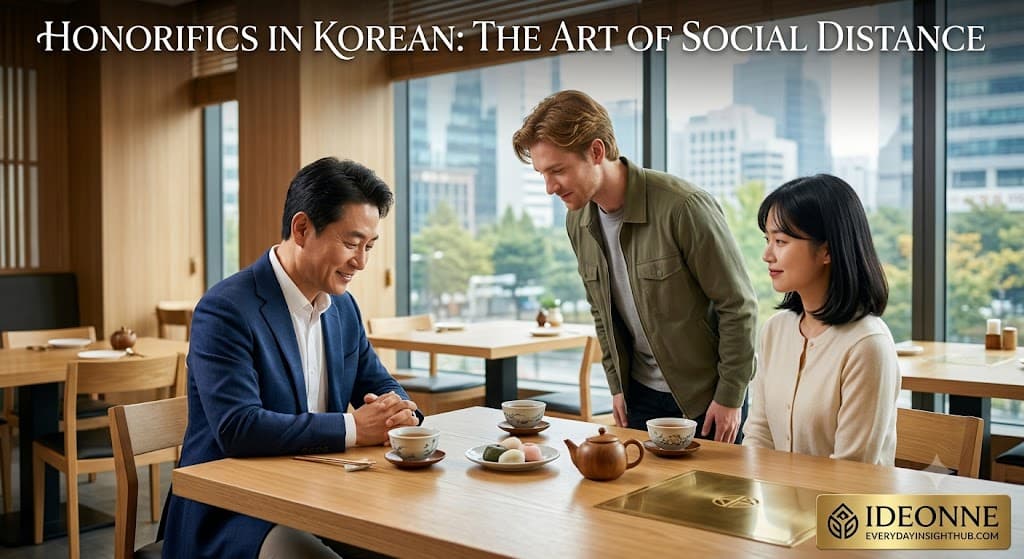
Understanding the true essence of Honorifics in Korean begins not with the daunting labyrinth of complex grammatical rules, nor with the mechanical memorization of verb endings. Rather, what drives Western visitors into the deepest state of wonder and bewilderment is, unexpectedly, the way this unique linguistic framework dynamically maps and shapes human relationships in real-time.
Beyond the simple academic act of altering sentence structures, this profound communicative philosophy—where speakers constantly calibrate their tone and level of speech to foster deep mutual respect—invites us to ask: How does this invisible coordinate system of human connection truly function?
☕ A Brazilian Designer’s Epiphany: Tuning the Temperature of Meaning
Lucas, a vibrant graphic designer from São Paulo known for his warm South American charm and easygoing friendliness, experienced a subtle cultural awakening just a few weeks after moving to a bustling co-working space in Seoul to study the local language.
Adjusting his fashionable horn-rimmed glasses, he stepped into a cozy, sunlit cafe in Gangnam. Approaching the counter, where a barista in a neatly tied apron was busy grinding fresh coffee beans, Lucas carefully voiced a Korean phrase he had practiced diligently in his notebook:
“Igeo juseyo (Give me this).”
The barista offered a polite, gentle smile and handed over a warm Americano. On the surface, the transaction was entirely flawless; information was successfully transmitted, and business was completed. However, sitting at a nearby table, his Korean colleague leaned in and whispered softly, “Lucas, next time, instead of just juseyo, why not try saying, Hoksi igeo jusil su isseulkkayo? (Could you perhaps give me this?)”
Lucas blinked, resting his chin on his hand in genuine bewilderment. “Wait a minute. Don’t both phrases ultimately mean the exact same thing? They both result in a cup of coffee in my hand.”
His colleague laughed softly and replied, “Literally, yes. The literal meaning is identical. But the texture, the respect, and the emotional resonance that lands on the listener’s heart are entirely different.”
In that exact moment, Lucas felt a wave of clarity. He realized that in this linguistic universe, what matters most is not the rigid definitions found in a dictionary, but rather the living, breathing “climate and temperature of the relationship” established the very second a phrase is spoken.
🎭 The Fluid Self: Existing Through Connection
In Western linguistic traditions, the speaking subject—the proud, independent “I”—serves as the unshakeable anchor of the sentence. No matter who you are, and whether you are addressing a head of state or a small child, the structural integrity and height of “I” remains proudly unchanged.
In sharp contrast, the inner workings of Honorifics in Korean reveal that the “Self” is never a fixed, immutable boulder. Instead, the boundaries, height, and very identity of the speaker shift fluidly like a chameleon, depending entirely on who they are facing. Standing before a childhood friend, the “Self” becomes delightfully weightless and informal. Yet, within a solemn corporate boardroom, that same individual transforms into a carefully measured, deeply cautious entity. When addressing a family elder, they gracefully lower their position to honor the wisdom of the collective.
Therefore, this unique linguistic art does not merely demand, “Who are you?” Instead, it constantly inquires, “Who are you in relation to the person before you?” While Western languages beautifully catalog the independent dialogues of individuals, Korean actively builds the emotional ties that bridge those individuals together.
🌡️ The Paradox of Intimacy: Drawing Closer or Raising the Shield
This masterful art of emotional calibration operates almost like magic in daily life. When intimacy reaches its absolute peak and all psychological barriers dissolve, Koreans call this “dropping honorifics” (banmal, or informal speech). Yet, fascinatingly, even between lifelong lovers or oldest friends, the moment the emotional climate shifts, this linguistic coordinate system twists instantly.
Consider a domestic scene where a wife, usually brimming with affectionate banter, suddenly looks at her husband with a piercing, icy gaze and utters a sentence in supreme, hyper-formal honorifics: “What did you just say, sir?” (Jigeum mworago hasyeotseumnikka?)
Grammatically, she has employed the most profoundly polite and respectful verbs available in the language. Yet, the air in the room instantly freezes into an arctic glacier. Here, the sudden leap into honorifics is not an act of courtesy; it is a powerful linguistic shield signaling, “You have crossed a sacred boundary, and I am actively enforcing a safe psychological distance.” Koreans, it turns out, are highly sophisticated psychological architects capable of embracing a soul or exiling them miles away with a single shift in verb endings.
🍁 Ethan’s Year at the Convenience Store: Flowing Like Water
While this intricate social intuition feels as natural as breathing to those raised within the culture, it presents a monumental mountain to climb for outsiders. Ethan, a broad-shouldered young man with golden hair from Vancouver, had spent years diligently studying East Asian literature from textbooks. Hoping to immerse himself in real life, he took a late-night part-time job at a dynamic convenience store near a major university in Seoul. Yet, the raw reality of the counter was worlds apart from the clean pages of his textbooks, and during his first few weeks, he broke into a cold sweat with every approaching customer.
Armed with a familiar Western approach to customer service, Ethan greeted every single human being who crossed the threshold with the exact same wide smile and the exact same robotic, textbook tone: “Annyeonghaseyo! (Hello!)” To him, this uniform approach represented absolute equality and fairness.
However, as a grueling year melted away and he locked eyes with tens of thousands of local customers, Ethan began to catch the invisible rhythms of the city. He noticed a beautiful, organic transformation blooming at the tip of his own tongue. He was no longer just stringing vocabulary together; he was feeling the language.
When a silver-haired elder pushed open the glass door, Ethan’s waist instinctively bowed a few degrees lower, his voice carrying a deep, resonant gravity of respect. When a tired college student carrying a heavy backpack walked in, he softened his cadence into a light, comforting rhythm. And when the familiar neighborhood middle-aged uncle arrived at midnight for his regular can of beer, Ethan welcomed him with a warm nod and a touch of friendly, grounded familiarity.
The very system of Honorifics in Korean that once seemed so painfully rigid and impenetrable had finally decoded itself within his heart. By blending a humble posture of respect with a deep awareness of community, his speech began to flow as effortlessly and gracefully as a butterfly in flight. Across the neon-lit counter, Ethan’s gentle, perfectly calibrated words transformed into a small, flickering hearth, beautifully warming the bitter cold of the Seoul winter night.
🕊️ Epilogue: A Gentle Blessing in an Era of Fractured Dialogue
We live in a hyper-fragmented digital age where a single anonymous comment can deeply lacerate a soul, and where individuals frequently hide behind screens to hurl sharp verbal weapons at one another. While the speed of our communication has surpassed the velocity of light, the profound depth of our human connections has tragically withered into a dry, sterile desert.
In such a world, the eternal philosophy embedded within Honorifics in Korean—which demands that we deeply contemplate the presence of the listener before releasing a single sound, gracefully lowering our own height to elevate another—offers a stunningly beautiful resonance. It is not a tool of rigid hierarchy. It is a brilliant, empathetic art form designed to safeguard the dignity of the individual while securing a peaceful, harmonious space between us.
Ultimately, the honorific system is far more than a mere combination of linguistic sounds. It stands as one of the most intelligent formulas for peace ever devised, and remains, undoubtedly, one of the most humble, elegant blessings one human being can extend to another.
(To see how this delicate linguistic calibration of respect mirrors the deep communal warmth shared around a table, feel free to explore our previous guide on Korean Dining Culture and the art of sharing a single pot.)
Pingback: How Korean Honorifics Map K-Drama Connections
Pingback: Education Fever in Korea: High Cost & Deep Love