When people first encounter South Korea, one feature of everyday life can be difficult to understand from the outside: the extraordinary importance placed on education. The long school days, after-school academies, private tutoring, entrance examinations, and carefully planned academic schedules can look like the machinery of an intensely competitive society. It is easy to describe this simply as “education fever.” But that phrase explains the intensity without fully explaining the emotion behind it. Why are Korean families willing to invest so much time, money, and energy in education? Why does one child’s academic journey so often become a family project? And perhaps most importantly, what happens when a culture built around educational achievement begins to ask whether achievement alone is enough?
For many families, the answer cannot be separated from Korea’s modern history. Within the lifetime of older generations, South Korea moved from the devastation of war and widespread poverty to a highly industrialized, technologically advanced society. Education came to represent more than academic knowledge. It became a pathway to opportunity, stability, and social mobility. Parents who had experienced scarcity often came to see education as something that could be passed to their children even when material possessions could not. This history helps explain why the Korean educational story is more complicated than a simple contest for higher grades.
☕ When One Child’s Schedule Becomes a Family Schedule
One of the easiest ways for a visitor to notice the difference is to look at an ordinary family calendar. In many Korean households, a child’s schedule can include regular school hours, evening academy classes, private lessons, homework, test preparation, and weekend activities. The schedule does not belong to the child alone. Parents may arrange transportation, prepare meals around study hours, communicate with teachers, compare educational programs, and make decisions about which opportunities are worth pursuing.
To someone accustomed to thinking of education primarily as an individual responsibility, this can seem surprising. In many Western educational cultures, parents certainly care deeply about their children’s education, but the boundary between a child’s academic life and the rest of family life may feel more distinct. In Korea, those boundaries have historically been less rigid. A child’s examination can become a family event; a school application can influence where a family lives; and an important test can affect the rhythm of an entire household.
This does not mean every Korean parent follows the same path, nor does it mean every Korean child experiences intense academic pressure. Korean families differ greatly by generation, income, region, personality, and educational philosophy. Still, the idea of education as a shared family investment remains an important key to understanding Korean society.
The deeper question is therefore not simply, “Why do Korean students study so much?” It is also, “Why did education become important enough for an entire family to organize itself around it?”
🌋 Hope Rising from the Ashes
To understand that question, it helps to step back from the modern classroom and look at the Korea of the mid-20th century. The Korean War left enormous destruction, and the decades that followed were marked by poverty, rapid industrialization, and a national determination to rebuild. For families who had very little material wealth, education offered something unusually powerful: a form of capital that could travel with a person.
A house could be lost. Money could disappear. A job could vanish. Knowledge, however, could become a lasting resource.
That belief did not emerge from one single proverb or historical event. It developed through the experience of generations who saw education open doors that had previously been closed. Academic achievement could provide access to universities, professional careers, government positions, and eventually a higher standard of living. In this sense, education became closely associated with the remarkable upward mobility experienced by many Korean families during the country’s rapid economic development.
This historical background is essential because it changes the way “education fever” should be interpreted. From the outside, the intensity may look irrational. From inside the historical experience that produced it, much of it makes emotional sense. Parents were not simply chasing grades. Many were trying to give their children a future that had once seemed impossible.
🚌 The Yellow Buses of Daechi-dong
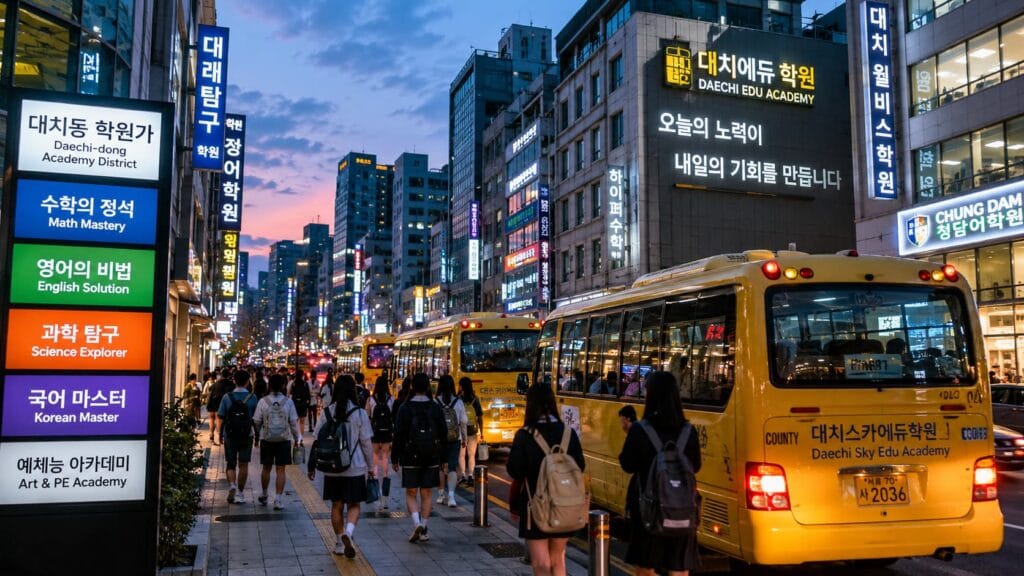
There are few places where the intensity of contemporary Korean education is more visible than Daechi-dong, a neighborhood in Seoul widely associated with private education. In the evening, the streets around major academy buildings can become crowded with students, parents, taxis, and the familiar yellow buses used by private academies.
For a visitor seeing this for the first time, the scene can be almost cinematic. Students emerge from buildings carrying backpacks after hours of classes. Parents wait nearby, check their phones, or hurry home to prepare dinner. The city continues moving around them, but the rhythm of the evening has been organized around education.
The important point is that the yellow buses are not merely transportation. They are a visible symbol of an educational ecosystem that extends well beyond the school classroom.
Private academies, or hagwons, occupy a distinctive place in Korean educational life. Some students attend them for intensive examination preparation; others study languages, mathematics, music, sports, or other subjects. For some families, hagwon attendance is considered almost routine. For others, the financial and emotional burden is a reason to question the system itself.
This is where the story becomes complicated.
The same system that can provide additional opportunities can also create anxiety. If one family believes that extra preparation is necessary, other families may feel compelled to follow simply because they fear their children will otherwise fall behind. What begins as an individual choice can gradually become a social expectation.
That dynamic is not uniquely Korean. Competitive educational environments exist in many countries. What is distinctive in Korea is the scale, speed, and degree to which educational decisions have historically become woven into everyday family life.
🎓 The Cost of Being Afraid to Fall Behind
Education becomes especially powerful when hope and fear begin to work together.
A parent may sincerely believe that education will give a child greater freedom in adulthood. At the same time, that parent may worry that reducing academic effort will close doors that cannot easily be reopened. The two emotions can coexist: “I want my child to be happy” and “I am afraid my child will fall behind.”
This tension helps explain one of the most difficult aspects of Korea’s education culture. The pressure does not necessarily come from parents who do not care about their children’s happiness. Quite often, it comes from parents who care deeply but have learned to associate preparation with protection.
A useful way to understand this is to imagine two generations looking at the same school desk. An older parent may see opportunity: My child has access to something that I once could only dream about. A younger student may see something different: How long am I expected to keep proving that I deserve that opportunity?
Neither perspective is completely wrong.
The challenge emerges when an educational system designed to create opportunity begins to turn opportunity itself into a source of permanent anxiety.
🌳 What Does a Successful Future Look Like?
There is another change taking place beneath the surface of Korea’s education culture. The meaning of success is gradually becoming more open to debate.
For decades, certain professions carried enormous symbolic weight. Medicine, law, engineering, government service, and positions at major companies were often viewed as especially secure or prestigious career paths. Academic achievement was therefore closely connected to social expectations about what a successful adult life should look like.
Today, that picture is becoming more diverse. Younger generations are increasingly questioning whether a prestigious career automatically produces a satisfying life. Creativity, entrepreneurship, technical skills, personal interests, work-life balance, and mental well-being have entered conversations that once focused primarily on examination results.
The change does not mean that academic competition has disappeared. It has not. Nor does it mean Korean parents have stopped worrying about their children’s futures. Rather, the definition of a “good future” is gradually becoming less uniform.
Perhaps the most revealing question is no longer, “What job will your child have?”
It is becoming, “What kind of person will your child become?”
That is a much harder question to answer.
🤖 Education in the Age of Artificial Intelligence
The question becomes even more complicated in the age of artificial intelligence.
For generations, education rewarded abilities such as memorization, calculation, information retrieval, and the ability to perform accurately under examination conditions. Those skills remain valuable, but AI is rapidly changing the relationship between humans and information.
A student can now ask an AI system to summarize a difficult text, explain a mathematical concept, translate a passage, generate practice questions, or provide alternative ways of approaching a problem. This does not make education less important. In some ways, it makes the deeper purposes of education more important.
If machines become increasingly capable of producing answers, human education may have to place greater emphasis on deciding which questions are worth asking.
That shift offers Korea an interesting opportunity. A society that has invested extraordinary energy in education now has a chance to reconsider what that investment should ultimately produce. Perhaps the next stage of educational ambition will not be about producing students who can simply outrun one another, but about developing people who can think independently, adapt to uncertainty, work with others, and remain curious when there is no obvious answer.
The child who asks a good question may eventually become more valuable than the student who merely remembers the correct one.
🕊️ From Education Fever to Educational Balance
Korea’s education culture cannot easily be classified as either good or bad. It contains both remarkable strengths and genuine costs.
Its strengths are visible in the value placed on learning, the determination of families, the country’s extraordinary educational expansion, and the belief that knowledge can change a person’s circumstances. Its costs can be seen in academic pressure, private education expenses, reduced leisure time, family anxiety, and the fear of falling behind.
The challenge for modern Korea is therefore not necessarily to extinguish the fire of education. It is to learn how to control it.
A fire contained in a hearth can warm a home. The same fire, once it spreads beyond its boundaries, can consume the forest around it. Education can work in much the same way. Ambition can give a young person confidence and direction; excessive pressure can make that same ambition feel like a weight.
Perhaps the healthiest future lies somewhere between indifference and obsession: a culture that continues to value education deeply while allowing children to discover that their worth is not determined by a score.
The most meaningful scene in Korea’s educational story may therefore not be found inside an examination hall. It may happen much later at night, when a student finally returns home after a long day, leaves a backpack by the door, and falls asleep. A parent quietly walks past the room, notices the light still on, and switches it off.
For a moment, there are no rankings, no entrance examinations, no academy schedules, and no competition.
There is simply a tired child and a parent who hopes that all this effort will someday lead to a life worth living.
That may be the most human truth behind Korea’s education fever. Beneath the competition is hope. Beneath the anxiety is love. And beneath both lies a question that Korea, like many societies, is still learning how to answer:
How can we give the next generation every opportunity to succeed without making success so heavy that they forget how to enjoy the journey?
🔗 Continue Exploring Korean Culture
Education is only one part of the larger cultural landscape. To understand how Korean society expresses relationships through language, explore Honorifics in Korean and the linguistic art of human connection. For another perspective on the Korean idea of belonging and shared identity, see The Curious Case of “Uri”: How Koreans Reimagine the World. And for the historical and cultural foundations behind Korea’s rapid transformation, return to Beyond the Korean Wave: The Thousand-Year Cultural Foundations of Korea’s Global Influence.
Ultimately, Korea’s education fever is not a cold obsession with data and knowledge; it is the breathtaking, sacrificial manifestation of a generation offering its entire existence to love the next.