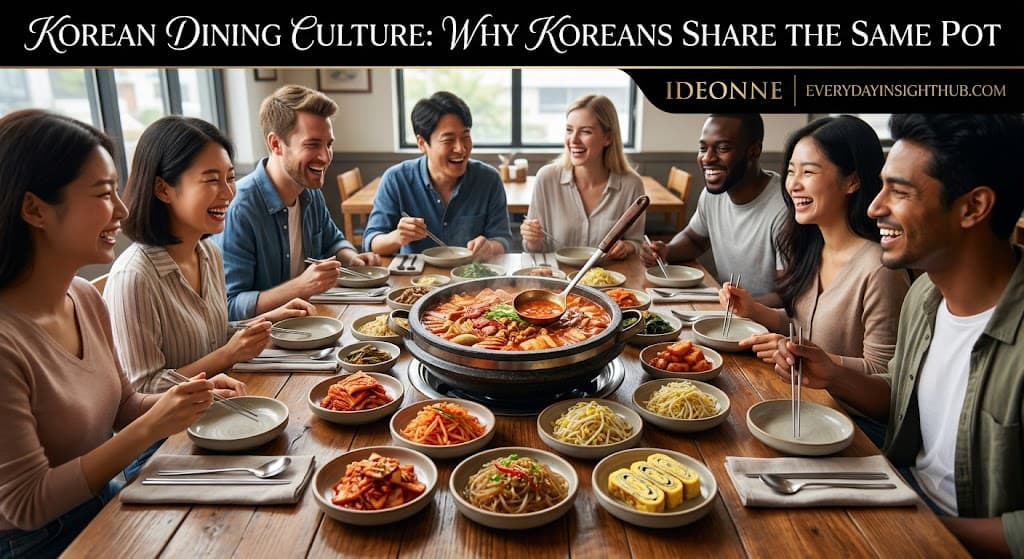
Understanding the true essence of Korean Dining Culture begins not with the sheer abundance of side dishes that fill the table, nor with the intense spiciness of kimchi. Rather, what drives Western visitors into the deepest state of wonder and bewilderment is, unexpectedly, the very way Koreans approach and interact with their food. Beyond the simple physiological act of consuming nutrients, the unique landscape of Korean Dining Culture—where people share a single boiling pot and weave an invisible tapestry of human connection—invites us to ask: Where does this profound collective warmth truly originate?
🍲 A Dutch Architect’s Bewilderment: One Pot, Separate Plates, and an Unexpected Paradox
On a crisp autumn evening, Tomas, a young Dutch architect working at a major firm in Seoul, attended his first dinner gathering with his Korean colleagues. Hailing from Amsterdam, where strict individualism and “going Dutch” (splitting the bill down to the exact cent) are deeply ingrained from birth, the young man rolled up his sleek shirt sleeves, naturally expecting everyone to order their own individually plated meals.
However, moments later, a portable gas burner was placed at the very center of the table, followed by a massive, bubbling pot of Budae-jjigae (army base stew) radiating a rich, crimson broth. A large communal ladle sat resting in the pot, and the colleagues naturally began using it to scoop out portions, distributing the food into their respective individual front plates.
From a European perspective, this remained a subtly peculiar sight. Even when using a communal ladle, the very structure of pulling food from a single, shared source felt entirely foreign. Standing before this unexpected ritual, Tomas blinked behind his Finnish-designed glasses and hesitated for a moment.
“Wait a minute, team. Are we not ordering separate dishes, but rather sharing this one massive pot together?”
His Korean colleagues burst into hearty laughter, using the ladle to heap generous portions of tofu and ham onto his plate. “Of course, Tomas! In Korea, sharing a single source of food like this is how we become real family.”
That night, returning to his studio apartment in Itaewon, Tomas made a video call to his mother in the Netherlands and said with an excited voice, “Mom, tonight I experienced something extraordinary—I shared a single, massive pot with ten Koreans.” After a brief, heavy silence over the receiver, his mother, armed with typical Northern European pragmatism, asked earnestly, “My goodness, Tomas. Is that culturally customary? And did you manage to eat enough to fill your own stomach?”
Tomas looked out at the glittering night view of Seoul and smiled. “The table was remarkably orderly and pristine, completely dissolving any initial hesitation I had. I was not only bursting with fullness, but inexplicably, I felt a deep warmth right in the center of my chest.” At the time, he could not explain this strange satiety through anthropology. Yet, it was the exact moment he felt the true temperature of Korean Dining Culture—the genuine essence of sharing and Jeong (profound attachment).
🌾 Historical Roots: Overcoming Hardship Through the Sacred Art of Sharing
This cultural DNA traces its ancestry back to the ancient days when ancestors cultivated the rugged terrains of the Korean Peninsula. Rice farming was a highly labor-intensive endeavor that could never be accomplished by a single individual alone. During the frantic planting and harvesting seasons, entire villages bound themselves together into a massive, singular collective destiny known as Pumasi (communal labor sharing).
For farmers who spent the entire day bending their waists under the scorching sun, the arrival of Saecham (between-meal snacks) was a ritual of survival. The scene of villagers crowding around a single massive wooden basin, tossing in barley, wild greens, and gochujang, and diving in with their own spoons was born out of profound necessity. A shared bowl of rice at the end of backbreaking labor was not merely nutrition; it was a silent, sacred oath: “We sweat together, and we survive together.” The center of the Korean table remains vital because it is the public square where the solidarity of the community actively boils.
🥶 Sarah’s Winter: When “Have You Eaten?” Replaces “How Are You?”
This profound solidarity is beautifully crystallized in the most frequent everyday greeting in the Korean language. Instead of a formal, detached phrase like “How have you been?”, Koreans naturally ask each other: “Have you eaten rice?” (Bab meogeosseo?)
Sarah, a freelance writer from Toronto possessed of a sharp eye for observation, initially found this question utterly bizarre during her first year in Seoul. “Why are Koreans so obsessively preoccupied with whether I am meeting my daily caloric intake? Do they genuinely fear I am suffering from malnutrition?”
Then came a particularly brutal winter in Seoul. Sarah contracted a severe flu and lay completely bedridden, unable to move for three days in her tiny studio apartment in Mapo. Shivering from high fever and the crushing weight of loneliness in a foreign land, she received a casual text message from a Korean friend. The first sentence was, inevitably, “Have you eaten?” Sarah replied via text with a weak, weary heart, “No, I have absolutely no appetite, so I’m just lying down.”
Exactly two hours later, her doorbell rang. When she managed to drag herself to the door, the hallway was completely empty, but sitting on the floor was a warm bag from a local porridge shop, alongside neatly sliced apples in a Tupperware container and flu medicine. Her friend had already stepped into the elevator, leaving the gifts behind. Sarah later recorded this profound moment in her travel essay:
“That day, I finally understood. When a Korean asks if you have eaten, they are not checking your caloric status. It is a beautiful, disguised language of love asking: ‘Are you lonely right now?’ and ‘Have you lost your footing under the heavy weight of life?’ It is the warmest cryptography on earth.”
🧠 A Psychologist’s View: How the Dining Table Creates the Conversation
In orthodox Western dining etiquette, the table is a space where individual sovereignty is fiercely protected. Within the physical boundaries of one’s personal plate, food is cut and consumed individually, and conversation occurs during the interludes when one is not actively chewing. In essence, Westerners arrange a dinner in order to have a conversation.
In stark contrast, within Korean Dining Culture, the very physical process and time during which the stew boils and the meat sizzles at the center of the table melts away the frozen barriers between human hearts. Business partners who initially exchanged stiff, awkward greetings completely dismantle their defense mechanisms as the meat turns golden on the grill and they clumsily assist each other with the communal scissors.
Dr. David, an American social psychologist who thoroughly researched this unique communal dining phenomenon, shared a fascinating observation during an academic seminar:
“In Western dining, conversation happens during the meal; however, on the Korean table, the act of dining itself actively creates the conversation.”
Indeed, Koreans process the most profound emotional transactions of their lives over a shared table. When resolving deep misunderstandings or offering a sincere apology, they say, “Let me buy you a meal.” When celebrating a monumental achievement, they lead each other away saying, “Let’s go eat something delicious.” In this realm, food is no longer a mere material passing through the lips; it serves as the ultimate translator of complex human emotion.
📱 The Lone Table of the Digital Age: Preserving the Eternal Warmth
To be sure, modern Korean society is weathering a massive tidal wave of transformation. Words like Honbap (eating alone) and Honsul (drinking alone) have shifted from strange anomalies into complete cultural norms. Sleek single-serving meal kits and restaurants dedicated strictly to solo diners now populate every corner of metropolitan centers. The modern figure quietly staring into a smartphone screen while consuming a meal in Seoul looks no different from a diner in New York.
Yet, what remains profoundly mesmerizing is that even amidst this hyper-fragmentation, Koreans passionately choose to eat together during the vital anchors of human life. On birthdays, no matter how chaotic life becomes, families gather to boil and share seaweed soup. During traditional holidays, they brave historic traffic jams to return to their hometowns to fry pancakes together. Upon hearing a long-lost friend’s joyous news, the very first instinct is to lock in a date to sit across from one another over a meal. Though technology attempts to isolate us, humanity refuses to surrender the analog solace born over a warm, shared table.
💌 Epilogue: The Warmest Invitation to a Lonely World
From an anthropological lens, humanity consists of the descendants of ancient hearth-gatherers who, for thousands of years inside primitive caves, crowded around a central fire to distribute hunted game. Though centuries have passed, cooking utensils have become hyper-modernized, and menus have fused across continents, the emotional salvation derived from sharing sustenance while looking into another human being’s eyes remains entirely unchanged.
Perhaps this is the true reason why K-food is capturing the hearts of global audiences. The world is not merely infatuated with the recipe of spicy tteokbokki or the vibrant colors of bibimbap. They are yearning for the clamor, the affectionate glances, and the atmosphere of profound connection that overflows around a Korean table.
In this dry, modern digital society—where countless individuals possess thousands of virtual friends yet suffer from acute, profound loneliness—when a Korean casually drops the phrase, “Let’s grab a meal sometime,” it is never an empty formality. It is a vibrant, life-giving rescue line ensuring you do not wither away alone in the cold. It remains, undoubtedly, one of the most beautiful and tender invitations an individual can extend to another.

Pingback: Honorifics in Korean: The Linguistic Art of Human Connection