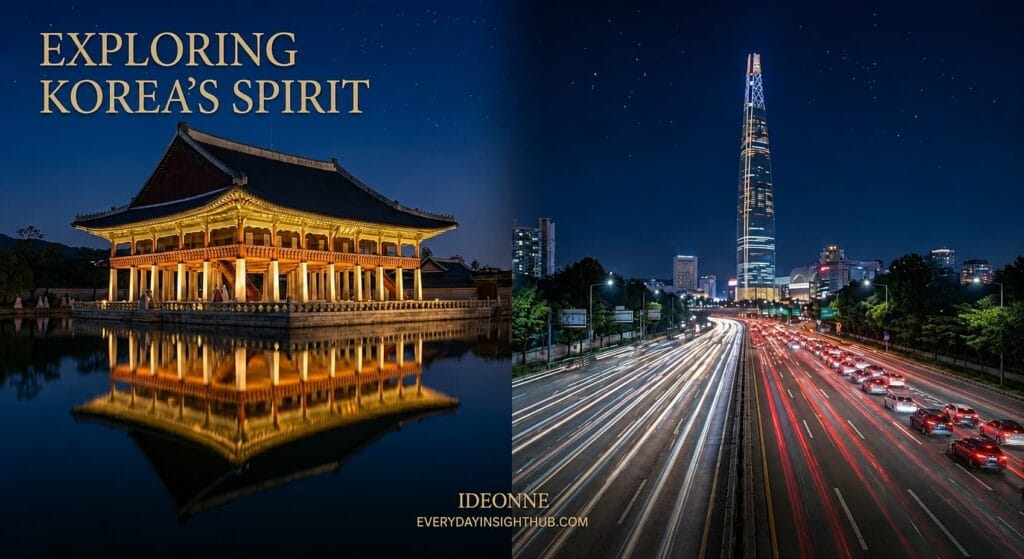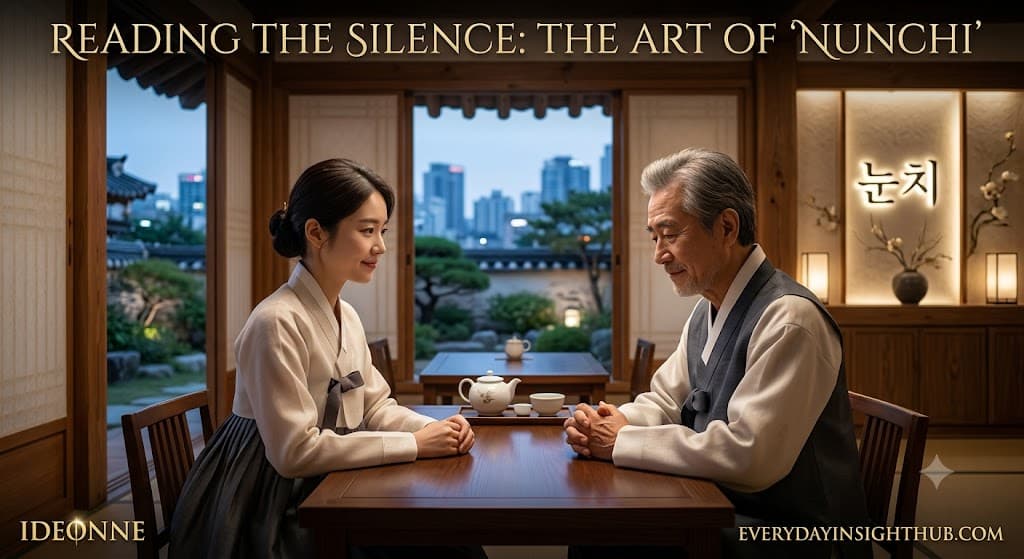
There is a peculiar cultural trait that foreign visitors to Korea initially struggle to comprehend, yet grow deeply fascinated by as time passes. It is not the brilliant architecture of Gyeongbokgung Palace, nor the chart-topping melodies of K-pop, nor the world-leading semiconductor technology. Rather, it resembles an invisible, intuitive superpower—a mental radar that defines the core of Korean Nunchi.
Many describe nunchi simply as the “ability to gauge the atmosphere.” While not incorrect, this definition barely scratches the surface of its cultural depth. In reality, nunchi is the collective human endeavor to read an individual’s hidden emotions, the intricate context of human relationships, the unspoken dynamics of a community, and the silence that lingers heavily behind a person’s words.
🍽️ When a Refusal is Not a Refusal: Alejandro’s “Heart Translator”
One evening, in a quiet residential neighborhood of Seoul, Alejandro—a literary translator from Madrid, Spain—found himself culturally stranded. Possessing deep brown eyes and a mind that prided itself on logic and literal definitions, this young Spaniard had been invited to dinner at the home of his close Korean friend.
After savoring a rich, homemade meal of galbi-jjim (braised beef short ribs) and doenjang-jjigae (soybean paste stew), Alejandro displayed his refined European manners by rolling up his sleeves.
“Eomeoni (Mother), thank you for the wonderful meal. Let me help you with the dishes.”
To his surprise, his friend’s mother waved her hands in polite resistance, flashing a warm, maternal smile.
“Oh, no! You are a guest. What do you mean, dishes? Go rest on the sofa!”
Believing the text exactly as it was spoken, Alejandro replied with a cheerful “¡Gracias!” and immediately made himself comfortable on the couch, scrolling through football news on his phone.
However, something felt strangely amiss. The mother continued washing the dishes with the same gentle and hospitable smile, yet within the mind of this innocent foreigner, a faint, invisible ripple of caution seemed to manifest. No one frowned at him, and no one expressed displeasure, but in the heavy silence of the living room, Alejandro broke into a cold sweat, sensing a mysterious cultural frequency he could not yet decipher.
The next day, bursting into laughter, his Korean friend initiated him into the first secret code of nunchi. “Alejandro, in Korea, the first refusal is often not a literal refusal. It is a courteous dance—a polite social choreography.”
Alejandro tapped his forehead in enlightenment. “As a translator of literature, I realize that in Korea, translating the words is easy; it is translating the human heart that is a hundred times more difficult.”
⏳ An Ancient Instinct Becomes a Cultural Virtue
Long before humanity invented alphabets and complex grammar, we survived by reading each other’s faces. Even in the depths of ice-age caves, humans likely preserved harmony by observing the furrow of a chieftain’s brow or the subtle stance of a hunter. In this sense, nunchi is rooted in a primal human instinct. However, Korean society has nurtured and refined this raw survival tool into a sophisticated and beautiful cultural asset.
Children raised in Western societies are often encouraged from infancy to “be confident” and “speak your mind clearly.” Conversely, in a Korean household, a child might frequently hear a piece of gentle, cautionary feedback:
“Why do you have so little nunchi?”
To foreign ears, this might sound like a demand for rigid conformity or the suppression of individuality. Yet, the true, deeper meaning of this sentence is far from submission. It is a mature invitation to empathy: “Observe whether your actions inconvenience those around you; look upon the universe of others with just a little more tenderness.”
🍉 The Watermelon Pieces and the Tango: Diego’s Unspoken Choreography
A common misconception about nunchi is that it is a form of obsequious sycophancy or a rigid, secret code designed for walking on eggshells around superiors. In truth, genuine nunchi is a profoundly humane and warm phenomenon.
Consider the delightful misadventure of Diego, a passionate musician from Buenos Aires, Argentina. While Diego possessed a brilliant ear for musical pitch, he was initially deaf to Korea’s “frequencies of silence.” One hot afternoon, he sat in the living room of a senior Korean colleague.
On the table sat a massive platter of watermelon, its crimson flesh bursting with sweetness. The hostess offered generously:
“It is a sweltering day. Please, have some watermelon.”
Instantly, as if rehearsed, the Korean junior colleagues in the room shook their hands in unison.
“Oh, no, Eomeoni! We ate so much for lunch, we are truly fine.”
The hostess insisted, “Come now, it is sweet as sugar. Please, dig in!” to which the juniors launched a secondary defense: “Oh, no, we are genuinely full.”
Diego, raised under the radiant South American sun, rejoiced internally. ‘Ah, Koreans must not care for watermelon when it is hot! If no one wants it, I shall have it all.’ With a bright, unabashed smile, he reached out, snatched the largest, most perfectly ripe slice from the platter, and took a massive bite.
In that fraction of a second, the room fell completely mute, as if someone had pressed a master mute button. No one glared at Diego, nor did anyone utter a word of anger. Yet, within that sudden, vacuum-like silence, Diego’s artistic intuition flared. ‘Ah, I have just completely disrupted an invisible, sacred order.’
Later, after hearing his friends’ explanation, Diego marveled with a musician’s insight:
“In Argentina, we need music to dance the tango. But for Koreans, daily conversation itself is already a tango without music. Stepping back politely (‘I am fine’), stepping forward gracefully (‘Please, eat’), and finally achieving harmony—it is a flawless choreography of respect.”
🌾 A Legacy of Living in Close Proximity
Why, then, did the Korean people develop such an exquisite, tango-like sensitivity to the unspoken word? The answer lies deep within the Korean peninsula’s history of agricultural collectivism and high population density.
For centuries, communities lived tightly bound to one another on a limited expanse of arable land. In the spring, they had to plant rice together; during droughts, they had to share scarce water channels; and in the freezing winters, the entire village had to huddle together to survive the seasons. In such an interdependent environment, prioritizing one’s individual desires was a recipe for communal ruin. Subduing one’s ego and anticipating a neighbor’s discomfort before they had to verbalize it was the ultimate wisdom for survival.
Though modern South Korea has transformed into a hyper-technological nation of skyscrapers and fiber-optic cables, this cultural DNA—the ancestral habit of prioritizing the comfort of the collective—remains vividly active in the contemporary psychological radar.
⚖️ The Shadow of Nunchi, and Its Evolution in the 2026 AI Era
Undeniably, nunchi is a double-edged sword with its own shadows. While it serves beautifully as a “social lubricant”—preventing friction between individuals like oil in a car engine—an excess of it can become a suffocating prison. It can breed anxiety, forcing an individual to worry constantly about “how others perceive me” rather than expressing their authentic self.
Fortunately, contemporary Korean society is healthier than ever in addressing this side effect. Rather than using nunchi to suppress individuality, there is an active, mature dialogue focused on finding the golden ratio between “respect for others (nunchi)” and “confident self-expression.” True nunchi is not a shackle that enforces silence, but a bridge that fosters deeper mutual understanding.
📱 A Traditional Radar Enters the Digital Frontier
Remarkably, this ancient intuition has not withered in our current era of 2026, where artificial intelligence and algorithms dictate daily life. Instead, it has evolved into a hyper-nuanced digital form.
Koreans display a high degree of “digital nunchi” when sending text messages. They agonize over whether ending a sentence with a simple period (.) sounds too cold, deliberate over where to place a friendly tilde (~) or a smiling emoticon (^^), and consciously calibrate their response times to match the rhythm of the sender. While it may seem excessive to an outsider, the core motivation remains beautifully unchanged: “When the other person reads this single line of text, how will it make their heart feel?”
⚓ Proving Human Warmth in the Age of Artificial Intelligence
Today, the world is hurtling toward an era governed by ultra-large language models, massive data streams, and predictive algorithms. The sum of human knowledge can now be summoned with a single click.
Yet, paradoxically, as information becomes cheaper, the art of truly understanding another human being has become rarer and infinitely more precious. Reading sorrow in a pair of moist eyes, comprehending the profound loneliness within a heavy silence, and comforting the exhaustion hidden behind a brief “I’m fine”—these remain the majestic and exclusive domains of human empathy.
Korean nunchi is perhaps a cultural ark, preserving the most vital human warmth for a species navigating a cold, digital expanse.
Therefore, nunchi is far from being a mere exotic custom of a single East Asian nation. It is a profound declaration of care—a way of saying, “I am deeply attentive to you,” without burdening the other person with the weight of spoken words. If we remember that every human being harbors an innate, lonely desire to be understood, then nunchi—born from the warm, deliberate observation of our fellow travelers—is surely one of the most beautiful forms of social intelligence humanity has ever cultivated.