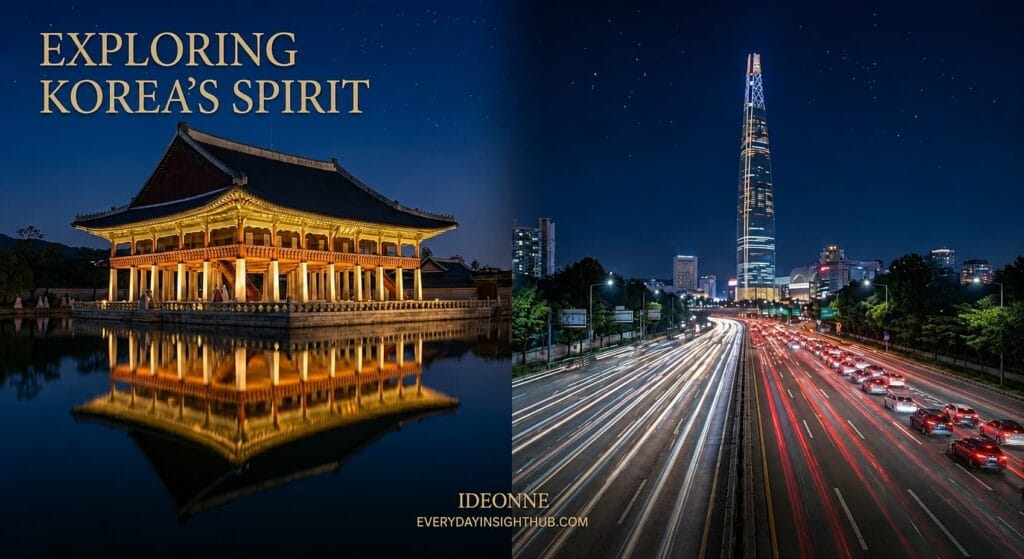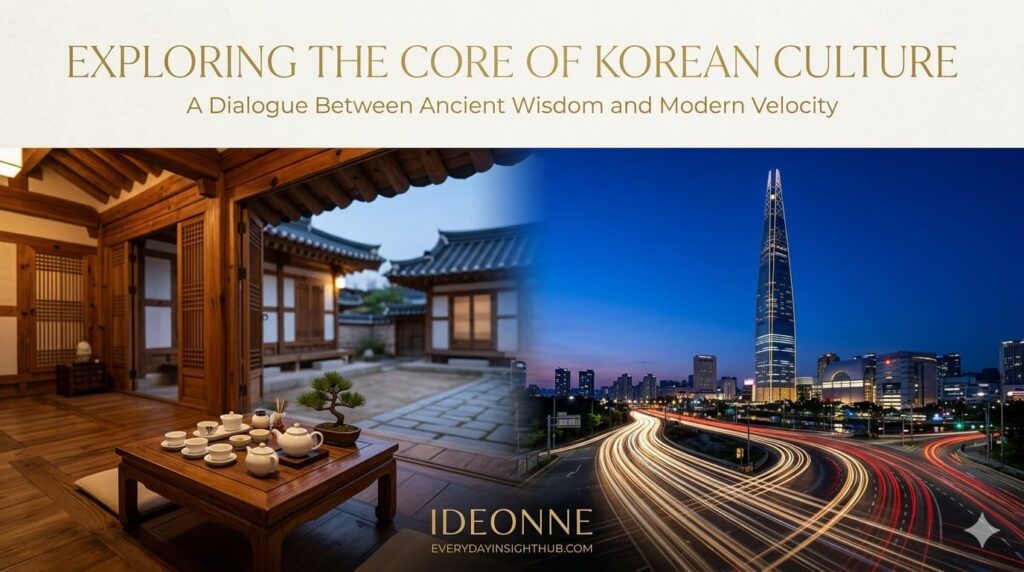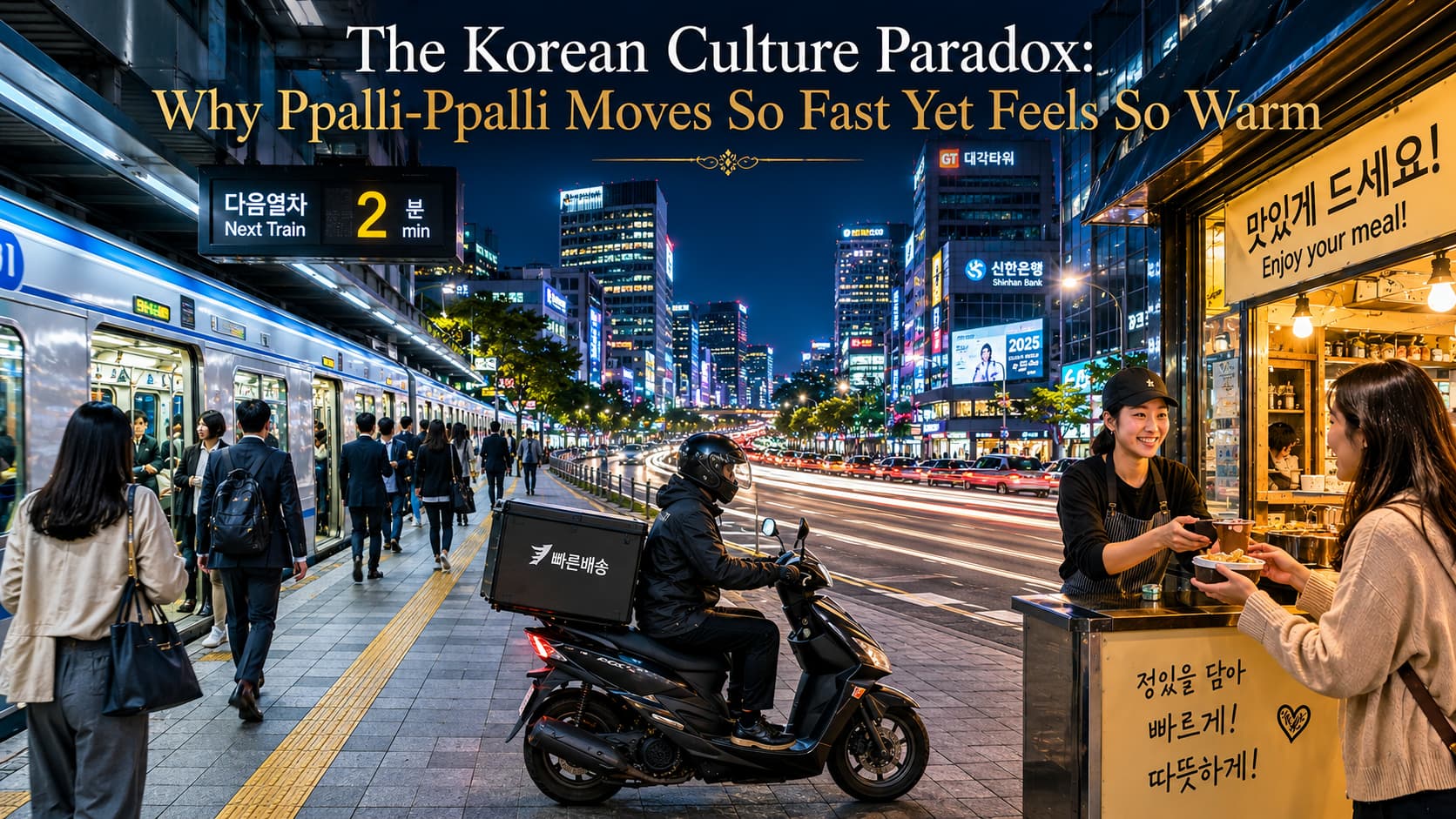
For a first-time visitor, Korea can feel as if someone has quietly turned up the speed of everyday life. A subway arrives, and people step on almost immediately. A restaurant order can be placed within moments of sitting down. A delivery that might take much longer elsewhere can sometimes arrive within hours. Even an elevator ride can reveal the same impatience: someone presses the close button almost instinctively, as though waiting a few extra seconds were a genuine inconvenience. After a while, a visitor may laugh and ask a simple question: Why does everything seem to happen so quickly in Korea?
The Korean expression ppalli-ppalli (빨리빨리) literally means “quickly, quickly.” It is often used to describe Korea’s strong preference for speed, efficiency, and prompt action. But describing ppalli-ppalli simply as impatience misses something important. The more interesting question is not why Koreans dislike waiting, but why speed became such a deeply embedded part of everyday life—and why that speed so often exists alongside a noticeable sense of warmth, attentiveness, and consideration for others.
A restaurant server may hurry to bring your food, yet also notice that you need an extra side dish before you ask. A colleague may rush through a task, then quietly leave a drink on your desk after noticing that you are tired. A delivery service may operate at astonishing speed, while the people using it expect an equally quick response when something goes wrong. This is the paradox at the heart of ppalli-ppalli: Korea has developed a remarkable ability to move quickly without completely abandoning the human desire to care for one another.
That does not mean the culture is always comfortable, nor does it mean speed is always beneficial. Modern Korea also wrestles with exhaustion, competition, impatience, and the pressure to keep up. To understand ppalli-ppalli, therefore, we need to look beyond the stereotype of impatient people rushing through crowded streets. We need to look at the history, habits, expectations, and relationships that gave speed its particular meaning.
Why Did Korea Become So Fast?
Korea’s preference for speed did not emerge from a single cultural trait. History matters. In the decades following the Korean War, South Korea faced enormous economic and social challenges. The country moved from extreme poverty and dependence on foreign assistance toward industrialization and eventually a high-income, technology-driven economy. The World Bank describes this transformation as one of the remarkable development stories of modern history. World Bank: Korea Overview
That transformation required enormous investment in infrastructure, education, industry, technology, and human capital. It also created a particular relationship with time. When a society is changing rapidly, yesterday’s solution can become inadequate surprisingly quickly. Businesses have to adapt. Cities have to expand. Transportation systems have to accommodate growing populations. Consumers become accustomed to improvements that once seemed extraordinary. Speed gradually becomes more than a personal preference; it becomes an expectation.
This helps explain why 빨리빨리 is broader than simply telling someone to hurry. It can describe an entire rhythm of getting things done: respond quickly, decide quickly, fix problems quickly, and move on to the next task. The historical background is important, but it should not be treated as a complete explanation. Korea’s rapid development was shaped by many forces, including government policy, international trade, industrial strategy, infrastructure, education, and private-sector investment. Ppalli-ppalli is better understood as one cultural expression that developed within this rapidly changing environment.
When Speed Becomes an Everyday Habit
Visitors often notice ppalli-ppalli through tiny moments rather than dramatic events. Imagine ordering at a busy Korean restaurant. You have barely opened the menu when the server asks whether you are ready. You may still be comparing two dishes while the people at the next table have already ordered, received their food, and started discussing what to have for dessert. Or consider a familiar elevator ritual: the doors are already closing automatically, yet someone presses the button again. Then again. To someone accustomed to a slower rhythm, the behavior can look almost comical.
But the underlying behavior is revealing. The person is not necessarily angry. They may simply be accustomed to reducing unnecessary waiting whenever possible. The same expectation appears in transportation, restaurants, online services, banking, shopping, and customer support. Once speed becomes normal, even a small delay can feel strangely noticeable.
This creates an interesting cultural difference. In some societies, waiting is treated as an unavoidable part of everyday life. In Korea, people may be more likely to wonder whether a delay could have been prevented or shortened. The question becomes less “How long must I wait?” and more “Why does this have to take so long?” That small change in expectation is one of the keys to understanding ppalli-ppalli.
The Unexpected Side of Speed
Here is where the Korean experience becomes more interesting. Speed does not always feel cold. In fact, some visitors discover that Korean efficiency can feel surprisingly personal.
Consider food delivery. The technological infrastructure behind Korean delivery is impressive, but technology alone does not explain why fast and convenient service has become such a strong expectation in everyday life. People have become accustomed to convenience, responsiveness, and quick solutions to ordinary problems.
A similar expectation can appear in restaurants. If a customer asks for water, an additional side dish, or something that was forgotten, the response is often immediate. This creates an unusual combination: the faster the system becomes, the more quickly people may expect human needs to be noticed.
That distinction matters. Ppalli-ppalli is not simply about machines operating faster. It can also mean people responding faster to one another. This helps explain why a culture that sometimes appears impatient from the outside can also feel remarkably attentive.
The same person who cannot tolerate waiting several minutes for an elevator may notice that a friend looks exhausted and quietly ask, “Have you eaten?” The two behaviors are not necessarily contradictory. They can come from different expressions of the same broad expectation: things should work, and people should respond.
When Efficiency Becomes Consideration
This is one of the places where ppalli-ppalli becomes particularly interesting as a cultural concept. In some contexts, efficiency can sound impersonal. A process is efficient because it minimizes time, cost, or effort. But in everyday Korean life, speed can also function as a form of consideration.
If someone brings your order quickly, they may be helping you avoid unnecessary waiting. If a colleague responds promptly to a request, they may be showing that your problem matters. If a service provider resolves a problem without making you repeat the same explanation several times, the speed itself can feel respectful.
Of course, none of this is uniquely Korean. People everywhere appreciate good service and consideration. What is distinctive is how strongly expectations of responsiveness and speed have become woven into many ordinary interactions. This is one reason visitors sometimes experience a curious contradiction: Korea can feel rushed and caring at the same time.
The contradiction is real, and it is worth taking seriously rather than explaining it away as a stereotype.
The Cost of Living at High Speed
Every cultural strength has a shadow. The same expectation that encourages rapid problem-solving can also create pressure. When people become accustomed to immediate responses, delays can feel more frustrating. When competition is intense, being fast can become associated with being competent. When society changes quickly, slowing down can sometimes feel like falling behind.
Modern Korea has increasingly confronted the costs of this mentality. Conversations about burnout, work-life balance, youth pressure, and the difficulty of disconnecting from constant digital communication are part of a broader question about how fast contemporary life should be.
This is an important part of the ppalli-ppalli story because the culture is not frozen in the era that helped shape it. The question is no longer simply “How can Korea move faster?” It is increasingly “What deserves to be faster, and what should be allowed to take time?”
That is a very different question. And perhaps it is the most important question facing a society that has become exceptionally good at acceleration.
The Slow Things Korea Still Protects
For all its speed, Korea has never abandoned slowness completely. Some of the country’s most meaningful traditions depend on time. Kimchi develops its character through fermentation. Traditional tea culture encourages attention to quiet moments. A bowl of soup can be simmered slowly. Mountain temples offer spaces where the noise of modern life becomes distant.
Even contemporary Koreans who live intensely fast weekday lives may deliberately seek slower experiences on weekends. They travel into the mountains, walk along quiet coastal paths, sit in traditional tea houses, wait for autumn leaves to change color, or spend hours sharing a meal with family and friends.
These choices reveal something important. Korean culture does not necessarily reject slowness. It often distinguishes between waiting that feels unnecessary and time that feels meaningful.
That distinction helps explain the apparent paradox. People may become impatient when a website takes too long to load, yet happily spend hours preparing and sharing a meal with people they love. They may expect fast delivery, yet spend an entire afternoon hiking a mountain trail. They may hurry through a workday, then linger over drinks and conversation late into the evening.
Speed and slowness therefore do not always compete. Sometimes they serve different purposes.
Ppalli-Ppalli and the Modern Korean Mind
This may be the deeper cultural insight behind the expression. Ppalli-ppalli is not simply a command to move faster. It is a way of relating to time. Time can be something to save. It can be something to optimize. It can be something to share. And sometimes, it can be something to deliberately stop measuring.
This makes ppalli-ppalli more complicated than the familiar image of Koreans rushing through Seoul. The culture has been shaped by extraordinary acceleration, but it is also learning how to question acceleration itself.
That process is visible in many parts of modern Korean life. People still value speed. They still expect fast internet, efficient transportation, rapid delivery, and prompt responses. At the same time, there is growing appreciation for rest, slower travel, local food, nature, traditional culture, and time spent away from constant productivity.
The contradiction is not necessarily a weakness. It may be evidence of a culture adapting to its own success.
What Foreign Visitors Sometimes Misunderstand
A visitor seeing Korea for the first time may conclude, “Koreans are simply impatient.” That interpretation is understandable, but it misses the deeper pattern.
The more useful question is not whether Koreans are naturally more impatient than people elsewhere. There is no simple cultural measurement that can establish such a claim. The more interesting observation is that Korean society has developed strong expectations around responsiveness and speed.
Those expectations are learned through everyday life. A child sees adults responding quickly. A student becomes accustomed to rapid schedules. A worker learns to value prompt communication. A customer expects a problem to be solved rather than merely explained. Over time, these expectations become normal.
And once something becomes normal, people stop noticing how unusual it may appear to outsiders.
That is why visitors often notice ppalli-ppalli before Koreans themselves do. They are seeing an ordinary rhythm from the outside.
The Question After the Rush
Perhaps the most interesting chapter of ppalli-ppalli is still being written. Korea has become extraordinarily capable of moving quickly. Its transformation from a poor post-war economy into a high-income, innovation-driven economy is well documented. World Bank: Korea Overview
Its technological competitiveness is also visible on international stages. At CES 2026, 168 Korean companies were among 284 companies recognized in the Innovation Awards announced in the first round, while Korean companies received all three Best of Innovation awards in the AI category. South Korean companies also received 15 of the 31 Best of Innovation awards overall. Korean Ministry of Trade, Industry and Energy: CES 2026
These achievements do not prove that ppalli-ppalli caused Korea’s technological success. They do, however, offer a contemporary glimpse of a society in which rapid adaptation and execution remain highly valued.
And that leads to a more human question.
What happens when a society that has spent decades learning how to accelerate begins to ask how to live well?
Perhaps the future of ppalli-ppalli will not be about becoming even faster. Perhaps it will be about becoming more selective.
Move quickly when speed helps. Slow down when something deserves attention. Respond immediately when another person needs help. But allow time to do its work when patience creates something that speed cannot.
That may be the next stage of the Korean paradox.
The culture that learned to run faster because it had to survive is now learning that not every meaningful part of life needs to be won through speed.
And perhaps that is why the most revealing image of modern Korea is not a person rushing through a crowded Seoul street. It is the same person, later that evening, sitting across from someone they care about, sharing a meal slowly enough to forget the clock.
Ppalli-ppalli taught Korea how to move. The deeper question now is knowing when to pause.
🔗Continue Exploring Korean Culture
🌏 Explore Korea Beyond K-Pop
→ Beyond the Korean Wave: The Thousand-Year Cultural Foundations of Korea’s Global Influence
🗣️ Discover Why Koreans Say “Our”
→ The Curious Case of “Uri”: Why Koreans Say “Our” Instead of “My”
❤️ Understand Korea’s Invisible Human Connection
→ What Is Jeong? Korea’s Invisible Language of Human Connection
🤝 Explore the Korean Way of Respect and Care
→ Understanding Hyo: The Korean Way of Expressing Respect and Care Across Generations
🌙 Discover the Culture of Everyday Trust
→ A Country Where the Night Is Not Afraid: Everyday Trust in Korea